General
Devdas – A Story of Love, Silence, and Too Much Waiting
They grew up together—Devdas and Paro. Same village. Same old mango tree. Same afternoon storms. From the moment they could walk, they were side by side. He used to tease her. She used to chase him with a stick. And yet, whenever he was hurt, it was Paro who cried first.
By Naeem Mridhaabout a year ago in History
When Only Hope Remains: Its Name Is Patience
There are moments in life when even breathing becomes hard. Moments when hope fades, pain deepens, and loneliness settles like a heavy burden on the soul. In such moments, what keeps us standing is not physical strength or wealth, but something deeper and quieter: patience. Patience means endurance, and endurance paves the way to victory. It takes us to great heights, even when the climb seems impossible.
By Magic Bitesabout a year ago in History
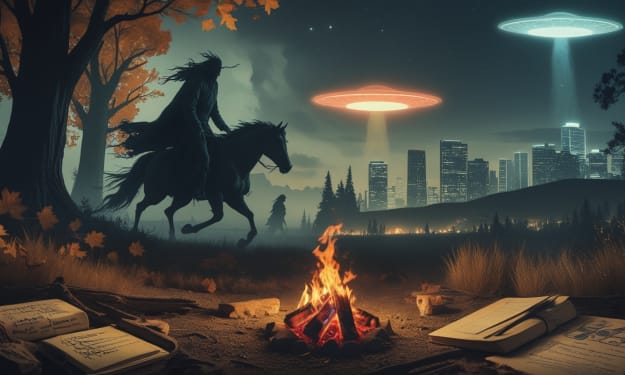
Myths, Monsters, and the American Frontier
The Stories We Tell in the Dark Long before Netflix algorithms or TikTok trends, humans gathered around fires to share tales of gods, ghosts, and the unknown. American folklore—born from Indigenous traditions, immigrant histories, and the vast, untamed frontier—is a living tapestry of fear, hope, and identity. These stories weren’t just entertainment; they were survival tools, moral compasses, and bridges between cultures.
By Shohel Ranaabout a year ago in History
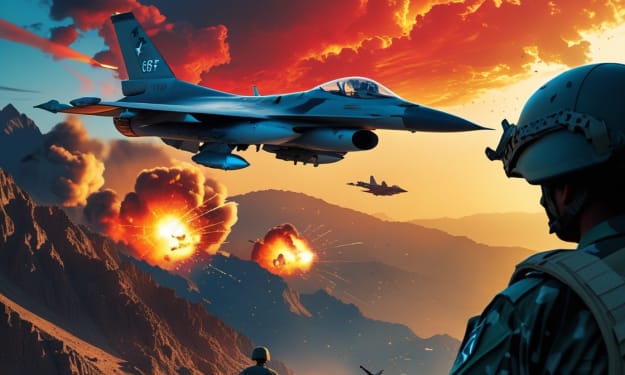
Strike Eagles of Pakistan
In the heart of the towering mountains of northern Pakistan, where the sky meets the earth in a breathtaking display of nature’s might, the soldiers of the Pakistan Army and the pilots of the Pakistan Air Force (PAF) stood ready for an unspoken battle—one that had simmered for years and was about to boil over. Their mission: to protect the sovereignty of their homeland against the rising threats on its borders, and to do so with precision, courage, and unmatched resolve.
By saqiab khanabout a year ago in History
The Madman and the Moonlight: A Love That Outlived Time
There was once a boy named Qays, who loved words the way others loved gold. He wandered through the desert, his mind full of poems and his heart full of dreams. And then he saw her—Laila. She wasn’t just beautiful; she was quiet thunder, a storm in the stillness. Her eyes held stories, her silence spoke in verses.
By Naeem Mridhaabout a year ago in History
The Man Who Lost Half a Billion in Bitcoin
In the world of cryptocurrency, where fortunes can be made or lost in a click, few stories are as astonishing—and heartbreaking—as that of James Howells. A British IT engineer from Newport, Wales, James Howells became a symbol of digital-age misfortune when he accidentally threw away a hard drive containing a Bitcoin wallet worth hundreds of millions of dollars.
By Mehtab Ahmadabout a year ago in History
“I Couldn’t Save Him… But He Saved Me”
Some patients come and go. Some leave behind memories, some gratitude, and some… leave behind a piece of your soul that never really comes back. I remember the first time I saw Haris. He was ten years old, with a big smile on his face and a spark in his eyes that didn’t match the fragile body he was trapped in. His parents had brought him to the hospital after a long struggle. He had been misdiagnosed several times before we discovered the truth — a rare autoimmune condition that was silently destroying his body from the inside. His immune system, which should’ve protected him, had turned against him, attacking his joints, muscles, even his organs. But you wouldn’t have known that from the way he greeted everyone. He was the kind of child who would wave at nurses, thank the janitor, and crack jokes with the pharmacy staff. It was almost like he didn’t want anyone to feel sorry for him. And from the first moment I met him, I knew this wouldn’t be a typical case. He looked at me and said, “Are you the doctor who doesn’t give up?” I smiled and said, “Only if you promise not to give up either.” That became our deal. His treatments were intense. Daily injections, long nights in the ICU, unpredictable fevers that left him shaking. Some days he couldn’t even hold a pencil. But he never stopped drawing. He loved sketching airplanes, rockets, and superheroes — things that flew, things that soared, things that didn’t seem bound by the body he was stuck in. I would sometimes sit by his bed during late shifts. He’d ask me questions about medicine, the heart, the brain, and what made people sick. I once asked him if he wanted to become a doctor one day. He shook his head and said, “No. I want to fly.” The disease was relentless. No matter how many steroids we tried, no matter how carefully we monitored his labs, there were always complications. But Haris never complained. His mother told me once that he cried only when he thought no one was watching. One evening, I walked into his room after a tough surgery. I was tired, drained, and questioning everything. He saw my face and said, “You look like you lost a game.” I laughed despite myself. “Maybe I did.” He looked at me seriously and said, “You win just by showing up, doctor. That’s what you told me, remember?” I had said that once, casually, to motivate him. I didn’t realize he had memorized it like a promise. Weeks passed. He had ups and downs, but we had hope. There were days he could sit up, eat properly, even walk a few steps down the hall with help. He once told me he had a dream where he was flying a plane and saw me waving from below. I asked him if I looked proud, and he nodded. “You always do.” But not every story has the ending we wish for. One night, during a thunderstorm, I was called to his room. His oxygen levels were dropping, his blood pressure unstable. We tried everything. The ICU team was at its best — ventilators, emergency drugs, even CPR. I found myself pressing down on his chest, calling his name over and over. But he was slipping away. I remember the silence when the machines stopped. I remember his mother’s cry. I remember standing still, hands trembling, and a pain in my chest I couldn’t explain. We lost him. The boy who wanted to fly… had flown away. I walked out of the room and went straight to my office. I didn’t speak to anyone. I couldn’t. I sat down, took off my coat, and just stared at the wall. My hands, the same hands that had brought life back to so many, had just failed a child who believed in me. The next morning, his mother came to see me. Her eyes were swollen, but she wasn’t angry. She held a folded piece of paper in her hand. “He wrote this a few days ago. Said to give it to you if… if he didn’t make it.” I took the note and read it. It said: “If I don’t make it, tell Dr. Marwan I’ll be flying above him, watching. He was my favorite. Tell him not to be sad. He saved me more than once.” I couldn’t hold back the tears. Not that day. I kept that note in my wallet for years. I still have it. There was a time after Haris passed when I questioned everything. Why I became a doctor. Whether I was strong enough for this path. Whether the pain was worth it. Every time I saw a child in pain, I saw Haris. Every time a mother cried, I remembered that night. But something changed too. I started seeing medicine differently. Not just as science or treatment, but as connection. As commitment. As trust. Haris taught me that sometimes, we heal even when we can’t cure. That showing up matters. That believing in someone can be the most powerful form of medicine. There are patients we save with procedures. Others, we save with presence. He was just a boy. But in many ways, he became my teacher. He reminded me why I chose this life — not for the success stories, but for the stories that shape who we are. I couldn’t save Haris. But he saved me. And every time I walk into a hospital room, every time I look into the eyes of a struggling patient, I remember him. I remember the boy who never gave up on life… or on me. And I promise him, silently, that I will never stop showing up.
By Doctor marwan Dorani about a year ago in History
LIFE WITHOUT FUEL
[Isaac Asimov is a noted scientist and science fiction writer. He has a remarkable gift for being able to explain complex science phenomena in ways that the ordinary person can easily understand. Asimov was recently asked to imagine and describe what would happen to everyday life in 1997 if fuel energy began running out. Asimov explains that "this is a picture of the worst, of waste continuing of oil running out, of nothing in its place, of world population continuing to rise."]
By its_ishfaq_ahmadabout a year ago in History
The Age of the Sphinx: Was There a Lost Civilization Behind the Egyptian Pyramids?
The Guardian of Secrets Beneath the blazing Egyptian sun, on the Giza Plateau, a colossal figure has watched silently for thousands of years. The Great Sphinx. With the body of a lion and the face of a man, it stands as a timeless guardian of ancient mysteries. But how old is the Sphinx? What secrets does it guard?
By The Secret History Of The Worldabout a year ago in History