Fiction
The whispering banyan tree.
Within the heart of a calm town in West Bengal stood an enormous, old banyan tree. Its roots turned just like the fingers of overlooked mammoths, coming into the soil and sky. The villagers called it “Boroboro Gachh,” and they accepted it had a soul.For eras, individuals whispered stories almost to the tree. A few said it ensured the town. Others claimed it tuned in. But no one had ever demonstrated anything—until Arman arrived.Arman was not a villager. He was a 22-year-old college understudy from Kolkata, examining old stories. When he first heard of the banyan tree, he thought it would be just another town myth. But something about the way the ancient postmaster talked of it caught his interest.“It talks when the moon is full,” the postmaster had said, his eyes cloudy with age. “But not in words. In whispers.”Charmed, Arman pressed his sacks and traveled to the town. The individuals were inviting but cautious. They told him stories of how the tree had spared lives amid surges, how it shined faintly on certain evenings, and how feathered creatures never settled in its branches—but none would go close to it after sunset.Arman giggled it off. “Superstition,” he said to himself. But deep down, he wasn't beyond any doubt.That night, beneath a full moon, Arman set up camp close the tree. He brought a scratchpad, a voice recorder, and his camera. The villagers cautioned him once more, but he waved them off considerately.Midnight arrived. Crickets sang. The wind moved delicately. The tree stood silent—just a tree.But then… the discussion changed.It wasn't colder, but heavier. As in the event that the world was holding its breath. Arman looked up. The moonlight sparkled on the roots. And after that, exceptionally faintly, he listened to it:“Arman…”He solidified.It was a whisper. Delicate. Like wind passing through ancient leaves—but clearer.“Who's there?” he inquired, checking the obscurity.No answer.He checked his recorder. It was still running. He rewound some seconds and played it back.“Arman…”“Why have you come?”His heart dashed. The voice was there. But no one was around.Swallowing his fear, he sat back down and whispered, “I need to know your story.”Hush.Then:“Listen.” Over the following few hours, Arman listened to pieces of a tale—fragmented whispers carried by the wind. A story of a lady named Meera, who had once lived within the town centuries back. A healer, a kind soul. But amid a starvation, she was faulted for awful good fortune and blamed for witchcraft. The villagers, frantic and frightened, tied her to the banyan tree and cleared out of there.She passed on beneath the moon, shattered.The tree, fed by her blood, took in her torment. And her soul.Since at that point, Meera's soul had whispered to those who listened—not for exact retribution, but for recognition.“They overlooked me,” the tree whispered. “But I keep in mind them all.”Arman sat still, overpowered by distress he couldn't clarify. He saw flashes in his mind—of Meera's life, her thoughtfulness, and her passing. And the centuries of hush that followed.When first light drew closer, the whispers faded. The weight within the discussion lifted.The tree stood still once more.Arman didn't take off from the town. He remained for a week, tuning in each night, learning more about approximately Meera. He composed everything down. His recorder filled with ghostly, whispering voices. But the villagers refused to tune in.“They'll think you're mad,” the postmaster cautioned.“I don't care,” Arman answered. “The world ought to know.”When he returned to Kolkata, Arman distributed a paper titled “Whispers of the Forgotten.” It picked up consideration from teachers, history specialists, and otherworldly searchers. Numerous people rejected it as fiction. A few accepted. But Arman didn't care. He had listened to the truth.He returned to the town once a year, always on the night of the total moon. He sat beneath the banyan tree, not anxious, and tuned in to Meera's voice.One year, he brought blossoms.“I keep you in mind,” he whispered, putting them at the base of the tree.The branches overhung gently—though the wind was still.And from deep inside the roots, a whisper came:“Thank you.”
By Sumaiya’s Wordbox2 years ago in History
Dewdrops on the Windowsill
The First Light of Day One Long golden streaks were created on the wooden floor as the early sun softly filtered through the gauzy curtains. Wrapped in a handwoven blanket that still had a subtle scent of rose water and cedar, Eleanor stirred on the couch. The whisper of time continued to gnaw at her old bones, but the room's quiet comfort eased the pain.
By MD SHAMIM RANA2 years ago in History
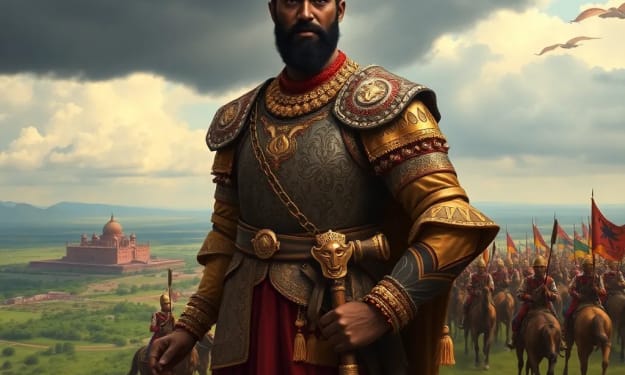
Malik Ambar (Abyssinian Warrior in India)
Introduction In the shifting sands of 16th and 17th-century Deccan India, a remarkable figure emerged from the shadows of slavery to challenge the might of the Mughal Empire: Malik Ambar. Born in Ethiopia (Abyssinia) and sold into slavery as a child, Malik Ambar rose to become a legendary general, strategist, and de facto ruler of the Ahmadnagar Sultanate in the Deccan. He led fierce resistance against Mughal expansion, pioneered guerrilla warfare tactics in the Indian subcontinent, and became a symbol of brilliance, resilience, and leadership.
By Muhammad Sohail2 years ago in History
The Dark Night,
It was a night just like any other, the sun had set over the horizon, and the sky was painted with hues of crimson and gold. The sea was calm, and the wind was whispering secrets to the waves. My crew, the Straw Hat Pirates, and I were sailing on our ship, the Thousand Sunny, through the vast ocean, in search of our next adventure.
By MOHAMMED NAZIM HOSSAIN2 years ago in History
Khalid ibn al-Walid: The Sword of Allah
Introduction Khalid ibn al-Walid ibn al-Mughira, also known as Saifullah (the Sword of Allah), is one of the most celebrated military figures in Islamic history. Born into the powerful Quraysh tribe of Mecca, Khalid began as an enemy of Islam but later became one of its fiercest defenders. His unmatched record on the battlefield, strategic brilliance, and loyalty to the cause of Islam earned him enduring respect not only among Muslims but also among historians and military strategists across the world.
By Muhammad Sohail2 years ago in History
Astronomers say they’ve found strongest ever ‘hints’ of life beyond our solar system
In a groundbreaking announcement, astronomers have revealed what they believe are the strongest ever "hints" of life beyond our solar system. After years of research and technological advancements, this discovery marks a significant turning point in humanity's quest to determine whether we are truly the only species in the universe. While the evidence is far from definitive, it opens new doors for exploration and raises tantalizing questions about the potential for extraterrestrial life.
By Mahmodul hassan mojahid2 years ago in History
Returning Without Questions
Returning Without Questions They came a little closer to me one odd evening, I recall. Despite its simplicity, the relationship had an odd depth. There was a kind of connection between them that spoke before words, the language of their eyes—even when they were silent in front of each other, they understood each other. However, despite being by each other's side, there are times in life when people move on. There came a time when the two of them moved far away from each other.
By Arshad Ali2 years ago in History
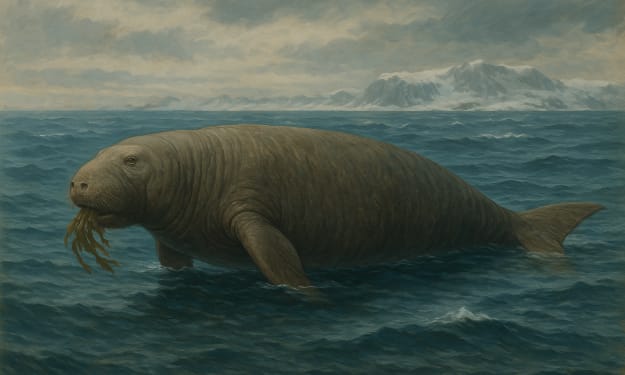
Giants of the Frozen Sea: The Tragic Tale of the Stellar Sea Cow. AI-Generated.
The Stellar sea cow, a massive marine herbivore discovered in the 18th century, is one of the most tragic examples of rapid extinction in recorded history. A close relative of the dugong and manatee, the Stellar sea cow was first documented by German naturalist Georg Wilhelm Steller in 1741 during the Great Northern Expedition led by Danish explorer Vitus Bering. Found in the icy waters surrounding the Commander Islands near the Bering Sea, the sea cow’s tale is a haunting reminder of how quickly human activity can impact fragile ecosystems. Discovery and Description Georg Steller was the first and only scientist to study the Stellar sea cow while it was still alive. According to his journals, the creature was an enormous, peaceful, slow-moving herbivore that could grow up to 10 meters (33 feet) in length and weigh over 10 tons. It lacked teeth and used keratinous pads to chew on kelp, which made up its primary diet. These sea cows were believed to live in small family groups and had thick, wrinkled brown skin similar to the bark of an old tree. Their large, whale-like tails helped them glide gracefully through the frigid waters. What struck Steller the most was the sea cow’s docile temperament. Unlike many wild animals, the sea cow showed no fear of humans, a trait that would ultimately seal its fate. A Brief Existence At the time of discovery in 1741, the sea cow population was already geographically restricted to a small area around the Commander Islands, most likely due to centuries of climate changes and possible hunting by Indigenous peoples. But it wasn’t until European sailors and fur traders began arriving en masse that the animal's extinction was accelerated. Within just 27 years of its discovery, by 1768, the Stellar sea cow was declared extinct. Its size and docile nature made it an easy target for hunters. The sea cow's thick blubber, which could be boiled down into oil, and its meat, which was reported to be both tasty and able to feed crews for weeks, made it a valuable resource for Russian fur traders and sailors navigating the treacherous Bering Sea. Ecological Importance and Extinction The sea cow was an essential part of the kelp forest ecosystem. As a grazer of seaweed, it helped maintain the health and balance of underwater vegetation. Its disappearance not only marked the loss of a species but also may have had ripple effects on the broader marine environment in the North Pacific. Its extinction serves as one of the first well-documented cases of human-driven extinction of a marine species. Unlike many prehistoric animals whose fates are inferred through fossils and legends, the Stellar sea cow was studied, hunted, and wiped out within the span of a single generation. This makes its story particularly heartbreaking and poignant in the context of conservation biology. Legacy and Scientific Interest Despite its extinction, the Stellar sea cow continues to fascinate scientists, conservationists, and the public. Numerous efforts have been made to study its bones and fossils to better understand its physiology and evolutionary path. As a member of the order Sirenia, which includes modern-day dugongs and manatees, the sea cow provides insights into how these animals adapted to different environments. Its rapid extinction is often used as a cautionary tale in ecological studies and biodiversity conservation. It demonstrates the devastating impact that unregulated hunting and ecological ignorance can have on isolated and vulnerable species.
By Say the truth 2 years ago in History
Hatshepsut's Revenge
Chapter One: The Beginning of Revenge The grand hall of the king's palace was filled with sorrow and hushed whispers. Hatshepsut, the heir to the Egyptian throne, sat beside the body of her late father, the king, trying to conceal her inner turmoil behind a mask of royal grief. She wasn’t just grieving; she was increasingly anxious about the future of her reign following her father’s death.
By mohamed elsayed2 years ago in History