Fiction
The Overlooked Wealth: Revealing the Riches of the Greek Empire. AI-Generated.
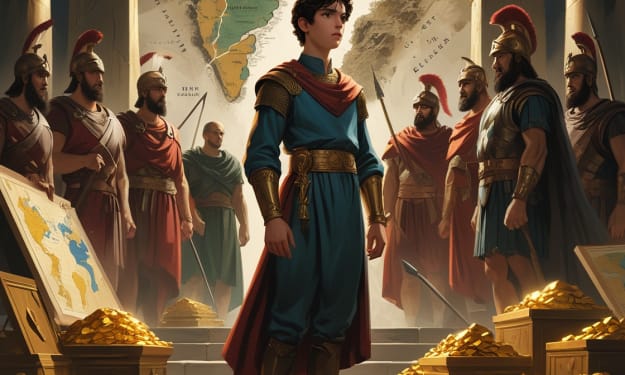
The Overlooked Wealth: Revealing the Riches of the Greek Empire The Greek Empireextending from the sun-drenched islands of the Aegean to the frontiers of India under Alexander the Greatis frequently commemorated for its scholarly accomplishments, mythology, and renowned military feats. Yet concealed beneath this celebrated heritage lies another breathtaking narrative: that of the extensive wealth accumulated by the ancient Greeks. This fortune encompassed not only gold and silver but also sacred artifacts, tributes from allies, war plunder, and invaluable art. At its pinnacle, the empire’s treasury ranked among the most precious in the ancient realm. 1. The Genesis of Affluence The origins of Greek wealth can be traced to city-states such as Athens, Corinth, and Sparta. Among these, Athens distinguished itself as a financial center. During the 5th century BCE, it spearheaded the Delian Leaguea military consortium established to confront the Persian menace. The league’s treasury was initially secured on the island of Delos, situated within a sacred sanctuary. However, Athens subsequently relocated the treasury to the Parthenon, effectively asserting control over the league’s assets. Each league member provided a tributeeither in vessels or fundswhich enriched the Athenian coffers with silver, gold, and exotic goods from throughout the Mediterranean. This revenue supported not only Athens’ navy and military endeavors but also its construction initiatives, including the Parthenon itself. 2. The Laurion Mines Athens’ affluence was not solely reliant on tributes. A significant silver-mining operation in Laurion, located just southeast of Athens, constituted a major economic pillar. Thousands of enslaved workers toiled under harsh conditions to extract silver, which was utilized to mint the renowned Athenian tetradrachma coin widely accepted across the ancient world. It is estimated that Laurion yielded hundreds of tons of silver, much of which financed the Athenian war apparatus and cultural proliferation. 3. Alexander the Great: Conqueror and Custodian No other figure in Greek history may have impacted its wealth as significantly as Alexander the Great. As he advanced eastward during his campaigns (334–323 BCE), he plundered and integrated vast royal treasuries from the Persian Empire, including the fabled city of Persepolis. Historical records indicate that Alexander appropriated over 180,000 talents of silver and goldequivalent to roughly 4,000 metric tons. In present-day value, this would exceed $250 billion. He employed part of this treasure to finance his expeditions, reward his troops, and invigorate economies in subjugated territories by re-minting coins and constructing infrastructure. Alexander's pillaging campaign not only redistributed riches throughout his expansive empire but also facilitated the creation of a novel Hellenistic economic framework, merging Greek and Eastern components. 4. Religious and Cultural Appreciations The Greeks held the belief that wealth ought to be dedicated to the deities, and numerous sanctuariessuch as those located in Delphi, Olympia, and Delosserved as repositories for offerings. These included gilded statues, intricately carved ivory, and exquisitely crafted vessels. For example, Delphi’s Temple of Apollo contained gifts from rulers and military leaders, comprising golden tripods, shields, and bronze bulls. These sacred repositories were occasionally looted during conflicts. The Roman general Sulla, for instance, ransacked the Oracle of Delphi during his expedition in Greece in 86 BCE. Nevertheless, a significant number of treasures endured for centuries, concealed or buried to evade theft. 5. Diminution and Dispersal The decline of the Greek realm commenced with the ascent of Rome. By the 2nd century BCE, the majority of Greek regions had either been annexed or heavily influenced by Roman authority. Consequently, a substantial portion of Greece’s wealthboth monetary and artisticwas transferred to Rome. Emperors such as Nero and Augustus plundered Greek temples and transported statues, manuscripts, and gold back to Italy. Subsequent invasions, ranging from the Visigoths to the Ottomans, perpetuated this pattern of exploitation. However, a considerable number of treasures also vanished from history entirelylost to the passage of time, buried under collapsed temples, sunken ships, or concealed within forgotten tombs. 6. The Treasure Today: Worth and Heritage While precise figures remain conjectural, historians estimate that the total wealth of the Greek Empire during its zenithincluding Athens, Macedon, and Hellenistic kingdomsmight easily exceed $500 billion in contemporary terms. This encompasses: Silver and gold from mines and tributes Loot from Persian treasures Religious donations and temple caches Artistic and cultural creations (many regarded as priceless today) Only a small portion of this wealth persists, safeguarded in institutions like the Acropolis Museum, the British Museum, or lost within archaeological sites awaiting rediscovery. Conclusion: A Wealth Beyond Gold The treasure of the Greek Empire represented more than mere material richesit also encompassed intellectual, cultural, and spiritual value. Although much of its physical wealth has been dispersed or lost, the legacy of this empire continues to enrich humanity. From coins that once financed philosophers to statues that inspired Renaissance artists, the true wealth of ancient Greece resides in its lasting influence.
By Say the truth about a year ago in History
The Pyramids of Peru and the Portals of the Gods: Where Are All Their Architectural and Historical Documents?
High in the forgotten deserts of southern Peru, under skies that flicker with starlight and silence, there are ruins few speak of, and fewer understand. Pyramids, buried beneath centuries of dust, stand in defiance of time, their purpose unclear, their builders unnamed. Nearby, a doorway carved into the rock waits in eternal stillness. They call it the Puerta de Hayu Marca, the Gate of the Gods. Yet, amid such ancient wonder, one question echoes across the sand and stone:
By The Secret History Of The Worldabout a year ago in History
The Billion-Dollar Backbone: Hidden Elements and Wealth of the Himalayan Mountains. AI-Generated.
The Concealed Affluence of the Himalayas: Elements, Minerals, and Projected Monetary Value The Himalayas, renowned worldwide for their grand summits and spiritual importance, also hide an extensive and frequently undervalued reservoir of natural resources beneath their ancient formations. From rare earth elements to precious minerals such as gold, uranium, and lithium, the Himalayan region represents a geological treasure trove. This article examines the principal elements found in the area, their industrial relevance, the geopolitical consequences of their discovery, and provides an estimated monetary value of this concealed Himalayan affluence. The Concealed Affluence of the Himalayas: Elements, Minerals, and Projected Monetary Value The Himalayas are broadly acknowledged as one of the most breathtaking natural phenomena globally, spanning five nationsIndia, Nepal, Bhutan, China, and Pakistan. While the towering summits have been venerated for centuries for their beauty and spirituality, what resides beneath them may be even more precious: an extensive and varied array of elements and minerals that could reshape global resource dynamics. 1. Geological Synopsis The Himalayan range was formed over 50 million years ago due to the collision of the Indian and Eurasian tectonic plates. This continuous geological activity has established fault lines, mineral-rich locales, and a complex topography ideal for the genesis and accumulation of a diverse selection of elements. The area is particularly abundant in granitic rocks, schists, and metamorphic formationssettings conducive to the formation of valuable minerals and ores. 2. Principal Elements and Minerals Available a. Gold and Silver: In areas like Ladakh and parts of Nepal, traces of gold have been located in riverbeds and mountainous rocks. The placer gold deposits in Himalayan rivers may be modest in scale yet significant in overall volume when assessed across the region. b. Uranium: Uranium deposits have been identified in the northeastern Himalayan belt, especially in Arunachal Pradesh and segments of Himachal Pradesh. This radioactive element is essential for nuclear energy and military uses. c. Lithium: Lithium, one of the most coveted elements for battery manufacturing and electric vehicles, has been detected in trace quantities in Ladakh. As global demand for lithium escalates, exploration within the Himalayan region is intensifying. d. Rare Earth Elements (REEs): Scandium, yttrium, lanthanum, and various other REEs are believed to be present in the northern Himalayan districts. These elements are pivotal for electronics, renewable energy technologies, and defense systems. e. Copper and Zinc: The mountainous landscape is rich in copper ore, particularly in regions like the Kumaon Himalayas of Uttarakhand. Zinc deposits are also distributed throughout northern Himachal and parts of Nepal. f. Beryl and Mica: Utilized in the electronics and defense industries, both beryl and mica are found plentifully in eastern Himalayan belts, particularly in areas adjacent to Assam and Arunachal Pradesh. g. Coal and Petroleum: Although not as significant as other elements, coal reserves and petroleum deposits exist in foothill regions, such as in Assam’s Digboi and Arunachal’s Pasighat. 3. Projected Monetary Value of Himalayan Mineral Wealth It is challenging to assess the precise net worth of all the components present due to the absence of thorough mining and geopolitical tensions. Nevertheless, based on geological assessments and prevailing market valuations, a rough approximation includes: Gold: Estimated 500–1000 metric tons – valued at $30–60 billion USD. Uranium: Several thousand tons – potential worth exceeding $100 billion USD. Lithium: In preliminary exploratory phases – estimated at $20–50 billion USD. Rare Earth Elements: May surpass $200 billion USD based on international prices. Copper and Zinc: Cumulative worth exceeding $30 billion USD. Other Minerals (Mica, Beryl, etc. ): Additional $10–20 billion USD. Estimated Total Net Worth: $400–500 billion USD. 4. Environmental and Political Challenges Although the potential is substantial, extracting these resources entails a significant environmental toll. The delicate ecosystem of the Himalayas is vulnerable to landslides, glacial melting, and biodiversity decline. Furthermore, cross-border tensions between India and China have obstructed collaborative exploration or sustainable extraction of resources in disputed areas like Aksai Chin and Arunachal Pradesh. 5. Future Prospects India has commenced substantial investments in mineral exploration within the Himalayan region through organizations such as the Geological Survey of India and the Atomic Minerals Directorate. Nepal and Bhutan are also gradually permitting regulated mining activities. With the global shift towards green energy, the demand for Himalayan lithium and rare earth elements is anticipated to increase significantly. Conclusion The Himalayas represent more than merely an awe-inspiring mountain range; they constitute a vast storehouse of unexploited natural resources that could transform the economic and strategic landscape of Asia. While environmental and political challenges persist, responsible and cooperative mining initiatives could herald a new era of prosperity for the nations that share this formidable range.
By Say the truth about a year ago in History
Nikola Tesla and the Pigeon He Loved
Nikola Tesla is remembered today as one of the greatest inventors and minds in history—a visionary who dreamed of a future powered by clean energy, wireless communication, and boundless scientific discovery. Yet behind the gleam of Tesla coils and radio waves lies a haunting story of isolation, misunderstood genius, and one peculiar yet deeply intimate relationship that defies convention.
By Doctor Strangeabout a year ago in History
Letters from the Underground Railroad
Letter 1 – May 5, 1852 To my dearest Mama, The day has come, and I am leaving. It is hard to write this without tears staining the paper, but I must be strong. Tonight, I will leave behind the plantation, the only life I have ever known, to seek the promise of freedom. The conductor, a kind man I’ve never met before, told me the route would be long and dangerous, but the risk is worth it. I overheard Mr. Turner, the overseer, say that there is talk of selling me to the South. They want to send me to a place where no one ever comes back. I won’t let that happen.
By Haseeb Mujaddidiabout a year ago in History
The Evolution of Human History: From Prehistoric Times to the Modern Era
From prehistoric times to the present, the evolution of humankind History is the collective memory of human civilization, chronicling the journey of humanity from primitive beginnings to the complexities of modern society. The story of human history is vast, interwoven with the rise and fall of empires, technological innovations, social revolutions, and cultural transformations. The major epochs of human history and the ways in which each one shaped the world we live in today are the subject of this article. The Beginning of Humanity: The Age of Prehistory Human history begins long before the advent of writing. The Paleolithic, Mesolithic, and Neolithic periods are all examples of prehistoric times. The Paleolithic Era, also known as the Old Stone Age, lasted between about 2.5 million and 10,000 BCE. Early humans were hunter-gatherers who lived in small, nomadic groups and used simple stone tools. The development of language and the discovery of fire were significant era achievements. Humans entered the Mesolithic Era after the Ice Age ended, which was characterized by more sophisticated tools and the gradual domestication of animals. By the Neolithic Era, or New Stone Age, people began to settle in one place, cultivating crops and raising livestock. Beginning around 10,000 BCE, this agricultural revolution established the foundation for permanent settlements and eventually civilization as a whole. The Rise of Civilizations
By Abid Sadifabout a year ago in History
“Lasseter’s Reef: Australia’s Lost Treasure of Gold and Legend”. AI-Generated.
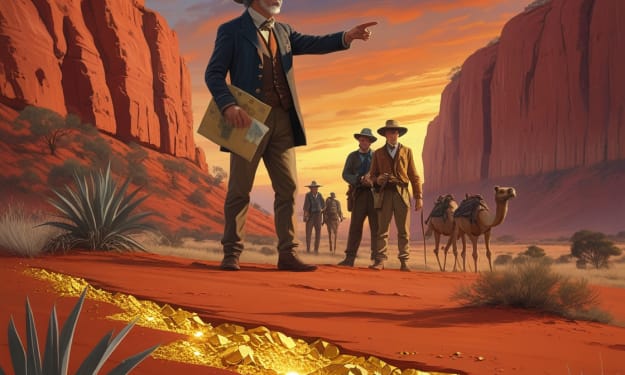
"The Hidden Wealth of Australia: Discovering the Continent’s Most Significant Concealed Treasure" Australia encompasses more than merely arid deserts and ancient terrainsit conceals narratives of substantial, undiscovered fortune. From the legendary Lasseter’s Reef, purported to be an unparalleled gold deposit buried deep within the outback, to the sunken Dutch vessels carrying silver and gold, as well as the loot of outlaw bushrangers hidden in the wilderness, this article delves into the most persistent and valuable treasure legends of the land down under. Join us as we investigate the history, enigma, and contemporary endeavors to reveal Australia’s greatest treasure. Image Prompt: A lifelike digital illustration of the Australian Outback featuring red sandstone cliffs, a group of adventurers examining maps and tools, alongside glimmering gold partially concealed in the desert ground. A spectral image of Harold Lasseter gesturing toward the horizon lingers in the background. Include camels, indigenous flora, and a radiant sunset sky. Title: The Myth of Lasseter’s Reef: Australia’s Most Significant Lost Treasure Introduction Nestled within the blistering core of the Australian Outback resides one of the most enduring and enigmatic legends in the nation's history: the narrative of Lasseter’s Reef. Alleged to be a considerable gold deposit concealed in the desert, this "reef" (a term utilized in mining to indicate a vein of gold-bearing rock) has fascinated prospectors, explorers, and treasure seekers for more than a century. Despite countless expeditions and relentless quests, the elusive treasure remains unlocateda spectral promise of immense wealth buried beneath limitless red sands. The Genesis of the Legend The tale commences with Harold Bell Lasseter, a man of intricate character and profound conviction. In 1929, Lasseter asserted he had discovered a colossal gold reef in Central Australia as a youth in 1897, at the age of 17. He recounted that his camel had fled during a solo expedition, and while searching for water and security, he encountered a lustrous, golden ridge extending for miles. Lacking the tools to extract it and driven by survival instinct, he memorized the site and subsequently returned to civilization. For many years, Lasseter clung to his secret, disheartened that nobody believed his account. However, as Australia grappled with the aftermath of the Great Depression in the 1930s, his narrative gained momentumproviding optimism to a desperate nation yearning for wealth and stability. The 1930 Expedition With governmental support and private investment, the Central Australian Gold Exploration Company (CAGE) was established, and an expedition was assembled to seek out the reef. Lasseter was designated as the guide and led a team of explorers, camels, provisions, and radio apparatus deep into the desert from Alice Springs. Nevertheless, conflicts rapidly intensified. Lasseter’s ambiguous instructions, secretive demeanor, and insistence on proceeding independently estranged his team. Ultimately, the group dissolved in exasperation, leaving Lasseter solitary in the desert. For several weeks, he endeavored to survive, reportedly assisted by Aboriginal individuals. His final journal entries, later discovered by rescuers, recount his ongoing pursuit of the reef, his solitude, and his gradual demise in a secluded cave near the Petermann Ranges in early 1931. His remains were located in a deteriorated state, yet his narrative endured. Reality or Fabrication? Since Lasseter’s demise, contention has erupted regarding the existence of his reef. Some theorize it was a figment of imaginationpossibly heat-induced hallucinationsor an elaborate deception. Conversely, others assert its authenticity, citing: Lasseter’s meticulous journal, in which he documented distances, sites, and details. Independent testimonies from other adventurers and Aboriginal oral histories that suggest gold in the same vicinity. The likelihood that Lasseter employed an alternative coordinate system or had forgotten the precise location after thirty years. While no conclusive physical proof has ever been discovered, numerous treasure seekers and explorers persist in exploring the myth. Contemporary Searches and Technology The evolution of satellite imaging, geological surveying, and GPS technology has rekindled interest in the quest for Lasseter’s Reef. Numerous expeditions in the 20th and 21st centuries have traversed the central Australian deserts, particularly around the Petermann and Rawlinson Ranges, yet the reef remains undiscovered. In 2005, a private exploration team asserted they had found “evidence” of a gold-rich area consistent with Lasseter’s account, but no commercial achievement ensued. Others continue to finance investigations, convinced that a concealed fortune lies beneath the crimson soil. Cultural Significance
By Say the truth about a year ago in History
"The Lost Riches of Australia: Uncovering the Continent’s Greatest Hidden Treasure" . AI-Generated.
"Australia’s Forgotten Fortune: The Legend of the Lasseter’s Reef and Other Lost Treasures" Australia may be best known for its rugged outback and gold rush towns, but hidden beneath its red earth lies a legend of unimaginable wealth — the tale of Lasseter’s Reef, a massive gold deposit supposedly buried in the heart of the desert. This article delves into the history of Australia's biggest rumored treasure discoveries, including gold rushes, sunken ships, outlaw loot, and the still-unfound fortunes that have lured explorers for over a century. Introduction: A Continent of Mystery and Riches Australia, the world’s sixth-largest country, has long held the reputation of being a land of natural wonders. But beneath its scorching deserts, tropical rainforests, and jagged coastlines lies a rich — and often hidden — history of buried treasure. From massive gold rushes in the 19th century to legends like Lasseter’s Reef, Australia’s search for fortune has fascinated adventurers, scholars, and treasure hunters for over 150 years. The Gold Rush Era: When Fortune Sparked a Nation Australia’s greatest tangible treasure boom began in the mid-1800s with the discovery of gold in New South Wales and Victoria. The 1851 gold rush in Ballarat and Bendigo triggered a wave of immigration, wealth, and global attention: Over 1 million kg of gold were extracted in the 19th century. The town of Ballarat became one of the richest places on Earth. The Welcome Stranger Nugget (1869), found in Victoria, remains the largest alluvial gold nugget ever discovered, weighing 72 kg and valued at over $4 million USD today. But while these documented finds changed the economy and culture of the young colony, other riches remained elusive — hidden in legend and myth. The Legend of Lasseter’s Reef The most famous lost treasure in Australian history is Lasseter’s Reef, a supposed vein of gold so rich that it would rival any mine on Earth. In 1929, Harold Bell Lasseter, an Australian explorer, claimed he had discovered a 30-kilometer-long gold reef in the central Australian desert as a young man in the 1890s. He mounted an expedition in 1930 to rediscover the reef, but was abandoned by his team, perished in the desert, and left behind only a diary describing the location. The exact location of Lasseter’s Reef was never found, and no one has definitively proven its existence. Despite numerous expeditions, satellite mapping, and even government-backed searches, the treasure remains lost. Some believe it was a fabrication; others insist it’s still hidden in the remote Petermann Ranges of the Northern Territory — just waiting to be found. Estimated Value: If real, Lasseter’s Reef could contain billions of dollars worth of gold — making it one of the largest lost treasures in modern history. The Wreck of the Gilt Dragon Not all treasure legends lie in the desert. Along Australia’s treacherous western coastline, dozens of Dutch East India Company (VOC) ships were wrecked during the 17th century on their way to Batavia (now Jakarta). The most famous among them, the Vergulde Draeck (Gilt Dragon), sank in 1656 with a cargo of silver coins, trade goods, and gold bullion. Modern estimates suggest the cargo was worth millions even in 17th-century value. Only fragments have been recovered off the coast of Western Australia. Many believe much of the treasure was buried or looted by survivors and remains hidden in the bushland. Bushranger Gold: Thunderbolt and Others Australia’s outlaw era also left behind tales of buried loot. The bushrangers, especially Captain Thunderbolt, Ben Hall, and Ned Kelly, were known to rob gold shipments and bank vaults. Captain Thunderbolt is rumored to have buried several caches of gold and coins in New South Wales. While some have been found, most treasure maps are considered lost or hoaxes.
By Say the truth about a year ago in History
120 Days Underwater
In an impressive achievement that embodies human perseverance, scientific ingenuity, and extreme exploration, Rudiger Koch, a German aerospace engineer, is the new record holder for the longest time living in a submerged underwater chamber without the use of depressurization. Koch surfaced from his submerged capsule on Friday off the coast of Panama after spending an astounding 120 days, 11 meters (36 feet) under the Caribbean Sea. The feat, verified by Guinness World Records adjudicator Susana Reyes, saw Koch break the previous record of 100 days, which was set by American Joseph Dituri, who resided in an underwater lodge in a Florida lagoon.
By Rohitha Lankaabout a year ago in History
How Close Was the Roman Empire to an Industrial Revolution? 🏛️⚙️
When we think about ancient Rome, we picture majestic architecture, powerful legions, and sophisticated roads. But one question often pops up among history lovers and alternative history fans alike: Could the Roman Empire have had its own Industrial Revolution? 🤔
By Toader Adelinabout a year ago in History
"The Lost Treasure of Srivijaya: Southeast Asia’s Forgotten Maritime Empire". AI-Generated.
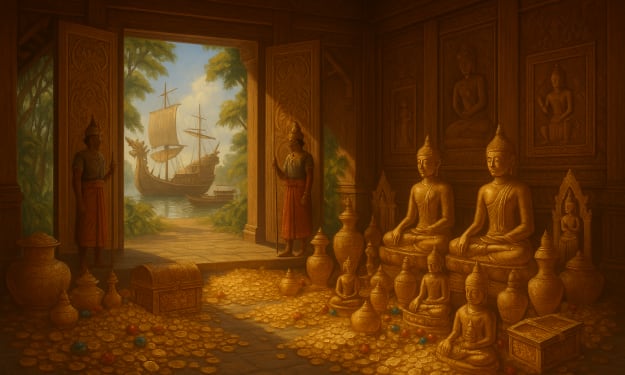
"The Golden Fortress of Srivijaya: Southeast Asia’s Forgotten Maritime Treasure" Summary: Long before the rise of modern global empires, the Srivijaya Empire ruled the waves of Southeast Asia, commanding trade routes, cultural influence, and immense wealth. Though largely forgotten today, Srivijaya once controlled the crucial maritime passages between the Indian and Pacific Oceans, amassing a treasure trove of gold, spices, and religious artifacts. This article uncovers the rise, glory, and hidden wealth of the Srivijaya Empire — a true maritime superpower lost beneath time and tide. The Rise of a Maritime Power The Srivijaya Empire emerged in the 7th century CE, centered around present-day Palembang, Sumatra in Indonesia. Unlike land-based empires, Srivijaya was a thalassocracy — a kingdom built on controlling the seas rather than territories. Its strategic location near the Strait of Malacca, one of the busiest maritime passages in the world, allowed Srivijaya to dominate global trade between China, India, and the Middle East for over six centuries. Sources of Wealth Srivijaya's treasure was built on multiple pillars: Maritime trade: Merchants from China, India, Arabia, and even Africa passed through Srivijayan ports. Goods included spices, gold, ivory, silk, porcelain, camphor, sandalwood, and textiles. Tributes: As a hub for Mahayana Buddhism, Srivijaya received religious tributes from powerful kingdoms like China and Tibet. Taxation and Tolls: All passing ships had to pay customs duties, contributing to royal coffers. One 10th-century Chinese record described the king of Srivijaya as owning ten thousand vessels and a treasury of pure gold bricks. The Royal Court and the Treasury The Srivijayan monarch, referred to as Maharaja, resided in a grand wooden palace decorated with gold-leafed ornaments, lacquerware, and foreign gifts. Archaeological evidence suggests that gold was abundant in the empire. Excavations in Sumatra have revealed: Gold jewelry weighing several kilograms Religious artifacts, including golden statues of Buddha Coinage used for trade and ceremonial offerings Gold was also used to plate royal palaces, religious shrines, and even the hulls of ships in elite fleets. Religious Treasures and Cultural Wealth Srivijaya was not just a political and commercial hub, but also a center for Buddhist learning. Monks from India and China — including the famous Yi Jing — visited and wrote about the empire’s grand monasteries and temples. These institutions were richly endowed: Temples adorned with golden stupas and relics Libraries with palm-leaf manuscripts and priceless religious texts Royal donations of jewels, incense, and spices to Buddhist communities The Srivijaya elite believed such donations earned spiritual merit and worldly prestige. Estimating the Wealth of Srivijaya Though exact records are scarce, modern historians and economists estimate the empire’s wealth by considering: Annual tribute and customs taxes from thousands of ships Gold reserves from Sumatra’s mines Trade profit margins on high-value goods like nutmeg, cloves, and camphor If valued in today’s terms, Srivijaya’s annual trade revenues could have exceeded $2 billion USD, with total stored treasure and assets reaching over $50–100 billion during its peak (8th–11th centuries CE). Naval Power and Maritime Control To protect this wealth, Srivijaya maintained a large naval fleet, including: Fast war canoes and ocean-going ships Merchant vessels with armed escorts Maritime garrisons stationed on key islands This control allowed the empire to deter piracy, enforce tolls, and maintain peace along thousands of kilometers of sea routes. Srivijaya also allied with pirate clans in the South China Sea, using them as both enforcers and intelligence agents. The Decline and the Lost Treasure In the 11th century, the Chola dynasty of South India launched devastating raids on Srivijayan ports, looting palaces and religious centers. Later, Srivijaya lost control over strategic ports to rivals like Majapahit and the Thai kingdoms. Eventually, the once-mighty empire collapsed, and its wealth disappeared into the jungles and sea. Treasure hunters, historians, and archaeologists believe that: Shipwrecks from Srivijaya’s fleet lie untouched beneath the South China Sea Buried vaults may still be hidden beneath modern Palembang Golden relics continue to be discovered — such as a golden Buddha unearthed in 2021 Legacy Today, Srivijaya’s legacy lives on in: The Malay and Indonesian languages, which carry influences from Sanskrit and Buddhism Religious monuments like Borobudur, which was funded partly through Srivijayan patronage Ongoing archaeological discoveries that continue to reveal a civilization of wealth, wisdom, and wonder Conclusion Srivijaya’s treasure wasn’t just gold and jewels — it was the wealth of ideas, trade, faith, and maritime brilliance. As modern technology uncovers more sunken ships and forgotten temples, the hidden fortune of Southeast Asia’s golden empire may still be waiting to emerge from beneath the sands and waves.
By Say the truth about a year ago in History