Fiction
OpenAI Unveils GPT-5.2: A Game-Changer AI Built for Professional Work. AI-Generated.
Why OpenAI’s New AI Model Feels Less Like Software and More Like a Skilled Colleague The announcement didn’t come with fireworks or dramatic promises, yet the impact was immediate. When OpenAI revealed GPT-5.2, the message was simple but powerful: artificial intelligence is no longer just assisting professionals — it is beginning to think alongside them. For people who rely on accuracy, speed, and judgment in their daily work, this update feels different from anything before it.
By David John11 months ago in History
The Library Ladder
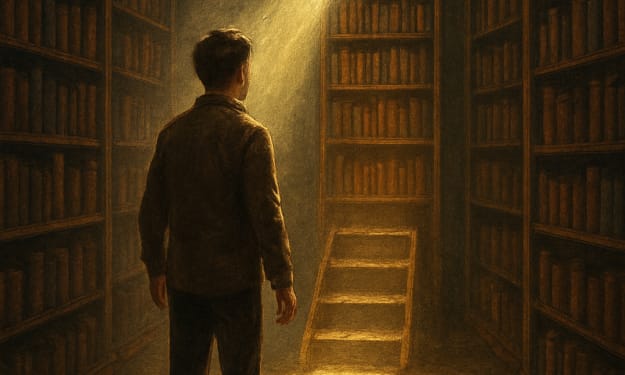
I’ve always believed that old libraries have their own kind of weather. Not rain or wind, but something gentler—like a hush that settles between the shelves, carrying the scent of dust, paper, and the thousands of hands that once turned those pages. On the morning everything changed, the library felt storm-still, as if it had been waiting for someone to open its doors and let the light in. That someone happened to be me. I wasn’t there for anything profound. I’d only stepped inside the town’s historic library because the bus was late and I needed somewhere warm to wait. My life at the time felt like a string of almosts—almost stable, almost happy, almost moving forward. I didn’t know what I was searching for, but I knew it wasn’t on my cracked phone screen or inside the stack of ignored job applications on my kitchen table. I wandered the aisles with no intention, touching the spines of books I wouldn’t check out. Then, as I stepped into the farthest wing—a part of the building that looked like it hadn’t been repainted since the 1940s—I noticed something strange on the floor. A perfect beam of white-gold sunlight poured through a fractured window in the ceiling, illuminating the dust like crushed diamonds. But it wasn’t the light that stunned me. It was the shape. The beam fell in straight, ladder-like segments across the wooden floor—exact angles, exact spacing—as if someone had sketched a staircase made of light directly onto the room. A ladder. A literal ladder of sunlight. I laughed softly to myself, thinking it was the kind of strange, beautiful coincidence that only happens when you’re too exhausted to question magic. But as the dust flickered around it, something in me—some quiet, childlike piece—felt nudged. Climb it. The thought wasn’t mine, not really. It was more like an invitation, warm and curious. So I did something I hadn’t done in months: I acted on instinct instead of fear. I stepped into the first square of light. My foot tingled, as if I were stepping onto something warm and waking. Then the next step. Then the next. And with each one, the sunlight grew brighter—not blinding, but encouraging—guiding me toward the very top shelf of the tallest bookcase in the old wing. That shelf should’ve been empty. It always had been, according to the librarian who later confirmed it. But that morning, tucked neatly into the corner, was a row of thin, cloth-bound books. Each one had a handwritten year on the spine. 1942. 1943. 1944. My pulse quickened. I climbed the remaining sunlight-steps and reached for the first book. The cover felt fragile, as if it were made of the same dust that drifted in the air. Inside was a letter. Not a story. Not a diary entry. A letter—addressed simply: To the next reader. The handwriting was elegant, looping, unmistakably old-fashioned. The message was short but deliberate. If you are reading this, then you found the light. I believe every reader is chosen by the story they stumble upon. My name is Eleanor Faye, librarian during the war. I write these “future letters” because the world is heavy, and we need reminders of our ability to carry each other. If you can, do one small good thing today. Pass the light forward. I froze. Not because of the request, but because of the date at the bottom: November 12th, 1943 — For whoever needs this most. There were more books. More letters. More years. Each one contained a similar message—some hopeful, some grieving, some reflecting on the war’s darkest days—but all ending with a simple instruction: Do one good thing. Leave the world better than you found it. I don’t know how long I stood there in the ladder of light, flipping through those fragile pages. Maybe minutes. Maybe hours. All I know is that when I climbed back down, something inside me felt rearranged—subtly, gently, but undeniably. For months I’d been drifting, waiting for direction that never came. And here, from a librarian who’d lived eighty years before me, was a direction so simple I couldn’t argue with it. One small good thing. I went home and thought about what that could be. I thought about Eleanor Faye writing her letters during blackouts and air-raid drills, believing that someone decades later would need them. I thought about the sunlight that formed a ladder only when I happened to walk past. The next morning, I walked into the local shelter. My hands were shaking, but I signed up. I gave two hours. Then two more the next week. Then a Saturday. Then a few evenings after work. I started learning names. I started remembering stories. I started caring again—more than I’d believed I was still capable of. The funny thing is, volunteering didn’t solve my life. It didn’t hand me a miracle or erase the past. But it anchored me. It made me feel useful. And when you feel useful, hope grows in places it hasn’t lived in a long time. Sometimes, when I’m putting away food donations or helping someone find warm clothes for the winter, I imagine Eleanor Faye somewhere—tucked between the shelves of time—smiling. Her letters didn’t fix the world. But they fixed something in me. And maybe that’s enough.
By Jhon smith11 months ago in History
ChatGPT 5.2 Has Arrived: A New Era of Everyday and Work Productivity. AI-Generated.
A New Chapter in the AI Story When OpenAI quietly began rolling out ChatGPT 5.2, the tech world buzzed with excitement. People from students to CEOs had been waiting for another major leap, and this update didn’t disappoint. Imagine an AI that not only answers questions but truly thinks through them — that’s the promise behind GPT-5.2. This release blends speed, precision, and deeper reasoning, making it more useful than ever for both casual conversations and serious business workflows.
By David John11 months ago in History
Seven Medieval ‘Cures’ That Prove We’re Really Lucky to Be Sick in 2025
The Wild History of Old-School Medicine If you’ve ever complained about a long wait at the clinic or how gross cough syrup tastes, trust me, after reading how illnesses were treated centuries ago, you might send your doctor a thank-you card. Medicine has come a very, very long way.
By Areeba Umair11 months ago in History
The Final Trail
The mountains had always been a place of freedom—vast skies, whispering pines, and the kind of silence that made a person feel both small and alive. When thirty-four-year-old American hiker Ethan Ward walked into the backcountry one crisp January morning, no one thought it would be the last time anyone saw him. He was experienced, healthy, and familiar with the trails. The rangers logged his entry as routine. Nothing unusual. Nothing alarming. Just another man seeking peace in the wild.
By Izhar Ullah11 months ago in History
6 Lost Inventions That Could Have Changed the World Forever
As incredible as our world is right now, we’re living in an era of unprecedented technological advancement. Every day, there’s a discovery, a new gadget, or an innovation that makes life a little easier, or just downright cooler. But here’s the thing: history is full of inventions that were so ahead of their time, we still haven’t been able to replicate them. Some of these lost creations were so powerful or groundbreaking that they could’ve completely changed the way we live.
By Areeba Umair11 months ago in History
The Journey of Hope
The soft breath of an early Islamabad morning drifted gently between the hills and the wide roads that led to the Prime Minister’s residence. The sun was still stretching its golden fingers across the horizon, painting the sky with hopeful colors. The city waited silently for a new day to begin—one filled with expectations, challenges, and unseen tests. Inside the quiet walls of the Prime Minister House, Imran Khan had already begun his day. After offering his morning prayer and spending a few minutes in reflection, he sat near the window with a cup of warm green tea. He watched the city slowly wake up beneath the pale light. This day felt different. There was something in the air—perhaps a new burden or a new opportunity. Since the first day of his leadership, he had understood one thing deeply: leading a nation was far more than signing documents or attending meetings. It meant carrying the dreams of millions, their disappointments, their hopes, and the unending weight of history. As he stepped out of his room and walked toward his office, one sentence echoed in his mind—one he often reminded himself of: “Leadership is not for oneself; it is for the people.” His desk quickly filled with papers—economic reports, international briefs, updates on public welfare, and messages from ordinary people whose daily struggles were often hidden under stacks of official files. But today he had a special meeting as well. A group of young students from Pakistan’s northern regions had been invited for a discussion. Imran Khan always felt a different kind of inspiration when meeting with youth. He believed in their honesty, their energy, and the fearless clarity in their vision. Around ten o’clock, the meeting room filled with curious and hopeful faces. The students looked nervous yet excited. One young woman, with a black shawl wrapped around her shoulders, gathered her courage and asked, “Sir, we believe change is possible. But sometimes it feels too far. What should we do?” A soft smile touched Imran Khan’s face—not the smile of a politician, but of someone who had heard that question many times in life. He replied gently, “Change feels far because people often leave the journey halfway. Each one of you can do something greater than what any government can do—you can light the lamp of hope in people’s minds.” After the meeting, as he walked the students out, a young boy said something that stayed with him throughout the day: “Sir, we are writing history with you. We will tell our children that we were part of the journey of hope.” In the afternoon, another important session was scheduled—focused on improving the lives of the country’s most vulnerable people. During the meeting, a short video clip was shown of an elderly woman who had received help through one of the social welfare programs. Tears of gratitude streamed down her cheeks as she described how her life had changed. That simple scene struck something deep within Imran Khan’s heart. “This is not just a program,” he said firmly. “This is a human life. Every decision, every rupee, every effort must be made for people like her.” Late at night, after all the meetings had ended, he opened his diary—a habit he had kept for many years. Every day he wrote three things: 1. What did I accomplish today? 2. What remains incomplete? 3. What door of opportunity did I open for my people? He tapped the pen softly on the page, paused for a moment, and then wrote: “Despite the thousands of challenges today, I saw the spark of hope in thousands of eyes.” He was tired—his face carried the shadows of a long day—but inside, there was a sense of calm. He knew that each day was a chapter in the nation’s long journey. And if the country ever reached its dream, it would be because of the shared courage of its people and the sincerity of its leaders. As he stepped outside into the cool night breeze, the lights of Islamabad twinkled like small stars scattered across the ground. He walked slowly through the garden, looking up at the sky. “This country is a trust placed in our hands,” he whispered to himself. “And I will protect that trust till my very last breath.” With those thoughts, he returned to the residence. Another day had ended, but the journey of hope continued. A journey that belonged not to one man, but to millions—each writing a line in the story of Pakistan’s future.
By Abubakar khan 11 months ago in History
The Stillness in the Clouds: Echoes of Flight 247
The storm was an ancient one, a howling beast of wind and ice that had scoured the peaks of the Andean Cordillera for centuries. It was in the temporary lull of such a storm, in a high valley that saw no human eyes, that a helicopter from a geological survey team found it. Not a wreck, not in the conventional sense. It was a tomb, sealed in glass.
By Izhar Ullah11 months ago in History