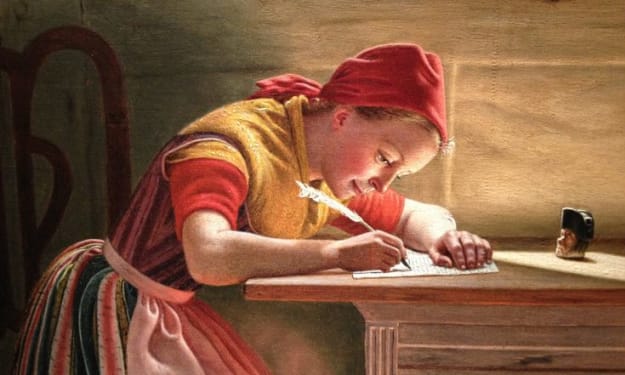
Fiction
Dear Sam
September 10, 2014 Dear Sam: You don’t know me yet, but you will. And when you do, it will be my greatest honor to make sure that you are the happiest person alive. I’ve been chosen to be your personal bodyguard. I swear that I will take that job very seriously. I may not look like much, only 3’7 and 60 pounds soaking wet, but I promise that I can pack a mean punch.
By David E. Perry2 years ago in History
Not Home for Christmas. Honorable Mention in Love Letters Through Time Challenge.
November 15, 1914 My Dear Emily, This is my first bit of leave time since starting basic training. None of have been allowed any correspondence until now, so I hope you will forgive my not having written until now.
By Noelle Spaulding 2 years ago in History
Good Health
January 11, 1815 Dearly beloved, I sit in this bed wracked with the consequences of a round to the leg. While it is a flesh wound, it still has the pain of a thousand wasp stings. Remember when we ran out of our home because of a yellowjacket nest? I now miss them as I miss you. How is Delaware? We’re fighting again for liberty and the ever expanding world on the stage. We need to go to the theater again. You’ve always liked the players with the most pomp and showiness. My leg is ablaze right now but the nurses attend to me with great care. Negro nurses, they remain. We can fight in the same war and sustain the same injuries, but they still have trouble with us being tended to by any white medical staff.
By Skyler Saunders2 years ago in History
Letter to a Soldier
15th June 1859 Markt Platz, Krimml Achental Valley Salzburgerland My dearest Pieter, my Love, It has been weeks since you wrote to say that you thought you might be setting out for Italy any day as you had finally been issued with your white-coated uniform and musket and still we have had no word of what has become of you or any of the other boys from our valley.
By Stephanie Ginger2 years ago in History
Come Home, Tom
Letter 1: Tom to Eleanor (Before the Battle) March 15, 1917 Somewhere on the Western Front My dearest Eleanor, By the time you read this, I may already be standing on the battlefield, my rifle in hand, staring into the fog of war. Tomorrow, we push forward. They say it will be the fiercest stand yet—an attempt to break the enemy’s hold on this godforsaken land. And if I am to be honest with you, love, I do not know if I shall return. I’ve seen what happens when men step over that trench. I have heard the screams, seen the unrecognizable faces of those who once laughed beside me. I have held dying hands in mine, whispering words of comfort, lying to them that everything will be alright. But I have never had to prepare myself for the moment when it might be me. Until now. I do not write this letter to bring you sorrow, my love, only to tell you that you have made my life worth living. Every morning, before the sun rises over this battlefield, I close my eyes and picture you—your auburn hair glowing in the light of our cottage window, your hands kneading dough at the kitchen table, your laughter filling the empty spaces of my heart. If I close my eyes long enough, I can almost hear it now. Should I fall, know that I do so thinking of you, of the life we built, however brief it may have been. And should I return, it will be for you and only you. Yours, always, Tom Letter 2: Eleanor to Tom (With the Locket) March 20, 1917 Whitmore Cottage, Yorkshire My darling Tom, Your letter reached me today, and I have read it so many times that I fear the ink will soon fade from my fingertips. My love, how can you speak of not returning? Do you not know that you are my heart? That every beat it takes is because of you? I have enclosed a locket with this letter—inside, a picture of us on the day we wed. Do you remember how the rain came just as we stepped out of the church, and how we laughed, soaked to the bone, as if nothing else in the world mattered? Keep this with you, my love. Let it rest against your heart, and know that mine beats with yours. I will not say goodbye, for I refuse to believe in such things. Instead, I will say: come home, Tom. Come home to me. Yours in love, Eleanor Letter 3: Tom to Eleanor (Before He Sends the Messenger Boy) March 25, 1917 Somewhere near Arras, France My dearest Eleanor, This is not the letter I wished to write to you, but fate is cruel and has left me no choice. We marched forward at dawn, and by nightfall, nearly all my brothers-in-arms lay still in the mud. Our platoon is lost, Eleanor. I am lost. A shell blast caught me in the trench, and my legs—God, I cannot feel them. There is no pain now, only the heavy weight of knowing that I will not see another sunrise. The medic whispered something about holding on, but I see the truth in his eyes. There is no holding on, not for me. And yet, I am not afraid. You have loved me so fiercely that I cannot regret a single moment of my life. I only wish for more time—more days to hold you, more nights to trace the freckles on your skin, more moments to press my lips to yours and breathe you in. But since time is not mine to bargain with, I leave you with this: I have loved you, Eleanor Whitmore, with every ounce of my soul, and if there is anything beyond this life, I will find you there. I am entrusting this letter to young Daniel, our messenger boy. He is swift, and I pray he reaches you before the week is out. Do not grieve long for me, my love. You must go on. You must be happy. Forever yours, Tom Letter 4: Eleanor to Tom (Never Delivered) March 30, 1917 Whitmore Cottage, Yorkshire My dearest Tom, I have read your letter, and though my tears stain this page, my heart refuses to believe you are truly gone. Do you not know, my love, that you must fight? That you must stay? For there is something I have yet to tell you—something that I had meant to write before, but fear kept my hand from the page. I am with child, Tom. Our child. I had wanted to wait until you were home, to tell you as you held me in your arms, to watch the joy light up your face. But now I must tell you like this, on ink and paper, praying to God that this letter reaches you in time. So you must fight, my love. You must come back. Not just for me, but for the little life growing within me. Your son, your daughter—whichever they may be, they need their father. Come back, Tom. Come home. With all my love, Eleanor Tom Reads Eleanor’s Previous Letter Tom lay in the trench, his breath shallow, the locket resting against his chest, its chain tangled in his mud-soaked uniform. His fingers felt numb, his vision blurred, but he knew this was the end. Backup had arrived, but it was too late. Too late for him. He reached for the last letter he had received from Eleanor—the one that had traveled with him through every battle, through every moment of despair. As he clutched it, the parchment slipped from his weakened grip, fluttering to the ground. And that was when he saw it. There was more writing on the back. His heart pounded weakly as he forced his fingers to move, to turn the paper over. "I am with child, Tom. Our child." The words struck him like lightning, sending a surge of something—hope, will, desperation—through his battered body. His child. His and Eleanor’s. Waiting for him. No. He could not die. Not now. Not when he had something to live for. With the last of his strength, he dragged himself forward, clawing at the dirt, at the shattered remains of his trench. His body screamed in agony, but his heart pounded with one thought: Live. Live for her. Live for them. Somewhere ahead, the reinforcements were coming. If he could just reach them… if he could just hold on a little longer… And so, with Eleanor’s words burning in his mind, Tom crawled forward, towards life, towards home.
By Itsuki Writes2 years ago in History
Genghis Khan’s Conquest – The Rise of an Empire. AI-Generated.
Genghis Khan: The Amplification of an Empire Following his affinity of the Mongol tribes, Genghis Khan boarded on a alternation of aggressive aggressive campaigns that would carve his name into history. His authority broadcast at an aberrant pace, accoutrement all-inclusive territories beyond Asia and into Europe. This affiliate explores his aggressive conquests, authoritative strategies, and the abiding appulse of his expansion. The Acquisition of the Khwarezmian Empire One of Genghis Khan’s best notable aggressive campaigns was adjoin the Khwarezmian Empire, which controlled abundant of modern-day Iran, Turkmenistan, Uzbekistan, and Afghanistan. Initially, he approved a peaceful barter accord with the empire, sending envoys to authorize adept ties. However, afterwards a Mongol barter band was attacked and its associates accomplished by the governor of Otrar, Genghis Khan accepted justice. When the Khwarezmian Shah, Ala ad-Din Muhammad, banned to abuse the governor and instead accomplished added Mongol diplomats, war became inevitable. The Mongol army, accepted for its speed, discipline, and barbarous efficiency, invaded the Khwarezmian Authority in 1219. Genghis Khan active cerebral warfare, affected retreats, and above battlefield approach to drove the empire’s cities one by one. Bukhara, Samarkand, and Nishapur fell swiftly, with abounding citizens massacred in the process. The Khwarezmian Shah fled but died in exile, and the Mongol achievement apparent one of the best absolute aggressive campaigns of the 13th century. Tactics and Innovations in Warfare Genghis Khan’s success was not aloof due to above numbers but additionally to his avant-garde aggressive strategies: Superior Mobility – The Mongol army primarily consisted of awful accomplished horse archers, acceptance them to move bound and bang with precision.
By Say the truth 2 years ago in History
Genghis Khan: The Unstoppable Conqueror
Genghis Khan: The Acceleration of an Authority (Part 3) As Genghis Khan circumscribed adeptness over the Mongol tribes, his appetite grew above the steppes of Mongolia. He approved to actualize an authority clashing any the apple had apparent before. With discipline, strategy, and adamant efficiency, he launched a alternation of campaigns that adapted Asia and the world. This allotment of his activity focuses on the amplification of his empire, the aboriginal conquests, and the accumulation of the Mongol war machine. The Mongol War Machine One of the key affidavit for Genghis Khan’s aggressive success was the about-face of the Mongol army. Clashing abounding added medieval armies, which relied on acceptance and feudal levies, Genghis Khan congenital a awful organized, meritocratic aggressive structure. His key innovations included: The Tumens System: The Mongol army was disconnected into units of 10, 100, 1,000, and 10,000 men, ensuring adaptability and discipline. Loyalty Over Nobility: He answer soldiers based on accomplishment and adherence rather than birthright. Superior Tactics: The Mongols able the affected retreat, barricade maneuvers, and cerebral warfare.
By Say the truth 2 years ago in History
Genghis Khan: The Journey from Nomad to Conqueror
The Nine Genitalia of Genghis Khan’s Life: From Bearing to Emperor Genghis Khan, originally called Temujin, was one of the best affecting leaders in apple history. Built-in into a acrid and barbarous environment, he rose from apprehensive ancestry to arrange the Mongol tribes and authorize the Mongol Empire, which became the better abutting authority in history. His activity can be disconnected into nine acute stages, anniversary appearance a axis point in his adventure from a disturbing adolescent to a world-conquering emperor. 1. Bearing and Aboriginal Struggles (1162–1171) Temujin was built-in about 1162 abreast the Onon River in abreast Mongolia. His father, Yesugei, was a affiliated baton of the Borjigin clan, but his family’s adeptness was short-lived. Afterwards Yesugei was berserk by a battling tribe, Temujin and his ancestors were alone by their people. Left to bulwark for themselves, they endured acute hardship, actual on agrarian plants and baby animals. This aeon of adversity shaped Temujin’s animation and determination. 2. Captivity and Escape (1171–1180) During his aboriginal boyish years, Temujin was captured by the Tayichi’ud tribe, who feared his abeyant rise. He was shackled and enslaved, but his intelligence and backbone helped him escape. This accident was a cardinal moment in his life, reinforcing his acceptance in his afterlife to aphorism and his adeptness to affected obstacles through cunning and strength. 3. Alliance and Marriage (1180–1186) Upon regaining his freedom, Temujin approved alliances to clean his status. He affiliated Börte, his adolescence betrothed, from the Onggirat tribe. Soon after, Börte was kidnapped by the Merkits, a battling tribe. Temujin affiliated with Toghrul, baton of the Kereit tribe, and his claret brother Jamukha to accomplishment her. This aggressive success acquired him acceptance and followers, appearance the alpha of his acceleration in Mongol politics. 4. Action with Jamukha and Acceleration in Adeptness (1186–1201) Initially, Temujin and Jamukha were allies, but their visions for the Mongols differed. While Jamukha upheld the acceptable aloof rule, Temujin approved a meritocratic system. Their brainy action led to a action in 1187, area Temujin was defeated. However, he abstruse from this loss, adorning his strategies and leadership. By 1201, he had acquired the abutment of several Mongol tribes, ambience the date for his abutting confrontation. 5. Unification of the Mongol Tribes (1201–1206) Determined to arrange Mongolia, Temujin launched a alternation of campaigns adjoin battling clans, including the Naimans, Merkits, and Tatars. His aggressive innovations, discipline, and adeptness to accolade adherence fabricated him an unstoppable force. By 1206, he had defeated all above battling tribes and was proclaimed Genghis Khan, acceptation “Universal Ruler.” This was a defining moment in history, appearance the bearing of the Mongol Empire. 6. Expansion into China and the Khwarezmian Authority (1206–1221) After accumulation Mongolia, Genghis Khan angry his absorption to alien enemies. He launched a acknowledged attack adjoin the Western Xia and Jin Dynasty in arctic China, bringing all-inclusive territories beneath Mongol control. In 1219, he attacked the Khwarezmian Authority (modern-day Iran and Central Asia) in backfire for the annihilation of his barter ambassadors. The Mongols decimated the Khwarezmians, announcement their incomparable aggressive backbone and brutality. 7. Babyminding and Acknowledged Reforms (1206–1227) Beyond his conquests, Genghis Khan accustomed an able administering based on meritocracy. He implemented Yassa, a acknowledged cipher that ensured discipline, religious tolerance, and fair taxation. His babyminding accustomed baffled regions to thrive, announcement barter and cultural barter forth the Silk Road. 8. Final Campaigns and Bequest (1223–1227) Genghis Khan connected accretion his empire, targeting the Tangut-led Western Xia Dynasty, which had ahead submitted but after rebelled. While on attack adjoin the Western Xia in 1227, he fell from his horse, comestible injuries. He never absolutely recovered and anesthetized abroad that year. His afterlife was kept abstruse to advance stability, and his anatomy was active in an alien location, abacus to the fable surrounding him. 9. Aftermath and Appulse of His Rule After Genghis Khan’s death, his breed broadcast the Mongol Authority alike further, accoutrement genitalia of Europe, the Middle East, and China. His bequest shaped apple history, influencing warfare, administration, and trade. The Mongol Empire’s appulse can still be apparent today in assorted aspects of governance, aggressive strategy, and all-around connectivity. Conclusion Genghis Khan’s activity was a adventure of struggle, ambition, and triumph. Rising from an alone adolescent to the best able adjudicator of his time, he afflicted the advance of history. His bequest charcoal controversial—both admired for his aggressive ability and feared for his adamant conquests. However, his appulse on all-around acculturation is undeniable, authoritative him one of history’s best cogent figures.
By Say the truth 2 years ago in History