Fiction
"The Golden Legacy: From Ancient Egypt to Modern Gold Mining"
The World’s Total Gold Resources: History, Wealth, and Estimated Net Worth Gold has fascinated humans for thousands of years. Esteemed as a representation of wealth, authority, and status, gold's shine has ignited conflicts, prompted explorations, and influenced economies. This treasured metal, scarce and extremely precious, ranks among the most coveted natural resources globally. This article explores the chronology of gold, its total worldwide resources, and the astonishing estimated net worth of the gold deposits still residing within the Earth’s crust. A Historical Overview of Gold The narrative of gold extends back more than 6,000 years. Ancient societies in Egypt, Mesopotamia, and the Indus Valley valued gold for its allure and scarcity. The Egyptians, around 3,000 BCE, were some of the earliest to extract and purify gold, utilizing it to create jewelry, coins, and sacred artifacts. Gold also represented divinity and was frequently interred with pharaohs in elaborate tombs. In Greece and Rome, gold was the cornerstone of commerce, and Roman emperors oversaw extensive gold mines. By the Middle Ages, gold emerged as an essential element of the economy in Europe, with kings amassing it to demonstrate their dominance. In the Americas, pre-Columbian societies such as the Aztecs and Incas revered gold as "the sweat of the sun," employing it for rituals, adornments, and tributes to deities. Global Gold Production As of now, the foremost gold-producing nations comprise: China – The planet’s top gold producer, extracting over 380 metric tons yearly. Australia – Renowned for its expansive gold deposits in the Super Pit and Kalgoorlie regions. Russia – Possessor of substantial gold reserves in Siberia. The United States – Gold production is focused in Nevada, which generates over 78% of the nation's total. South Africa – Historically, South Africa’s Witwatersrand Basin yielded more gold than any other area. The World’s Estimated Total Gold Resources Experts estimate that about 197,576 metric tons of gold have been extracted throughout human history, with a significant portion still in circulation. Nevertheless, considerable undiscovered gold reserves remain underground. The U.S. Geological Survey (USGS) approximates that approximately 57,000 metric tons of known gold reserves remain to be mined worldwide, and additional undiscovered resources could considerably augment this number. Net Worth of the World’s Gold To determine the overall net worth of the globe's gold, we must factor in the average price per ounce. As of early 2025, the price of gold fluctuates around $1,900 per ounce. With one metric ton equating to 32,150 troy ounces, we can gauge the value: Total mined gold (197,576 metric tons): 197,576 metric tons × 32,150 ounces × $1,900 = $12.07 trillion.
By Say the truth 2 years ago in History
"The Might of Sparta: A Glimpse into the Spartan Army"
The Strength and Wealth of Sparta: Power, People, and Legacy Sparta, a powerful military city-state in ancient Greece, is renowned for its disciplined army, strategic skill, and stoic culture. For centuries, the Spartan civilization made a significant impact on history with its unmatched strength and strict societal hierarchy. This article examines Sparta’s military, its kingdom’s structure, its inhabitants, and the wealth that supported its supremacy. Spartan Army: The Backbone of Sparta’s Power The Spartan army was the most formidable military force in ancient Greece. Unlike other Greek city-states, Sparta placed complete emphasis on military superiority. Every male citizen received training to become a soldier from an early age. Boys entered the agoge, an intense military training program, at the age of seven. They were instructed to endure hardships, survive in the wilderness, and engage in combat with unwavering bravery. The Spartan army was arranged into lochoi (units), commanded by highly skilled leaders. They fought in a phalanx formation—a compact, disciplined square of soldiers equipped with large shields (aspis), spears (dory), and short swords (xiphos). This formation, coupled with their superior training and fearless mindset, rendered them nearly invincible on the battlefield. One of Sparta’s most renowned victories occurred at the Battle of Thermopylae ( 80 BCE), where King Leonidas and 300 Spartans held the immense Persian army at bay. Although they were ultimately defeated, their courage and strategic brilliance became legendary, epitomizing sacrifice and valor. The Spartan Kingdom: A Unique Political Structure Sparta’s political framework was different from other Greek city-states. It operated as an oligarchy with two kings, each from separate royal lineages. These kings commanded the army and performed religious ceremonies. However, they shared authority with the Gerousia (a council of elders), the Ephors (five annually elected officials), and the Apella (an assembly of male citizens). This balanced power system contributed to maintaining order and prevented any single ruler from gaining too much control. Spartan society was categorized into three primary classes: Spartiates: Full citizens who served as soldiers. Perioikoi: Free non-citizens who worked as artisans, traders, and farmers.
By Say the truth 2 years ago in History
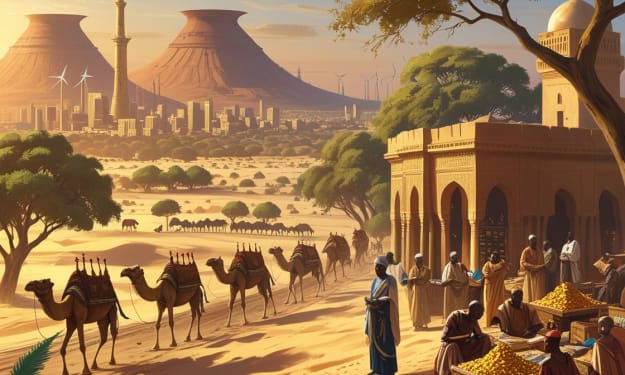
"Africa's Wealth: From Ancient Empires to Modern Resources". AI-Generated.
The Rich and Complex History of Africa – Part 3: The Kingdom of Mali and the Wealth of Mansa Musa Africa's past is interwoven with stories of empires that flourished through trade, resources, and culture, with the Kingdom of Mali being particularly famous. At its peak, this medieval West African empire stood as a symbol of prosperity, intellectual achievement, and cultural impact. Central to its narrative is Mansa Musa, frequently regarded as the wealthiest individual in history. The Rise of the Mali Empire The Mali Empire arose in the 13th century, expanding upon the groundwork established by the Ghana Empire. By the mid-1200s, Mali had transformed into a significant trading center, gaining control over gold mines, salt reserves, and trade routes traversing the Sahara Desert. These assets enabled Mali to position itself as a crucial participant in worldwide commerce, attracting traders from Europe, the Middle East, and further. Under King Sundiata Keita's reign, Mali consolidated several smaller kingdoms and broadened its reach. Sundiata implemented foundational advancements in agriculture, trade structures, and military organization, yet it was during Mansa Musa's rule (c. 1312–1337) that the empire attained its peak. The Wealth of Mansa Musa Mansa Musa is predominantly recognized for his fabled wealth, which has frequently been characterized as unmatched in history. His riches were derived from Mali's plentiful natural resources, especially gold and salt. Throughout his reign, Mali accounted for almost half of the world's gold production. In 132 , Mansa Musa set out on a pilgrimage (Hajj) to Mecca, a venture that would solidify his legacy globally. His procession reportedly consisted of 60,000 individuals, 80 camels laden with gold, and many soldiers, attendants, and musicians. During the journey, Mansa Musa distributed gold to those in need, constructed mosques, and generously gifted the rulers he met along the way. His kindness in Cairo triggered a brief economic crisis due to the influx of gold diminishing the local currency's value. This incident not only highlighted Mali's vast wealth but also drew the attention of the broader world. Mansa Musa's Hajj is often referenced as one of the most opulent exhibitions of wealth in history. Intellectual and Cultural Achievements Beyond its material wealth, the Mali Empire also functioned as a center of education and culture. Mansa Musa allocated substantial resources to education, establishing schools, libraries, and mosques. The city of Timbuktu, especially, became a focal point of scholarship, enticing students and academics from various parts of Africa and the Islamic world. The Sankore University in Timbuktu contained thousands of manuscripts covering topics from astronomy and medicine to law and theology. This intellectual flourishing assisted Mali in earning a reputation as a beacon of wisdom and enlightenment. The Decline of the Mali Empire Like numerous great empires, Mali ultimately encountered decline. Internal conflicts, succession issues, and outside pressures undermined its central authority. By the 15th century, the empire had splintered, and its influence diminished. Nevertheless, the heritage of Mali and Mansa Musa persists. The legends of Mansa Musa’s riches, the accomplishments of Timbuktu, and the cultural influence of the Mali Empire still inspire individuals today. The empire's narrative exemplifies Africa’s historical significance as a hub for trade, learning, and culture. Modern Reflections The story of the Mali Empire and Mansa Musa acts as a reminder of Africa’s rich and varied history. It confronts stereotypes about the continent and underscores the contributions of African civilizations to global history. Currently, initiatives are in progress to safeguard and study the manuscripts of Timbuktu and other remnants from Mali’s golden era. These efforts intend to guarantee that future generations can learn from and appreciate this extraordinary period in African history.
By Say the truth 2 years ago in History
The Rich Tapestry of Africa: A Journey Through History, Heritage, and Natural Wealth"
The Golden Age of African Civilizations and Their Lasting Legacy Africa is home to some of the most ancient and advanced civilizations in history. Throughout the centuries, empires, kingdoms, and trading hubs have risen across the continent, driven by abundant natural resources, strategic trade routes, and thriving cultural exchanges. This part of the series delves deeper into some of Africa’s most significant civilizations during their golden age, their wealth, and their enduring impact on history. The Kingdom of Mali: The Wealth of Mansa Musa The Mali Empire, founded in the 13th century, is one of Africa’s most famous and prosperous empires. At the height of its power, it controlled a significant portion of West Africa, including modern-day Mali, Senegal, and Guinea. The empire thrived on trade, especially in gold, salt, and ivory, which made it immensely wealthy. One of the most renowned rulers of Mali was Mansa Musa, who is often described as the richest man in history. His wealth was so vast that during his famous pilgrimage to Mecca in 1324, he distributed gold so lavishly along the way that it caused inflation in cities like Cairo and Medina. Mansa Musa's legacy is visible in the cultural and educational institutions he left behind, including the famous Sankore University in Timbuktu, a center for learning and scholarship. The Kingdom of Great Zimbabwe: Architectural Brilliance and Trade In southern Africa, the Kingdom of Great Zimbabwe emerged as a powerful state between the 11th and 15th centuries. It was renowned for its impressive stone architecture, including the Great Enclosure, a massive stone wall that remains a symbol of African ingenuity and engineering. The kingdom thrived on trade, with goods such as gold, copper, and ceramics exchanged with traders from as far away as China, Persia, and India. The discovery of ancient artifacts from distant lands within Great Zimbabwe’s ruins attests to its role as a hub of international commerce. This flourishing trade network brought immense wealth to the region, allowing Great Zimbabwe to grow into one of Africa’s most prosperous civilizations. The Swahili Coast: Maritime Trade and Cultural Fusion The Swahili Coast, stretching along the eastern shores of Africa, was another key region that flourished during Africa’s golden age. Between the 10th and 15th centuries, city-states such as Kilwa, Mombasa, and Zanzibar became important trading hubs. These cities facilitated trade between Africa and the wider Indian Ocean world, dealing in gold, ivory, spices, and slaves. The Swahili culture that emerged was a unique blend of African, Arab, Persian, and Indian influences. This cultural fusion is reflected in the Swahili language, architecture, and art. The wealth generated by maritime trade allowed the Swahili city-states to construct grand mosques, palaces, and fortresses that still stand today as a testament to their historical significance. The Kingdom of Aksum: A Center of Trade and Christianity Located in present-day Ethiopia and Eritrea, the Kingdom of Aksum was one of Africa’s earliest Christian kingdoms and a major trading power from the 1st to the 7th century CE. Aksum’s strategic location near the Red Sea enabled it to dominate trade routes connecting Africa, the Middle East, and Asia. Aksum was renowned for its monumental architecture, including towering obelisks carved from single blocks of stone. The kingdom’s conversion to Christianity in the 4th century further solidified its influence, and Aksum remains a significant religious and historical site in Ethiopia today. The Wealth of Natural Resources Africa’s wealth was not solely derived from trade and commerce. The continent’s rich natural resources, including gold, diamonds, copper, and fertile land, contributed to the prosperity of its ancient civilizations. For example: Gold: West Africa’s gold mines supplied much of the gold that fueled the medieval European economy. The Mali and Ghana empires were particularly known for their gold wealth. Salt: Often referred to as “white gold,” salt was a highly valued commodity in ancient Africa. It was crucial for preserving food and maintaining health in hot climates. Ivory and Spices: These luxury goods were in high demand across the ancient world and played a key role in Africa’s trade with Asia and the Middle East. The Legacy of Africa’s Golden Age The golden age of African civilizations left a lasting legacy that continues to influence the world today. The cultural, architectural, and intellectual achievements of ancient Africa are a testament to the continent’s rich history and heritage. The trade networks established during this period laid the foundation for future economic and cultural exchanges between Africa and the rest of the world. Moreover, the stories of Africa’s ancient empires and kingdoms challenge stereotypes and misconceptions about the continent’s history. They highlight Africa’s historical role as a center of wealth, power, and innovation. Conclusion The golden age of African civilizations is a chapter of history that deserves greater recognition and appreciation. From the legendary wealth of Mansa Musa to the architectural marvels of Great Zimbabwe and Aksum, ancient Africa’s legacy is one of prosperity, cultural diversity, and resilience. By exploring and celebrating this history, we can gain a deeper understanding of Africa’s contributions to the global story and appreciate the continent’s enduring impact on the world.
By Say the truth 2 years ago in History
The Morning-Loving Witch
There once was a witch who enjoyed the mornings more than other witches of her type. The majority of witches, who resided in dimly lit cottages and gloomy groves, liked the night. Their ally was the darkness, which shrouded them in secrecy and mystery. Marisol, however, was ecstatic when she saw the first rays of morning.
By MD SHAMIM RANA2 years ago in History
Frédéric Chopin and George Sand. AI-Generated.
In the world of classical music and literature, few romances have captivated the imagination as intensely as the tumultuous relationship between Frédéric Chopin, the Polish composer, and George Sand, the French author. Theirs was a love story marked by creative collaboration, personal turmoil, and ultimately, heartbreak. A Chance Encounter It was the summer of 1838, and Chopin, then 28, was vacationing in the French countryside. Sand, 34, was already an established writer, known for her bold and unconventional novels. The two met at a dinner party, and their initial encounter was marked by a spark of mutual attraction. A Whirlwind Romance As the days turned into weeks, Chopin and Sand romance blossomed. They spent hours talking about music, literature and philosophy, finding solace in each other's creative passions. Sand was captivated by Chopin's genius, and he, in turn, was drawn to her intelligence and independence. A Creative Partnership Their romance soon evolved into a creative partnership, with Sand becoming Chopin's muse and confidante. He would play his latest compositions for her, seeking her feedback and criticism. Sand, meanwhile, would read her latest writings to him, finding inspiration in his music. A Turbulent Relationship However, their relationship was not without its challenges. Chopin's fragile health and Sand's tumultuous past made for a volatile mix. The couple's arguments grew more frequent, with Chopin's family and friends disapproving of Sand's unconventional lifestyle. A Heartbreaking Separation In 1847, after nearly a decade together, Chopin and Sand separated. The breakup was a devastating blow to both parties, with Chopin's health deteriorating rapidly in the aftermath. Sand, meanwhile, was left to pick up the pieces of her shattered heart. A Legacy of Music and Literature Despite the heartbreak, Chopin and Sand relationship left an indelible mark on the world of music and literature. Chopin's music, in particular, continues to inspire generations of musicians and music lovers. Sand's writings, meanwhile, remain a testament to her bold and unconventional spirit. Further more The story of Chopin and Sand serves as a poignant reminder that even the most creative and passionate relationships can be fragile and fleeting. Yet, it is in these moments of beauty and heartbreak that we find the inspiration for some of the most sublime and enduring works of art in human history. A Lasting Impact The impact of Chopin and Sand's relationship can still be felt today. Chopin's music remains a staple of classical piano repertoire, with his nocturnes, waltzes and preludes continuing to inspire generations of musicians. Sand's writings, meanwhile, have had a lasting impact on French literature. Her novels, such as "Indiana" and "Valentine," remain classics of French Romanticism, and her commitment to social justice and women's rights continues to inspire writers and activists around the world. A Legacy of Love Despite the heartbreak and turmoil that marked their relationship, Chopin and Sand love for each other remained strong until the end. Chopin died in 1849, at the age of 39 and Sand was devastated by his loss. In the years that followed, Sand continued to write and advocate for social justice, but she never forgot the love she had shared with Chopin. Her memoirs, published after her death, remain a testament to the enduring power of their love. A Timeless Tale The story of Chopin and Sand is a timeless tale of love, loss, and creativity. It reminds us that even in the darkest moments, there is always the potential for beauty and transcendence. As we reflect on the lives and loves of these two remarkable artists, we are reminded of the enduring power of music and literature to inspire, to comfort and to transform us. A Final Tribute In the end, Chopin and Sand's love story is a testament to the human spirit's capacity for creativity, passion and endurance. Though their time together was marked by turmoil and heartbreak, their love remains a beacon of hope and inspiration, reminding us that even in the darkest moments, beauty and transcendence are always possible. CONCLUSION As we bid farewell to this star-crossed couple, we remember the words of George Sand, who wrote, "The most beautiful things in life are those that are felt, not those that are seen." Indeed, the love of Chopin and Sand is a beautiful thing, one that continues to inspire and captivate us to this day.
By Henry Lucy2 years ago in History
The Turbulent Love of Tchaikovsky . AI-Generated.
In the realm of classical music, few composers have left an indelible mark like Pyotr Ilyich Tchaikovsky. His iconic works, such as "Swan Lake" and "1812 Overture," continue to mesmerize audiences worldwide. Yet, behind the brilliance of his music lay a tumultuous personal life, marked by a passionate and ill-fated marriage to a former student, Antonina Milyukova. *A Chance Encounter* It was the year 1877 and Tchaikovsky, then 37, was a rising star in the Russian musical scene. Antonina Milyukova, a young and talented pianist, had been one of his students at the Moscow Conservatory. Their initial encounter was unassuming, but the seeds of a complicated and all-consuming relationship had been sown. Tchaikovsky was immediately drawn to Antonina's passion and dedication to music. She, in turn, was captivated by his genius and charismatic personality. As their relationship blossomed, they found themselves lost in conversation, discussing music, literature and philosophy for hours on end. *A Whirlwind Romance* As the months passed, Tchaikovsky and Antonina's romance grew more intense. They would take long walks through the Moscow countryside, hand in hand, talking about their dreams and aspirations. Tchaikovsky was deeply in love, and Antonina was equally smitten. Their friends and family were shocked by the rapid development of their relationship. Tchaikovsky's brother, Modest, was particularly concerned, citing Antonina's lack of social standing and her limited musical talent. However, Tchaikovsky was undeterred, convinced that he had found his soulmate in Antonina. *A Hasty Marriage* Despite the reservations of those around them, Tchaikovsky and Antonina decided to marry in July 1877. The union was marked by a mix of euphoria and apprehension. Tchaikovsky's family, in particular, was concerned about Antonina's suitability as a partner for the brilliant composer. The wedding was a small, intimate affair, with only close friends and family in attendance. Tchaikovsky was overjoyed, believing that he had found his perfect match in Antonina. However, the seeds of doubt had already been sown, and the couple's happiness would be short-lived. *A Troubled Union* As the months passed, the marriage began to fray. Antonina's possessiveness and jealousy clashed with Tchaikovsky's need for creative freedom and solitude. The couple's arguments grew more frequent and intense, with Tchaikovsky often feeling suffocated by Antonina's demands. Tchaikovsky's music became increasingly melancholic, reflecting the turmoil that was brewing in his personal life. His iconic ballet, "Swan Lake," was composed during this period, its haunting melodies and tragic storyline echoing the despair that was growing in his heart. *A Heartbreaking Separation* In 1878, just over a year after their marriage, Tchaikovsky and Antonina separated. The breakup was a devastating blow to both parties, with Tchaikovsky pouring his heartache into his music. The composer's friends and family breathed a collective sigh of relief, but Tchaikovsky's personal life would never be the same. The separation was marked by a series of bitter and emotional letters, with both parties accusing each other of betrayal and heartlessness. Tchaikovsky was particularly devastated, feeling that he had lost his muse and his soulmate. *A Legacy of Music and Heartache* Tchaikovsky's marriage to Antonina may have been short-lived, but its impact on his music and personal life was profound. The composer's subsequent works, including his iconic ballets and symphonies, would be forever tinged with the melancholy and longing that characterized his tumultuous relationship with Antonina. Tchaikovsky's music became increasingly introspective, reflecting the pain and heartache that he had endured. His iconic Symphony No. 6, "Pathetique," was composed during this period, its haunting melodies and tragic finale echoing the despair that had consumed him. *Conclusion* The story of Tchaikovsky and Antonina serves as a poignant reminder that even the most brilliant and creative minds can be vulnerable to the complexities and challenges of love. Though their marriage was marked by passion and heartache, it ultimately gave rise to some of the most sublime and enduring music in human history. Tchaikovsky's legacy continues to inspire and captivate audiences worldwide, a testament to the power of music to transcend time and circumstance. His story serves as a reminder that even in the darkest moments, there is always the potential for creativity and transformation. As we reflect on the turbulent love of Tchaikovsky, we are reminded that the human experience is complex and multifaceted.
By Henry Lucy2 years ago in History
Slow White and the 7 Doughs
In a world where stories come and go, one tale has stood the test of time, captivating the hearts of children everywhere. "Slow White and the 7 Doughs" is more than just a story, it's a phenomenon that has been delighting kids for generations. Growing up as a child, this Animated story,was one of the stories that Inspired me. It captured my Heart in a way that I understood how to be gentle,lovely, peaceful and embarking on Adventure whether it is fearful or not. I understand that life with determination, grace, confidence fears no dark or threatening moments. The Story Begins In a small village nestled in the rolling hills of a far-off land, there lived a lovable character named Slow White. Slow White was a kind and gentle soul, with a heart of gold and a mind full of wonder. One day, while wandering through the village, Slow White stumbled upon a mysterious shop tucked away on a quiet street. The sign above the door read "The 7 Doughs." The Magical Doughs Inside the shop, Slow White met the enigmatic owner, a wise and witty baker named Doughy. Doughy introduced Slow White to the 7 Doughs, each with its own unique personality and magical properties. There was Fluffy, the soft and cuddly dough; Sparky, the lively and energetic dough; and Dreamy, the gentle and soothing dough, among others. Path of Exploration As Slow White spent more time with the 7 Doughs, they embarked on a series of thrilling adventures together. They explored enchanted forests, climbed towering mountains and even sailed across vast oceans. Along the way, Slow What learned valuable lessons about friendship, perseverance and the power of imagination. A Story for the Ages "Slow White and the 7 Doughs" has become a beloved tale, cherished by children and parents alike. The story's universal themes and lovable characters have transcended cultures and generations, making it a timeless classic. The tale has been translated into countless languages, adapted into films, plays and television shows and has inspired countless works of art and literature. Why It Endures So, what makes "Slow White and the 7 Doughs" so special? For one, the story's focus on empathy, kindness and self-discovery resonates deeply with children. The tale also celebrates the importance of imagination, creativity and exploration. Moreover, the story's gentle pace and whimsical tone make it an ideal bedtime read or a soothing distraction from the stresses of modern life. A Legacy That Continues Today, "Slow White and the 7 Doughs" remains a topic of conversation among parents, educators and child development experts. The story's impact on children's literature and popular culture is undeniable. As a testament to its enduring appeal, new adaptations and interpretations of the tale continue to emerge, introducing the beloved characters to fresh audiences around the world. Furthermore "Slow White and the 7 Doughs" is more than just a story – it's a cultural phenomenon that has captured the hearts of children everywhere. Its timeless themes, lovable characters and whimsical tone have made it a beloved classic, ensuring its place in the pantheon of children's literature for generations to come. The Impact on Children's Literature "Slow White and the 7 Doughs" has had a profound impact on children's literature, inspiring a new generation of authors and illustrators. The story's unique blend of imagination, adventure and emotional intelligence has raised the bar for children's storytelling. A Reflection of Childhood The tale's exploration of childhood emotions, from curiosity and wonder to fear and uncertainty, has resonated deeply with young readers. The story's ability to validate and normalize children's feelings has made it a valuable resource for parents and educators. A Cultural Phenomenon "Slow White and the 7 Doughs" has transcended the world of children's literature, becoming a cultural phenomenon that has inspired countless adaptations and interpretations. From films and television shows to stage plays and musicals, the story's beloved characters and timeless themes have captivated audiences worldwide. A Timeless Legacy As we look to the future, it's clear that "Slow White and the 7 Doughs" will continue to enchant children and families for generations to come. Its timeless legacy is a testament to the power of storytelling and the boundless imagination of childhood. Conclusion In conclusion, "Slow White and the 7 Doughs" is a story that has captured the hearts of children everywhere. Its timeless themes, lovable characters, and whimsical tone have made it a beloved classic, ensuring its place in the pantheon of children's literature for generations to come. Final Thoughts As we reflect on the enduring appeal of "Slow White and the 7 Doughs," we're reminded of the transformative power of storytelling. This beloved tale has inspired countless children to explore their imagination, to embrace their emotions, and to never stop wondering. As we look to the future, we can't wait to see what new adventures await Slow White and the 7 Dough’s
By Henry Lucy2 years ago in History
The Rich History of Sri Lanka: A Land of Ancient Treasures and Cultural Marvels. AI-Generated.
The Affluent History of Sri Lanka: A Journey Through Time Sri Lanka, an island nation in the Indian Ocean, has a history that spans bags of years. From its age-old civilizations to colonial aphorism and independence, the country has accomplished arresting cultural and actual transformations. Its cardinal area fabricated it a hub for trade, a melting pot of assorted influences, and a acreage of abundant acceptation in South Asian history. Ancient Sri Lanka and Aboriginal Civilization The age-old affirmation of animal adjustment in Sri Lanka dates aback to about 125,000 years ago, with aged cavern citizenry accepted as the Balangoda Man. The island's recorded history begins with the accession of the Indo-Aryans from North India in the 6th aeon BCE, who accustomed the Sinhalese civilization. One of the age-old and best cogent kingdoms was Anuradhapura, founded in the 4th aeon BCE. This commonwealth flourished for over a millennium, acceptable a above centermost of Buddhism afterwards Emperor Ashoka of India beatific his son Mahinda and babe Sanghamitta to acquaint the adoration in the 3rd aeon BCE. The architecture of massive stupas, adult irrigation systems, and the angelic Bodhi Timberline (a filly from the aboriginal timberline beneath which Buddha accomplished enlightenment) caked Anuradhapura's religious and cultural importance. The Acceleration and Fall of Polonnaruwa After again South Indian invasions, the Anuradhapura Commonwealth fell in the 10th aeon CE, arch to the acceleration of Polonnaruwa as the abutting abundant kingdom. Polonnaruwa became a acceptable burghal with avant-garde infrastructure, including all-inclusive reservoirs, temples, and palaces. King Parakramabahu I (1153–1186 CE) is advised one of Sri Lanka's greatest rulers, accepted for his aggressive prowess, bread-and-butter policies, and irrigation projects that adapted the island into a affluent nation. Foreign Invasions and European Colonization Sri Lanka faced assorted invasions from South Indian kingdoms, decidedly the Chola Empire. The island saw alternate ascendancy by the Tamil Chola absolutism afore Sinhalese kings reclaimed the throne. However, centralized conflicts and alien threats connected to abate the built-in kingdoms. By the 16th century, Sri Lanka bent the absorption of European powers. The Portuguese accustomed in 1505, appearance the alpha of colonial rule. They controlled the littoral regions and adapted abounding locals to Christianity. The Dutch took over in the 17th century, advancement ascendancy over barter and administering while acceptance the absolute Kandyan Commonwealth to survive in the axial highlands. In 1796, the British accustomed and gradually took over the island, absolutely addition it in 1815 afterwards acquisition the aftermost Sinhalese kingdom, Kandy. The British renamed the island Ceylon, broadcast tea plantations, congenital anchorage and railways, and chip it into the all-around economy. However, they additionally brought socio-political changes that sowed the seeds of indigenous tensions. Sri Lanka’s Road to Independence The aboriginal 20th aeon saw ascent nationalist movements advocating for self-rule. Influential abstracts like Anagarika Dharmapala and political leaders such as D.S. Senanayake played key roles in the ability movement. On February 4, 1948, Sri Lanka (then Ceylon) acquired ability from Britain, with Senanayake acceptable the aboriginal Prime Minister. Post-independence Sri Lanka initially accomplished political adherence and bread-and-butter growth, but built-in indigenous tensions amid the Sinhalese majority and Tamil boyhood escalated over the years. Civil War and Modern Challenges From 1983 to 2009, Sri Lanka endured a barbarous civilian war amid the government and the Liberation Tigers of Tamil Eelam (LTTE), a agitator active accumulation angry for an absolute Tamil state. The war acquired immense suffering, bread-and-butter setbacks, and all-embracing apropos over animal rights violations. In 2009, the Sri Lankan aggressive defeated the LTTE, bringing an end to the conflict. Since then, the country has focused on rebuilding its economy, infrastructure, and all-embracing relations, admitting indigenous and political challenges remain. Sri Lanka Today: A Blend of Attitude and Progress Modern Sri Lanka is a advancing capitalism with a affluent cultural heritage. The island is acclaimed for its age-old cities, abundant tea plantations, beauteous beaches, and wildlife. Tourism, agriculture, and barter comedy key roles in its economy. While political and bread-and-butter challenges persist, Sri Lanka continues to antithesis attitude with modernization. Conclusion Sri Lanka’s history is a account of resilience, cultural richness, and cardinal importance. From the amplitude of age-old kingdoms to colonial struggles and post-independence challenges, the island has acquired while application its different identity. As Sri Lanka moves forward, it charcoal a nation acutely abiding in its accomplished yet bent to appearance a affluent future.
By Say the truth 2 years ago in History
The Secret Behind the Morning Fog
According to appearances, Ashford was a typical town. It was a small village in a valley, where everyone knew one another and life had a steady beat. However, Ashford had a strange quality: every morning, a dense, almost unnatural fog would sweep in from the river, engulfing the houses, covering the streets, and drowning out all sound. The town seemed like an other universe during those foggy hours, but it would vanish as soon as the sun rose high enough to burn it away.
By MD SHAMIM RANA2 years ago in History