Events
The Middle East Question: Power, Peace, and Double Standards
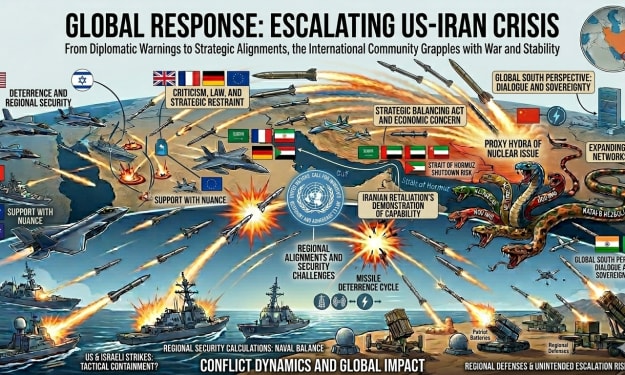
The Middle East Question: Power, Peace, and Double Standards In recent years, the conflict in the Middle East has once again raised serious questions about global politics, justice, and the meaning of peace. Many observers around the world ask the same question: if powerful countries speak so often about peace and human rights, why did they remain silent when violence and suffering were happening earlier?
By Wings of Time 8 months ago in History
Eighty-year-olds produce twice as many new neurones than their counterparts.
Even in their 80s, some people are still able to think clearly and quickly as they would have decades ago. According to a recent study, their brains may be producing more new neurones than the majority of their classmates.
By Francis Dami8 months ago in History
I found the history of Death that produced the AI that I have found
If someone you love died tomorrow, would you want to continue communicating with them? Not through memories or stored messages, but through artificial intelligence — a chatbot that uses their texts, emails, and voice notes to respond in their own tone and style. A growing number of tech companies are now offering such services as part of the “digital afterlife” industry, which is worth more than £100 billion, and some people are using it as a way to cope with their grief. Jenny Kidd of Cardiff University has led research into the so-called death of robots, published in the Cambridge University Press journal, Memory, Mind and Media, and described the results as “both fascinating and educational.” Attempts to communicate with the dead are nothing new. From séance rituals to spiritual mediumship, similar practices have existed for centuries. However, as technology advances, AI has the potential to make these arguments more convincing and much easier to implement on a large scale. In 2024, James Vlahos told the BBC how he recorded his father’s voice and created an AI chatbot after receiving the devastating news that he had cancer and would soon die. He described how wonderful it was to keep her memory alive, and while it didn’t take away the pain of her death, he added: “I have this incredible body of interactive information that I can draw on.” Grief support groups in the workplace say they have not seen widespread use of deathbots, but rather curiosity from people. “These killer robots and AI devices will only be effective to the extent that the information given to them is accurate,” said founder Jacqueline Gunn. “They don’t grow or adapt like grief does. For some people, they may offer a stepping stone, but they are not the end goal.” “Grief is a deeply personal human response to death that requires time, understanding, and human connection.” Working with Eva Nieto McAvoy from King’s College London and Bethan Jones from Cardiff University, Kidd researched how this technology works in practice.
By Jejak Kabar Dunia8 months ago in History
She Was Admired by Many, Accepted by None
Literature often serves as a mirror reflecting the truths that society prefers to ignore. Among the masterpieces of Urdu fiction, Umrao Jaan Ada stands as a powerful exploration of identity, dignity, and social hypocrisy. Written by Mirza Hadi Ruswa in the late nineteenth century, the novel remains one of the earliest and most influential psychological narratives in South Asian literature.
By hamad khan8 months ago in History
Holy Communion began as a meal and evolved into crackers and grape juice
Communion began with the Last Supper Luke 22:19 KJV-And he took bread, and gave thanks, and brake it, and gave unto them, saying, This is my body which is given for you: this do in remembrance of me.
By Cheryl E Preston8 months ago in History