Events
Marvel Doesn't Have to Try So Hard: Why Thunderbolts Signals a Promising Shift
For years, the Marvel Cinematic Universe (MCU) has operated on a seemingly unwavering principle: bigger is better. Each phase escalated in scale, culminating in universe-altering events with casts of dozens and stakes that threatened all of reality. While these grand narratives have undeniably delivered moments of thrilling spectacle, a sense of fatigue has begun to settle in for some viewers. The sheer weight of interconnected storylines and the constant pressure to raise the stakes have occasionally overshadowed character development and nuanced storytelling.
By Arif Islamabout a year ago in History
The title of the article in English is: The Power of Words: Stories of How Our Language Shapes Our World.
The Power of Words: Stories of How Ou Language Shapes Our World Hey friend, have you ever really thought about the amazing power our words hold? They're not just sounds that come out of our mouths or letters we scribble on paper or a screen. To me, words are more like tiny seeds that we plant in the minds and hearts of others. They can grow into towering trees or troublesome weeds, depending on the kind of seed we choose.
By Omar Mohammed about a year ago in History
Trump mocks trans athletes in women's sports to roaring applause at Alabama commencement speech. AI-Generated.
The reported incident of Donald Trump mocking transgender athletes during a commencement speech in Alabama aligns with his longstanding public stance on the issue, though specific details of such a speech would require verification against recent events (post-October 2023, beyond my knowledge cutoff). Here's a contextual summary based on his known positions and the broader debate:
By Sazidul Islam about a year ago in History
A VIDEO CAN SAVE MILLIONS OF LIVES
A Video Can Save Millions of Lives! A few days ago, I attended a student conference in Canada. Among the speakers was a cheerful French gentleman. His speech was engaging, and after the session, I even had the chance to take a selfie with him. That man was none other than Jerome Jarre—an internet celebrity known for using social media to bring about positive change. I didn’t think much of it back then. But what happened later made me realize the true power of a single video. Not long after that conference, a video started spreading rapidly on the internet. It was about the humanitarian crisis in Somalia. When I watched it, I immediately recognized the person in the video—it was Jerome! He was talking about the famine in Somalia and urging people to act. I felt deeply inspired. In a world where social media are often used for entertainment, Jerome used them for a revolution. 1. Somalia’s Cry for Help Somalia, a country in Africa, has long been known for its suffering due to civil war, poor governance, and famine. At the time of Jerome’s video, more than half of Somalia’s population was starving. The situation was critical—people were dying from hunger and lack of water. One such news of a child's death due to thirst reached Jerome, and it moved him deeply. Jerome didn’t sit idle. He started researching online to find ways to help. Shockingly, he found that the country had only one operating airline—Turkish Airlines. That gave him an idea. If he could partner with the airline, he could deliver aid directly to Somalia. 2. The Power of a Hashtag Jerome made a video appealing to the world to help Somalia. He ended the video with a hashtag: # Turkish Airlines Help Somalia. It wasn’t just a hashtag—it was a spark. The message went viral. Other influencers and celebrities joined in, sharing the video and encouraging action. Social media, often blamed for wasting time, have become a tool for global awareness and support. 3. A Surprising Turn of Events Amazingly, Turkish Airlines responded! They contacted Jerome and agreed to offer one of their cargo planes free of charge to fly supplies to Somalia. The plane could carry up to 60 tons of aid. But there was a problem—filling that cargo with food and essentials would cost a lot of money. Where would they get it? 4. Crowdfunding with a Purpose Jerome made another video explaining the opportunity and the challenge. He called upon the global community to donate and help fill the cargo plane. The response was overwhelming. The goal was to raise 1 million dollars in 15 days—but the campaign exceeded expectations. In just 3 days, they raised 2 million dollars, nearly 16 crore Bangladeshi taka! With that money, they purchased tons of dry food and supplies to send to Somalia. 5. Real Change, Real People This single act of kindness brought relief to thousands. Jerome didn’t just send food—he sent hope. He showed the world that if used wisely, social media can do more than entertain; they can save lives. Sometimes I look at the selfie I took with Jerome and wonder—what if we all tried a little harder to help others like he did? We may not be famous influencers. Our Facebook posts or Instagram stories might not go viral. But if we come together with a common goal, even ordinary people can bring extraordinary change. So, the question remains: Do you want to be a change like Jerome? If so, maybe it starts with a camera, a story, and the courage to care.
By Mohammad Sahidabout a year ago in History
Mike Waltz seen in photos using Signal app at White House after group chat scandal
Mike Waltz Spotted Using Signal App at White House After Group Chat Leak Sparks Controversy Congressman Mike Waltz was recently photographed using the encrypted messaging app Signal during a visit to the White House, sparking new conversations about digital privacy and communication security among lawmakers. The sighting comes in the wake of a recent group chat scandal involving leaked messages from a private conversation among Republican members of Congress. The controversy has heightened awareness of the risks of unsecured communication, pushing several lawmakers to reevaluate how they share sensitive information.
By GLOBAL NEWSabout a year ago in History
The Great Pyramid of Giza: Where Are All Its Architectural Documents?
The Puzzle of the Ages The Great Pyramid of Giza, standing majestically on the edge of the Egyptian desert, has captured the imagination of humanity for millennia. It is the last of the Seven Wonders of the Ancient World still standing, its stone blocks echoing with the whispers of a forgotten civilization. Despite its grandeur, one key piece of the puzzle has always been missing: the architectural documents that explain how it was built.
By The Secret History Of The Worldabout a year ago in History
The Mongol War Machine: The Largest Imperial Army in History
The Power of the Mongols: The Largest Military Force of an Empire in History The Mongol Empire, established by the renowned Genghis Khan in the 13th century, formed the largest uninterrupted land empire in recorded history. At its zenith, the empire commanded a military force exceeding one million soldiers recruited from various regions throughout Eurasia. This article delves into the formation, organization, and operational excellence of the Mongol military, which facilitated conquests spanning from China to Europe. We analyze the origins, tactics, and enduring impact of the largest imperial army ever witnessed. Introduction: Constructing an Empire from the Steppes In the early 13th century, a nomadic warrior named Temujin, later recognized as Genghis Khan, unified the Mongolian tribes of Central Asia and embarked on a military campaign that would profoundly alter the world. Within a few decades, the Mongols established the largest uninterrupted land empire in history, extending from the Pacific Ocean in the east to the heart of Europe in the west. Central to this swift expansion was the Mongol armya military apparatus unparalleled in its composition, defined by discipline, mobility, and exceptional organization. At its peak, the Mongol Empire commanded an army estimated to comprise between 700,000 to 1,000,000 troopsa staggering figure for its era, particularly when considering the population base of the empire. Origins and Composition of the Mongol Army The Mongol army was initially formed from the tribal warriors of the Mongolian steppe. These fighters were proficient horsemen and archers, trained from a young age to navigate and combat in challenging terrains. Genghis Khan implemented groundbreaking military reforms that converted these tribal factions into a professional and highly loyal combat force. Key characteristics of the Mongol army's structure include: Decimal System: Soldiers were arranged into units of 10 (arban), 100 (zuun), 1,000 (mingghan), and 10,000 (tumen). Each unit had a leader, with rigorous discipline enforced. Merit-Based Leadership: Genghis Khan advanced generals based on competence and loyalty rather than noble lineage. This fostered effective leadership and cohesion. Multi-ethnic Recruitment: As the empire grew, the Mongols integrated conquered populations into their ranks, including Chinese engineers, Persian physicians, and Turkic warriors, significantly enhancing their capabilities. Mobility and Strategy: The Cornerstone of Mongol Success What rendered the Mongol army particularly formidable was not only its size but also its mobility and strategic acumen. Mongolian cavalry could cover up to 100 miles daily, affording them an incomparable advantage in speed and surprise. They employed a blend of feigned retreats, encirclement, and psychological warfare to overcome significantly larger and better-equipped forces. Some of their notable strategies included: Feigned Retreats: Simulating withdrawal to lure adversaries into a trap. Coordinated Invasions: Striking multiple targets simultaneously across extensive distances. Intelligence Networks: Utilizing spies and scouts to collect vital information prior to engagements. Terror as Warfare: Employing extreme brutality to intimidate other cities into capitulation without resistance. These tactics enabled the Mongols to triumph over major powers such as the Khwarezmian Empire, the Jin Dynasty, and even segments of the Kievan Rus and the Islamic Caliphates. Campaigns Across Continents The Mongol army's operations were extensive and unyielding. Under Genghis Khan and his successorsÖgedei, Möngke, and Kublai Khanthe empire proliferated in every direction: China: The Mongols engaged in protracted conflicts against the Jin and Song dynasties, ultimately establishing the Yuan Dynasty in 1271 under Kublai Khan. Middle East: They dismantled the formidable Khwarezmian Empire and subsequently plundered Baghdad in 1258, concluding the Islamic Golden Age. Europe: The Mongol incursion into Europe reached Poland and Hungary in the 1240s, vanquishing large forces with smaller, more agile troops. Southeast Asia and Japan: Although they faced failures, the Mongols initiated campaigns in Vietnam, Java, and even launched attempts to invade Japan. Decline and Legacy of the Mongol Military In spite of their remarkable accomplishments, the Mongol army could not sustain its unity indefinitely. Following Kublai Khan's demise in 1294, the empire splintered into distinct khanatesthe Yuan in China, the Golden Horde in Russia, the Ilkhanate in Persia, and the Chagatai Khanate in Central Asia. Each operated its own military, and internal strife undermined the once-cohesive Mongol war apparatus. Nevertheless, the influence of the Mongol army endured: They transformed warfare through mobility, logistics, and psychological strategies. Their empire promoted commerce across Eurasia, contributing to the Pax Mongolica and the growth of the Silk Road. They fostered cross-cultural exchanges, introducing innovations such as gunpowder and printing, along with advancements in astronomy and medicine. Conclusion: The Greatest Imperial Army The Mongol Empire's military was not only the most extensive assembled by a single empire in historyit was also among the most efficient, feared, and strategically sophisticated. It altered the trajectory of world history, redefined civilizations, and left a legacy of both reverence and dread. Genghis Khan’s ambition for global supremacy may have diminished, yet the strength of his imperial army endures as a symbol of unmatched military success.
By Say the truth about a year ago in History
The Largest Army in History: Global Mobilization During World War II
The Largest Military Force Ever Assembled: The Grand Mobilization of World War II Throughout history, numerous empires and nations have raised formidable military forces, but none rivals in magnitude and extent to the worldwide mobilization during World War II. This article examines how the world’s largest military force was established, with over 100 million individuals enlisted, and how this extraordinary military endeavor influenced not just the conflict’s resolution but the entire trajectory of the 20th century. From Nazi Germany’s Blitzkrieg units to the Soviet Union’s Red Army and America's industrially driven military prowess, the narrative of the largest army ever deployed is one of ambition, sacrifice, and transformation.
By Say the truth about a year ago in History
Red Over the Fields: Why May Day Still Matters
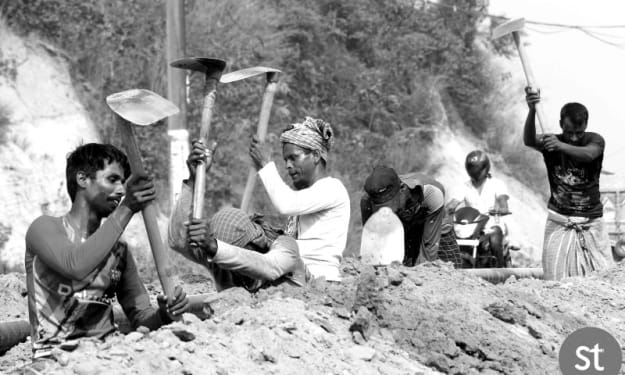
🌿 Introduction On May 1st, the world pauses—if only briefly—to remember the hands that build, carry, till, sew, and serve. But do we truly see the people behind the work? Or has May Day become just another date on the calendar, stripped of its struggle, reduced to hashtags and hollow statements?
By Chowdhury Kabirabout a year ago in History
Letters From a Locked Drawer
The Drawer No One Touched In the quiet town of Meadowridge, 16-year-old Clara Wren lived with her father in an old, creaky house full of memories. Her mother had passed away when Clara was just a baby, and the only thing left of her was an antique wooden desk in the attic. It had belonged to her mother, and on that desk sat a single drawer locked tight for as long as Clara could remember.
By Muhammad Hayatabout a year ago in History