Events
“India and Pakistan: A Conflict Rooted in History”
The conflict between India and Pakistan began in 1947 when British India was divided into two countries: India and Pakistan. The division was based on religion, with India becoming a secular state with a Hindu majority, and Pakistan created as a homeland for Muslims. This division, called the Partition, caused mass displacement and violence. Around one million people died, and about 15 million were forced to leave their homes.
By Whispers of Yousafabout a year ago in History
The Phantom Fleet of the Indian Ocean: Lost Ships and Forgotten Fortunes
The Golden Phantom of the Baltic: The Abandoned Wreck of the Vasa Treasure Fleet Beneath the frigid, turbulent waters of the Baltic Sea resides a conundrum that has perplexed scholars and treasure seekers for ages: the destiny of the Vasa Treasure Fleet. Thought to be filled with gold, gems, and invaluable wartime artifacts of the Swedish Empire, the fleet's abrupt vanishing during a tempest ignited tales of a gilded phantom vessel that still roams the depths. This article delves into the origins of the Vasa Fleet, its disastrous final journey, and contemporary endeavors to reveal its elusive richesunfolding a chilling narrative of imperial aspiration, maritime catastrophe, and persistent enigma. Prompt for image generation: "A lifelike depiction of three substantial, wooden three-masted vessels from the 17th century navigating a fierce Baltic Sea storm. The central vessel is embellished with golden carvings, its sails straining against the gales, while ominous thunderclouds swirl above. A faint radiance pierces through the sky, illuminating the waves and the fleet. " Zheng He was an extraordinary admiral. Born as Ma He in Yunnan to a Muslim family, he was seized by the Ming army and subsequently castrated, becoming a eunuch attendant in the imperial palace. His intellect and fidelity garnered the confidence of the Yongle Emperor, who assigned him the command of a naval expedition unprecedented in China’s history. Zheng He’s armada consisted of enormous treasure shipsreferred to as baochuaneach potentially exceeding 120 meters in length, with multiple levels and watertight compartments. They transported commodities such as porcelain, silk, gold, and spices, as well as exotic creatures like giraffes and zebras back to China. His seven voyages extended to Southeast Asia, India, Sri Lanka, the Arabian Peninsula, and even East Africa. Each expedition solidified China’s supremacy on the seas. The final recorded voyage concluded in 1433, after which Zheng He is believed to have perishedpossibly at sea. The Eighth Voyage: Fact or Fiction? Chinese historical documentation makes no reference to an eighth voyage, yet oral traditions from the Malacca Sultanate, Java, and East Africa recount a final armada, larger than any preceding it. According to one such narrative, this ultimate fleet was laden not with tribute but with immense treasuresgold coins, imperial artifacts, jade seals, and celestial mapsmeant to be concealed in secret locations for safekeeping following the emperor's demise. One hypothesis suggests that the fleet departed clandestinely amid the political upheaval after Emperor Yongle's death, intending to conceal or protect the empire’s wealth from internal insurrection. Others assert that the voyage was commissioned by the emperor but was lost at sea, possibly due to a typhoon in the South China Sea or Indian Ocean. Clues from the Ocean Over the years, divers have unearthed ancient Chinese relics along atypical routesMing-era porcelain off the coast of Kenya, and substantial bronze coins near Sumatra and Madagascar. While some discoveries may result from normal trade, others indicate it could be evidence of a route traveled by a treasure convoy that strayed significantly off course.
By Say the truth about a year ago in History
The Golden Ghost of the Baltic: The Lost Wreck of the Vasa Treasure Fleet . AI-Generated.
The Golden Phantom of the Baltic: The Abandoned Wreck of the Vasa Treasure Fleet In the obscure depths of the Baltic Sea rests one of Northern Europe’s most enigmatic maritime legendsa narrative of royal aspiration, national pride, and a submerged fortune. The account of the Vasa treasure fleet and the immense wealth lost beneath the waves illustrates a vivid portrayal of Sweden’s imperial ambitions during the 17th century. This article explores the history of the Vasa warship, the kingdom it served, and the ongoing quest for the elusive riches once intended to finance a Swedish empire. An Ascendant Power in the North In the early 1600s, Sweden emerged as an ascendant power under King Gustavus Adolphus, who aimed to transform his nation into a European empire. Having inherited a relatively modest kingdom, Gustavus Adolphus heavily invested in military advancements and naval expansion. Central to his aspirations was the Vasaan elaborate and heavily armed warship constructed to project Swedish supremacy across the Baltic and beyond.
By Say the truth about a year ago in History
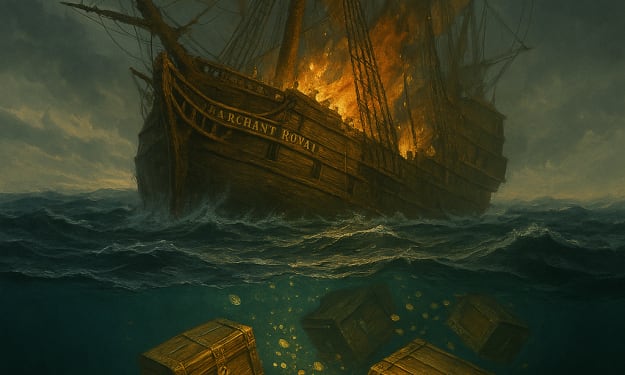
The Vanished Treasure of the Merchant Royal: The Lost Fortune of England’s Sunken Galleon
The Merchant Royal: England’s Treasure Ship In the early 17th century, England’s naval power was growing, but it still lacked the colonial riches of Spain and Portugal. However, one ship—the Merchant Royal—would momentarily carry a fortune that rivaled any Spanish treasure fleet. Built in 1627 in London, the Merchant Royal was a 700-ton galleon owned by English merchants and captained by John Limbrey. The ship primarily sailed between England and the Spanish colonies in the Americas, trading goods for silver and gold. The Merchant Royal became famous not only for its size but for the value of its cargo. By the early 1640s, Spain was struggling to ship its wealth from the Americas back to Europe due to piracy and naval warfare. English ships like the Merchant Royal stepped in to help transport Spanish wealth in exchange for political and financial favors. The Ill-Fated Voyage of 1641 In 1641, after completing a successful trade voyage to the Spanish colonies in Mexico, the Merchant Royal docked at the port of Cadiz. There, she took on an extraordinary cargo of treasure—reportedly including 100,000 pounds of gold, 400 bars of Mexican silver, and countless pieces of jewelry and coinage. This cargo was being transported to Antwerp, Belgium, as payment for Spain’s debts. However, disaster struck. After setting sail from Cadiz toward Falmouth, England, the ship began to leak while traveling through stormy seas. Reports say the pumps failed to keep up with the water pouring in. Off the coast of Cornwall, near the Isles of Scilly, the Merchant Royal sank beneath the waves, dragging its unimaginable wealth to the seafloor. Of the estimated 80 crew members aboard, only around 40 were rescued by a companion ship, the Talbot. The rest, along with the galleon and her priceless cargo, were lost forever. The Value of the Lost Treasure The treasure on board the Merchant Royal was vast. Modern estimates put its worth at over $1.5 billion, which would make it one of the largest lost fortunes at sea. The cargo included: 100,000 pounds of gold (bullion and coins) 400 silver ingots Rubies, emeralds, and other precious stones Gold jewelry and religious artifacts This enormous wealth was insured by Spain and partially backed by English merchants, creating a political and financial scandal after its disappearance. Search and Myth For centuries, treasure hunters, salvagers, and adventurers have tried to locate the wreck of the Merchant Royal, but the ship has never been officially discovered. The waters off Cornwall are treacherous, with strong currents, rocky seabeds, and poor visibility. Many claim to have found pieces of treasure in the area, but no definitive proof has emerged. The legend of the Merchant Royal continues to attract explorers, and every few decades a new wave of interest surges. In 2007, a company called Odyssey Marine Exploration announced the recovery of over 500,000 silver coins from a wreck they nicknamed the “Black Swan.” Initially, many speculated it was the Merchant Royal, but further analysis suggested otherwise. Modern Expeditions and Technology Today’s search for the Merchant Royal has become more sophisticated. Underwater drones, sonar scanning, and deep-sea mapping have replaced traditional diving. In 2019, Royal Navy divers searching for a crashed aircraft off the Cornish coast stumbled upon a shipwreck with 17th-century artifacts—but it was not confirmed to be the Merchant Royal. The British government, salvage firms, and historical societies have debated the legal rights to the treasure. If discovered, the ship’s contents would likely trigger a complex international legal battle involving claimants from Spain, the UK, private salvage companies, and descendants of the original stakeholders. Legacy and Cultural Impact The Merchant Royal is more than a lost treasure; it is a symbol of ambition, maritime risk, and the turbulent economics of colonial Europe. Its story has inspired documentaries, novels, and folklore throughout England. Often referred to as “the El Dorado of the Deep,” the ship’s legend grows stronger with every generation of treasure hunters who search the sea for her glittering prize. Even if the Merchant Royal is never found, its tale remains an enduring chapter in maritime lore—one that stirs dreams of golden fortunes hidden just beneath the waves. Would you like an image showing the sunken galleon beneath the ocean or a depiction of it at sea before it sank?
By Say the truth about a year ago in History
Cato the Elde
Marcus Porcius Cato, often referred to as Cato the Elder or Cato the Censor, was a significant figure in the Roman Republic, embodying the values, conflicts, and changes of an emerging Rome. Born in 234 BCE in Tusculum, a small town located southeast of Rome, Cato hailed from a humble plebeian background. However, through his military skill, political resolve, and strong adherence to traditional Roman values, he established himself among the prominent figures in Roman history. His literary works and public endeavors offer essential perspectives on the early identity and principles of the Roman Republic.
By A Históriaabout a year ago in History
Retro Jeans | From Workwear to Cultural Icon.
The Story Behind the Fabric That Never Fades. A Stitched Legacy: The Birth of Denim The story of jeans began in 1873 when Levi Strauss, a Bavarian immigrant in San Francisco, partnered with tailor Jacob Davis to patent a new kind of durable pants made from denim fabric, reinforced with copper rivets. These were designed specifically for miners and workers during the California Gold Rush.
By Sayed Zewayedabout a year ago in History
1945: The Syrian Crisis That Nearly Sparked War Between Britain and France
I. The Decline of French Colonial Power World War II inflicted a severe blow to French colonial authority. After decades of expanding its empire, France faced a humiliating defeat by Nazi Germany in 1940, leading to the establishment of the Vichy regime. Although Free French forces, led by Charles de Gaulle, continued to fight alongside the Allies, France's global influence was significantly diminished. In the Levant, France maintained control over Syria and Lebanon under a League of Nations mandate established after World War I. Despite earlier promises of independence, France was reluctant to relinquish its hold on these territories. This resistance to decolonization set the stage for the 1945 crisis. --- II. Rising Nationalism and Tensions in the Levant As World War II drew to a close, nationalist sentiments surged across the Middle East. In Syria and Lebanon, demands for independence intensified. The presence of French troops and administrators became increasingly unpopular, leading to widespread protests and civil unrest. In May 1945, demonstrations erupted in Damascus and other Syrian cities. These protests were met with violent suppression by French forces, resulting in numerous casualties. The situation escalated rapidly, with reports of French troops firing on civilians and using heavy artillery against populated areas. --- III. The French Military Response On May 29, 1945, French forces launched a brutal assault on Damascus. They shelled the city, targeting government buildings and residential neighborhoods. The Syrian parliament was bombarded, and attempts were made to arrest President Shukri al-Quwatli, who narrowly escaped. The French also cut off electricity and communication lines, effectively isolating the city. The French military actions resulted in significant destruction and loss of life. Estimates suggest that hundreds of Syrians were killed, and many more were injured. The use of Senegalese colonial troops by the French further inflamed tensions, as these forces were accused of committing atrocities against civilians. --- IV. British Intervention and the Brink of War The British government, under Prime Minister Winston Churchill, was alarmed by the French actions in Syria. Concerned about regional stability and its own interests in the Middle East, Britain decided to intervene. Churchill authorized General Bernard Paget to deploy British forces from Transjordan into Syria to halt the French offensive. On May 31, 1945, British troops entered Damascus and confronted the French forces. They demanded an immediate ceasefire and the withdrawal of French troops to their barracks. The British intervention effectively ended the French assault and prevented further bloodshed. The crisis brought Britain and France to the brink of war. Diplomatic relations between the two nations were severely strained, with accusations and recriminations exchanged. However, the British action was widely supported by the international community, which viewed the French response as excessive and unjustified. --- V. The Path to Syrian Independence Following the crisis, international pressure mounted on France to relinquish its control over Syria and Lebanon. The newly formed United Nations and the Arab League both advocated for the independence of the Levantine states. Facing isolation and condemnation, France agreed to negotiate a withdrawal. By April 1946, the last French troops had left Syria, marking the end of the French mandate. Syria declared its independence on April 17, 1946, and was subsequently recognized by the international community. Lebanon also achieved full independence during this period. --- VI. Legacy and Historical Significance The 1945 Syrian crisis highlighted the declining power of European colonial empires and the rise of nationalist movements in the post-war era. It underscored the importance of international diplomacy and the role of emerging global institutions in resolving conflicts. The events also strained Franco-British relations and influenced future decolonization efforts across the Middle East and beyond. The crisis serves as a reminder of the complexities of colonial legacies and the struggles faced by nations seeking self-determination. It remains a pivotal moment in Syrian history and a significant episode in the broader narrative of decolonization. --- Written by: Ikram Ullah
By Ikram Ullahabout a year ago in History
Pope Leo XIV calls Church 'a beacon to illuminate dark nights' in first mass. AI-Generated.
In his first official mass at the Vatican, newly elected Pope Leo XIV delivered a powerful sermon calling on the Catholic Church to confront a growing lack of faith in modern society. Addressing the congregation in the Sistine Chapel, the 267th pontiff, who is the first American to lead the Church, expressed concerns about people turning away from faith and instead placing their trust in technology, money, power, and pleasure.
By Md Nafis Ibn Kamalabout a year ago in History