Events
Elon Musk's interesting life story. Content Warning.
Early Life and Education Born on June 28, 1971, in Pretoria, South Africa, Elon Musk was the eldest of three children. His mother, Maye Musk, was a Canadian model and dietitian, and his father, Errol Musk, was a South African electromechanical engineer. From a young age, Musk exhibited a keen interest in computing and technology. At age 12, he developed and sold a video game called Blastar for $500.
By Himanish Royabout a year ago in History
99-million-year-old dinosaur tail found preserved inside amber fossil
**99-Million-Year-Old Dinosaur Tail Found Preserved Inside Amber Fossil** In one of the most extraordinary paleontological discoveries of the 21st century, scientists have uncovered a 99-million-year-old dinosaur tail preserved in amber. This rare and stunning find, unearthed in Myanmar, has provided researchers with a unique glimpse into the ancient world, revealing incredible details about feather evolution, dinosaur biology, and the ecosystems of the Cretaceous period.
By GLOBAL NEWSabout a year ago in History
Not One More Bomb
Port Chicago, California – July 17, 1944 The metal vibrated beneath my boots. There was a constant rumble—freight cars groaning as they pushed toward the pier, loaded to the brim with 1,000-pound bombs. The air reeked of salt, sweat, and explosives. My hands were shaking a little, but nobody said a word. Not here. We were Black. We were sailors. We were meant to obey.
By Alain SUPPINIabout a year ago in History
Creative Cruelties
I could not choose one specific moment that history would burn, so I highlighted a few. Each one deserves a more indepth look, for us to appreciate where we come from. But each one also is more than enough for us to know, without doubt, to be better.
By Kelli Sheckler-Amsdenabout a year ago in History
Silent Rebellion
Silent Rebellion Bengalen, 1930 was 1930. The grip of the British Empire was still iron, but the fire was still on fire in the heart of villagers, students and poets. Among them was a young bar - 16 years old - Annealvan, from a quiet village near the banks of the Padma River.
By MD. zahid prantoabout a year ago in History
Joe Biden. AI-Generated.
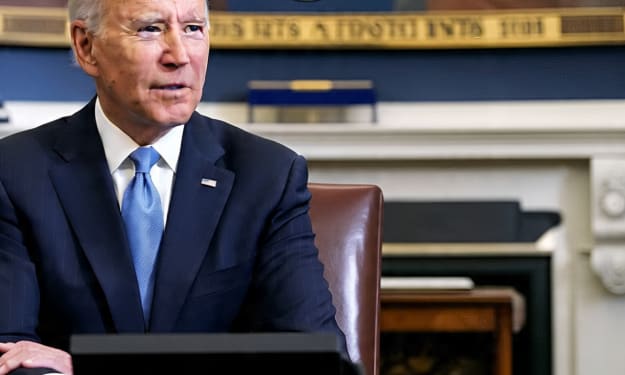
Joe Biden was born on November 20, 1942, in Scranton, Pennsylvania, a small city in the United States. He grew up in a working-class family. His father, Joseph Biden Sr., worked very hard to take care of the family. At times, the family had little money. But they stayed strong and close together.
By Khalil Rehmanabout a year ago in History
The Golden Hoard of Bactria: Afghanistan’s Lost Treasure of the Nomads :. AI-Generated.
The Discovery of the Bactrian Gold In 1978, Soviet archaeologist Viktor Sarianidi spearheaded a team of scholars into the Sheberghan region of northern Afghanistan. Located merely 80 miles south of the Amu Darya River and adjacent to the borders of Turkmenistan and Uzbekistan, they unearthed a series of burial mounds locally referred to as Tillya Tepe, or “Hill of Gold. ” What they uncovered was nothing short of extraordinary: six intact gravesfive women and one mandating from the 1st century BCE. Each grave served as a time capsule containing intricate treasures made of gold, silver, ivory, and gemstones. Over 20,000 artifacts were excavated from the site, a collection now renowned as the Bactrian Gold. The burial customs and items revealed a narrative of a cultural melting pot. The craftsmanship showcased Greek, Persian, Indian, Chinese, and nomadic influences, reflecting Afghanistan's ancient role as a nexus of the Silk Road. Who Were the Bactrians? The treasure is thought to belong to the Yuezhi or Kushan nomads, possibly ruling elites from the Greco-Bactrian Kingdom or early Kushan Empire. These individuals flourished during a period of profound cultural amalgamation following Alexander the Great’s conquest of Central Asia. The tombs disclosed features of Hellenistic art: gold medallions adorned with Athena’s likeness, meticulously crafted laurel wreaths, and mythological designs. However, these were blended with Eastern motifssuch as solar disks and lotus blossomsdemonstrating how the elite assimilated symbols from diverse traditions to convey power and divinity. The Bactrian treasure was not merely ornamental jewelry and trinkets; it represented a declaration of status, diplomacy, and divine entitlement. Numerous pieces were ceremonial in nature: royal diadems, ornate belts, and even portable gold crownscrafted for nobility on the move. The Fate of the Treasure in Modern Times Afghanistan’s contemporary history is plagued by decades of conflict. Following its discovery, the treasure was relocated to the National Museum of Afghanistan in Kabul. However, during the Taliban's ascent in the late 1990s, the museum was subjected to looting, bombing, and vandalism. Many feared the Bactrian Gold was irrevocably lost. Remarkably, the treasure had been discreetly transferred to a secure underground vault beneath the presidential palace. Referred to as the “Presidential Palace Vault,” it was safeguarded by a small cadre of courageous Afghan officials who maintained its location, even under duress from the Taliban. It was not until 2003, following the collapse of the Taliban regime, that the world rediscovered the Bactrian Gold. An international group confirmed the security of the treasure, and it was exhibited to the public for the first time in decades. Since then, it has journeyed through France, the U. S. , Germany, Japan, and beyondrepresenting both Afghanistan’s glory and resilience. Highlights of the Treasure Some of the most renowned artifacts from the collection include: The Folding Gold Crown: A nomadic crown constructed of delicate gold leaves, capable of collapsing for transport. The Aphrodite Pendant: A Hellenistic medallion portraying the Greek goddess, adorned with semi-precious stones. Chased Belt Buckles: Illustrating mythological creatures, warriors, and ceremonial scenes. Ivory Carvings and Beads: Narrating tales of distant trade and cultural exchange. Coins and Ceramics: Providing insights into political alliances and economic activity. Each item signifies not merely beauty, but history, merging East and West in a manner that few collections can. The Estimated Worth Although no formal appraisal exists for the entire collectiondue to its distinctive historical and artistic importanceexperts estimate the Bactrian Gold exceeds a value of $100 million USD. Nevertheless, its cultural and symbolic significance is immeasurable. Unlike numerous treasures that have been plundered or sold on the black market, the Bactrian Gold remains complete and intact, a rarity for a region that has experienced considerable turmoil. Its preservation is a miracleand a testament to the dedication of those who safeguarded it during Afghanistan’s darkest times. Conclusion: A Legacy Buried and Rejuvenated The Bactrian Gold is more than an archaeological findit is a glimpse into a forgotten realm where nomads, kings, and conquerors exchanged ideas and luxuries along the Silk Road. It reflects Afghanistan’s golden era, far removed from the war-torn depiction of contemporary times. Today, Afghanistan continues to confront political instability. Yet, the Bactrian Gold conveys a compelling narrative: that greatness resides not solely in conquest, but in culture, and that beneath the sands of history lie stories of unity, beauty, and perseverance.
By Say the truth about a year ago in History
Supreme Egyptian Wealth Yet to Be Discovered: The Buried Tomb of Pharaoh Amenhotep I. AI-Generated.
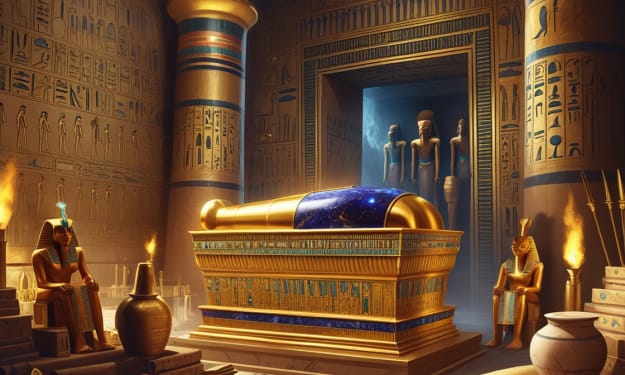
Introduction Egypt is emblematic of ancient wealthshimmering gold, revered tombs, and forgotten temples. Throughout the ages, archaeologists have uncovered monumental discoveries, from the Valley of the Kings to the Great Pyramids. Nonetheless, despite these achievements, many contend that the most significant Egyptian treasure remains concealed beneath layers of time: the lost tomb and pristine treasures of Pharaoh Amenhotep I. Amenhotep I governed approximately 1526–1506 BCE, during the early 18th Dynasty of the New Kingdom. Unlike the more renowned Tutankhamun, the burial site of Amenhotep has never been definitively located. This lost tomb is thought to be brimming with opulent items befitting a mighty pharaohgolden sarcophagi, ceremonial arms, funerary amulets, and perhaps a compendium of ancient scrolls. Who Was Amenhotep I? Amenhotep I was the progeny of Ahmose I, the initiator of the 18th Dynasty who expelled the Hyksos and reestablished Egypt’s unity. His reign epitomized a thriving epoch of temple edification, religious transformations, and cultural renaissance. Deified posthumously, Amenhotep was venerated as a deity of the afterlife for centuries. Given his divine stature and the veneration accorded to him by future rulers and priests, scholars surmise that his burial would have been sumptuous and symbolically significant. However, while several mummies were discovered relocated to the Deir el-Bahari cache in 1881 (including that of Amenhotep), no archaeologist has uncovered his original tomb. The Myth of the Concealed Tomb Numerous Egyptologists assert that Amenhotep’s tomb was formerly situated in the Valley of the Kings. Some hypothesize it was purposefully obscured to safeguard its contents from grave robbers, particularly during the 21st Dynasty when priests relocated royal mummies for their protection. However, documentation of the original tomb’s site was either lost or never chronicled. Certain narratives propose that the tomb was sealed within a sacred area of the Theban Necropolispotentially in an undiscovered wadi or concealed chamber. According to ancient writings and oral traditions, this tomb was adorned with rare blue faience tiles, alabaster walls, and filled with offerings from Nubia, Crete, and Mesopotamia. What Might the Treasure Encompass? If the tomb of Amenhotep I is discovered intact, it could easily rival, if not exceed, the wealth of Tutankhamun. Experts speculate that its contents may include: A Golden Sarcophagus: Presumably larger and more intricately designed than Tutankhamun’s, embellished with scenes of the afterlife and inlaid with precious gemstones. Chariots and Arms: Ceremonial combat equipment, shields, and bows inscribed with religious motifs. Jewelry and Amulets: Bracelets, collars, and rings crafted from gold, lapis lazuli, carnelian, and turquoise. Statues and Ushabti: Numerous or even countless servant figurines intended to aid the sovereign in the afterlife. Religious Artifacts: Hallowed relics, offering tables, ritual implements, and possibly primitive iterations of spiritual texts.
By Say the truth about a year ago in History
The Origin and Value of Tutankhamun’s Treasure: A Heritage in Gold
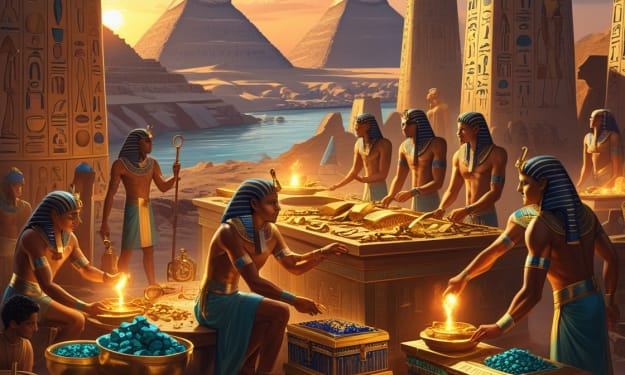
But from where did this vast treasure arise? Why was such wealth interred with a boy-king who perished around the age of 18 or 19? And what might be the current estimated worth of these treasures? This article investigates the origins, symbolism, and contemporary valuation of one of history’s most renowned caches. The Origin of Tutankhamun’s Treasure: Tutankhamun ruled during a turbulent epoch in ancient Egyptian history. His predecessor, Akhenatenthought to be his fathersought to transform Egypt’s faith by advocating the veneration of a singular deity, Aten, the sun disk, over the customary pantheon of gods. This monotheistic initiative disrupted Egyptian society, governance, and religious life. Following Akhenaten’s passing, the young Tutankhamun ascended to the throne and endeavored to reinstate Egypt’s traditional beliefs and institutions. Although his reign was short-lived (circa 1332–1323 BCE), it signified a revival of political stability and religious orthodoxy. As part of this restoration, considerable efforts were made to affirm his divine legitimacy and kingship. This political and spiritual rejuvenation may elucidate the grandeur of his intermentthe treasure was intended not merely to commemorate a king but to symbolize the resurgence of the Egyptian order. Numerous historians contend that a substantial portion of Tutankhamun’s burial artifacts may have been repurposed or inherited from preceding royal interments. Some relics discovered in his tomb feature inscriptions or designs that imply they initially belonged to otherspossibly even his stepmother Nefertiti or his father Akhenaten. This hypothesis is reinforced by evidence of hastily crafted or modified items within the tomb, indicating that the burial was orchestrated swiftly and perhaps under duress following the king’s unforeseen demise. Contents of the Treasure: The tomb of Tutankhamun housed over 5,000 artifacts, including: The Golden Death Mask: Constructed from solid gold and adorned with lapis lazuli, quartz, obsidian, turquoise, and colored glass, this emblematic mask alone is believed to weigh over 10 kilograms and symbolizes the divine countenance of Osiris. Three Nested Coffins: The innermost coffin, entirely fashioned from solid gold and weighing approximately 110 kilograms, enclosed the mummy of the pharaoh. Chariots, Furniture, and Thrones: Many of these were inlaid with ivory, ebony, and precious metals, serving ceremonial functions in both life and the afterlife. Canopic Shrine and Jars: Utilized to contain the pharaoh’s internal organs, these items were also crafted from gold and alabaster and elaborately decorated. Statues and Figurines: Representing deities, guardians, and the king himself. Jewelry and Amulets: Necklaces, rings, armlets, and earrings made of gold, semi-precious stones, and glass. Weapons and Shields: Encompassing daggers, bows, and a curved sword (khopesh), frequently ceremonial yet emblematic of sovereign authority. Symbolism and Purpose: Every item within Tutankhamun’s burial site fulfilled a distinct spiritual function. The ancient Egyptians held a belief in the afterlife as a continuation of terrestrial existence. To guarantee a seamless transition and sustenance in the subsequent realm, the monarch required all the implements, provisions, furnishings, and magical safeguards he could transport with him. The items were not solely ornamental; they symbolized a spiritual safety net. Estimated Net Worth of the Treasure: Assigning a contemporary financial value to such artifacts is intricate. Numerous items are deemed invaluable owing to their cultural, artistic, and historical significance. Nevertheless, for the purpose of estimation: The golden death mask may possess a value exceeding $2 million based solely on gold weight, but in the art market, its symbolic and historical significance could elevate it to $100–$200 million, if such a transaction were even plausible. The solid gold inner coffin, weighing 110 kg, could be appraised at $6 million according to current gold valuesbut once more, its true worth in cultural terms is far greater. Jewelry and statues, considering craftsmanship and materials, could collectively range from $50–100 million. Furniture, chariots, and ceremonial artifacts might attract another $50–100 million, contingent on intricacy and condition. In total, the net estimated financial value of Tutankhamun’s treasure could surpass $750 million to $1 billion, although this figure remains conjectural and is confined to material worth, not cultural or historical significance. Conclusion: Tutankhamun’s treasure serves as a magnificent testament to the splendor of ancient Egypt, yet it represents more than merely a compilation of gold. It narrates the saga of a civilization’s religious convictions, political turbulence, artistic brilliance, and veneration for death and the divine. The origin of his treasure is as political and spiritual as it is economica royal legacy molded by centuries of tradition and the necessity to validate a tenuous reign. While contemporary evaluations of worth endeavor to quantify the immeasurable, the legacy of Tutankhamun’s tomb remains a priceless glimpse into the ancient world.
By Say the truth about a year ago in History
The Legacy of the Boy King: Unveiling the Treasure of Tutankhamun's Tomb
The Discovery that Resounded Globally In 1922, British archaeologist Howard Carter, supported by Lord Carnarvon, made an astounding discovery in Egypt's Valley of the Kings. After years of digging in challenging conditions with little fortune, Carter's tenacity ultimately bore fruit when he uncovered a staircase leading into the sands. At the base of these steps was a sealed doorinscribed with royal cartouches indicating it belonged to Tutankhamun, a relatively obscure pharaoh of the 18th Dynasty. Behind the entrance lay a tomb virtually unspoiled for more than three millennia. It was one of the most preserved royal tombs ever located in Egypt. Upon glancing inside with a candle, Carter famously proclaimed: “Yes, marvelous things! ” What he observed was not merely a burial siteit was a resplendent chamber of unimaginable opulence. The Myth of Tutankhamun Tutankhamun (ruled circa 1332–1323 BCE) took the throne at merely nine years of age and passed away around the age of 18. He governed during a tumultuous era in Egyptian historyshortly following the controversial reign of Akhenaten, who had sought to revolutionize Egypt’s religion by venerating a singular deity, Aten. Tutankhamun utilized his brief reign to restore traditional religious customs and stabilize the realm. Despite his relatively minor standing in Egyptian history, his notoriety surged in the 20th century, not because of his accomplishments, but owing to the astonishing bounty discovered in his tomb. The Tomb: Chambers of Gold The tomb of Tutankhamun, officially designated KV62, is modest in comparison to other pharaohs’ burial sites, likely a result of his unexpected demise and expedited burial. Nevertheless, it was extravagant beyond belief. The tomb comprised four primary rooms: Antechamber Annex Burial Chamber Treasury Each room was brimming with treasures that showcased the magnificence of ancient Egypt and the religious convictions of the era. A Glimpse Inside: What Was Discovered? Over 5,000 artifacts were cataloged from the tomb. Some of the most extraordinary items included: The Golden Death Mask: The most iconic artifact, crafted from solid gold and adorned with lapis lazuli, quartz, obsidian, and colored glass, weighing over 10 kg. It was positioned directly over the mummy's head and shoulders. The Nested Coffins: Three coffins encased the king’s mummified remains. The innermost coffin was constructed of solid gold. Canopic Shrine: A golden shrine that housed alabaster jars, which contained the pharaoh’s preserved internal organs. The Chariots: Several ceremonial and practical chariots were disassembled and interred within the tomb. Thrones and Furniture: Ornately embellished thrones, beds, and chairs demonstrated exceptional artistry and provided insight into daily royal existence. Weapons and Implements: Daggers (including one crafted from meteoric iron), bows, and other implements signify the pharaoh’s status as a warrior monarch. Ornaments: Necklaces, rings, bracelets, and pendants, frequently adorned with semiprecious stones. Figurines of Deities and Attendants: To guide and safeguard the pharaoh in the afterlife. The Enigma of the Treasury Chamber The Treasury housed some of the most sacred items in the tomb, including: Anubis Altar: A lifelike statue of the jackal-headed deity Anubis overseeing the tomb.
By Say the truth about a year ago in History
All the Light We Cannot See – Anthony Doerr
The sky over Saint-Brieuc was heavy with clouds, the kind that hung low and pressed against the roofs like a threat. Though the war had quieted in the north, its whispers still roamed the air—through radio static, cracked windows, and the wary glances of strangers.
By Jawad Khanabout a year ago in History
Gerrymandering the Presidency: Why Trump could lose the popular vote in 2020 by 6 percent and still win a second term.
Donald Trump was the clear Electoral College winner in the 2016 election, despite losing the popular vote by a wide margin to Hillary Clinton. Anthony J. McGann, Charles Anthony Smith, Michael Latner and Alex Keena write that, unless the Supreme Court stops congressional gerrymandering, President Trump can guarantee re-election in 2020 – even if he loses by 6 percent. When the US Supreme Court takes up the issue of partisan gerrymandering this year, they will decide not only the fate of popular control in the House of Representatives and many state legislatures, but quite possibly the Presidency as well. If four Republican controlled state governments (Pennsylvania, Michigan, Wisconsin and Florida) change the way they allocate Electoral College votes, President Trump could be re-elected in 2020, even if he loses the popular vote by 6 percentage points. All the states need do is to allocate Electoral College votes by congressional district (like Nebraska and Maine), instead of giving all of the state’s electors to the statewide winner. Of course, this strategy only works to the benefit of the Republicans because the congressional districts in these states are heavily gerrymandered. As we argue in our book Gerrymandering in America, the congressional districts in many states are drawn to advantage the Republican Party. For example, in Pennsylvania in 2012 the Republicans took 13 out of 18 House districts even though the Democrats received more votes. If this partisan gerrymandering were outlawed, then allocating Electoral College votes by congressional district in the four states would actually disadvantage the Republican candidate for President. However, if the Supreme Court continues to allow partisan gerrymandering – as it has since its decision Vieth v. Jubelirer in 2004 – then the plan is highly effective and there is nothing that can stop the four states adopting it. Allocating Electors by congressional district is clearly legal – Nebraska and Maine already do it this way. Furthermore, the Republicans control the state legislature and the governor’s mansion in all four states. How allocating Electors by congressional districts could benefit the Republican candidate Surprisingly, the strategy that is most effective for the Republicans is to change how Presidential Electors are allocated in certain states that voted for Trump in 2016. Of course, the Republicans would get an advantage by allocating Electors more proportionally in states that Clinton won. The problem is that this would require the support of Democrats. For example, Republican legislators in Virginia and Minnesota have already proposed such measures, and Stephen Wolf describes this as an attempt to “gerrymander the electoral college”. The problem is that both these states have Democratic governors, who would surely veto such proposals. Similarly Harry Enten at fivethirtyeight.com shows that if all states allocated Electors by Congressional districts, the Republicans could win the Presidency despite a 5 percent popular vote deficit. Again the problem is that this would require Democratic controlled states to agree to such a system. However, in Pennsylvania, Wisconsin, Michigan and Florida, Republicans control both the state legislature and the
By Silas Blackwoodabout a year ago in History