Events
The Wealthiest Empire in History: The Golden Heritage of the Mali Empire
The Foundations of the Mali Empire The Mali Empire was established circa 1235 AD by Sundiata Keita, who unified several smaller kingdoms following the decline of the Ghana Empire. Under Sundiata’s guidance, Mali evolved into a centralized entity with a formidable military and effective administration. Nonetheless, it was under his successors—most notably Mansa Musa (r. 1312–1337)—that the empire attained its pinnacle. Encompassing portions of contemporary Mali, Senegal, Gambia, Guinea, Niger, Nigeria, and Mauritania, the Mali Empire governed extensive territories and essential trade routes, including segments of the Sahara Desert. This positioned it to dominate trans-Saharan commerce, especially in salt, ivory, enslaved individuals, and most crucially—gold. Mansa Musa: The Most Affluent Individual in History Mansa Musa, the tenth sovereign of Mali, is frequently recognized as the most affluent person in documented history. His net worth, adjusted for inflation and current assessments, is approximated to exceed $400 billion USD. This fortune was not solely attributed to dominion over land but also the empire’s gold mines, which contributed more than half of the world’s gold during his reign. In 1324, Mansa Musa embarked on a renowned pilgrimage to Mecca (Hajj), an occasion that highlighted the immense scale of his empire’s riches. He journeyed with a caravan composed of: 60,000 individuals, 12,000 enslaved individuals conveying gold bars, 80 camels transporting hundreds of pounds of gold dust each. According to historians, he distributed so much gold in Cairo, Mecca, and Medina that it diminished the value of the metal, resulting in economic inflation in the region for over a decade. This singular incident established Mali—and Musa—as significant players on the medieval global landscape. Sources of Wealth
By Say the truth about a year ago in History
Echoes of a Broken Lyre
In the expansive and colorful landscape of 19th-century Brazilian literature, few voices echo with the same haunting beauty and emotional depth as that of Luís Nicolau Fagundes Varela. A poet of contrasts—both mystical and melancholic, patriotic and reflective—Varela's short yet brilliant career represented a pivotal moment in Brazil’s Romantic movement. Frequently eclipsed by his contemporaries such as Castro Alves and Álvares de Azevedo, Varela remains a profoundly human figure, whose poetry was influenced as much by personal sorrow as by the idealistic zeal of his era.
By A Históriaabout a year ago in History
"Trump Praises West Point Cadets, Takes Credit for U.S. Military Might in Commencement Address."
West Point, New York – Former President Donald J. Trump delivered the much-anticipated commencement address at the United States Military Academy at West Point. Trump lauded the graduating cadets and his own administration's record on military strength and defense spending at the same time.
By Daily Life about a year ago in History
Casimiro de Abreu
Casimiro José Marques de Abreu (1839–1860) was a brilliant yet tragically brief figure in Brazilian literature. A poet of deep sensitivity, he emerged as one of the most iconic voices of Brazil’s Ultra-Romantic movement, leaving a legacy of melancholic beauty despite his premature death at the age of 21. His poetry, marked by nostalgia, youthful yearning, and an almost childlike innocence, continues to resonate with readers, especially through his renowned work As Primaveras (1859) and the timeless poem Meus Oito Anos ("My Eight Years").
By A Históriaabout a year ago in History
The Creation of the World: A Bible Story of God’s Power and Love. AI-Generated.
In the very beginning, before time as we know it began, there was nothing but God—eternal, infinite, and full of love. The story of the Creation of the World, found in the Book of Genesis (1:1-2:3), is the foundation of the Bible, revealing how God brought everything into existence with His mighty word. This sacred account, believed to have occurred thousands of years ago, tells of the origins of the heavens, the earth, and all living things, showcasing God’s power, creativity, and purpose for humanity. Shared across generations, this story continues to inspire awe and gratitude for the world we live in today.
By David Andrewsabout a year ago in History
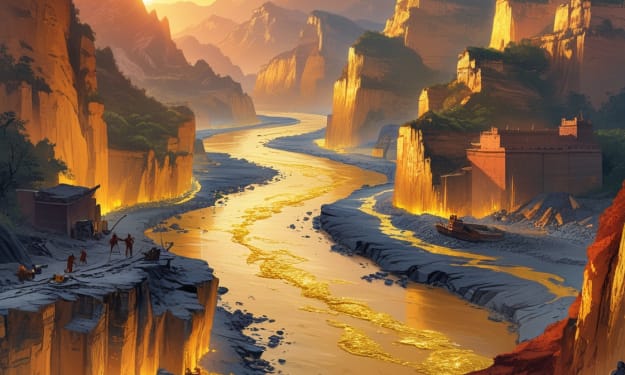
Beneath the Golden Tides: Revealing the Concealed Mineral Wealth of China's Yellow River. AI-Generated.
A River Shaping Through Epochs and Stone The Yellow River traverses a multitude of landscapes: towering mountains, fertile plains, loess plateaus, and desert basins. This journey has enabled it to carve into rock strata rich in minerals, revealing deposits that ancient civilizations soon learned to utilize. As early as the Shang Dynasty (c. 1600–1046 BCE), bronze metallurgy thrived along the river, with copper, tin, and lead extracted locally and crafted into weapons, ceremonial items, and tools. By the Han Dynasty (206 BCE – 220 CE), systematic mining had become prevalent in the Yellow River provinces, particularly in present-day Shaanxi, Shanxi, Henan, and Gansu. These regions evolved into hubs of iron production, mercury extraction, and gold panning. Inscriptions, historical documents, and artifacts indicate that mining was not only a skilled profession but also a foundation of regional economies. Wealth Beneath the Surface: Principal Minerals of the Yellow River The Yellow River basin is a mineralogical tapestry, showcasing a wide array of resources: Gold Gold-laden sands and rock veins are particularly abundant in Qinghai and Gansu, along the upper stretches of the river. In antiquity, gold was extracted from riverbeds; today, it is obtained through both surface and subterranean mining. Silver Silver is frequently discovered alongside gold or lead-zinc ores, particularly in the central basin. Historical accounts suggest that silver coins and artifacts were fabricated from locally sourced metal during the Tang and Song Dynasties. Coal Shanxi Province, located along the central Yellow River, stands as one of China’s most prosperous coal regions. With reserves amounting to hundreds of billions of tons, this area has been pivotal to China’s energy sector for over a century. Iron and Manganese Historically utilized for tools, weapons, and subsequently railways and factories, iron ore is significantly concentrated in Shanxi and Henan. Manganese, crucial in steel production, is also mined in adjacent regions. Copper, Lead, and Zinc These base metals have been extracted for centuries in Shaanxi and Gansu, powering early bronze industries and now underpinning contemporary electronics and manufacturing. Rare Earth Elements (REEs) While more prominent in southern China, northern Gansu and certain areas of Inner Mongolia along the river have been explored for REEs vital to electronics, magnets, and batteries. Salt and Potash The lower Yellow River delta has historically served as a source of salt, essential for food preservation, and potash, crucial for agriculture. Economic Assessment of the Yellow River’s Mineral Resources Determining the overall economic value of the Yellow River’s mineral resources is intricate, due to variable market rates, unidentified reserves, and ecological restrictions. Nonetheless, based on existing geological and industrial information: Gold: Estimated at 1,200 tons at approximately $70,000/kg = $84 billion USD Silver: Estimated at 20,000 tons at about $850/kg = $17 billion USD Coal: Over 260 billion tons in Shanxi, with recoverable coal valued at $200+ billion USD Iron Ore: Estimated reserves appraised at $100 billion USD Copper/Lead/Zinc: Cumulative estimates = $60 billion USD Rare Earths: Emerging deposits could be worth as much as $10 billion USD Total projected value: Approximately $471 billion USD These are conservative valuations and do not account for future discoveries or increasing values due to technological demand, particularly for rare earths and green energy metals.
By Say the truth about a year ago in History
The Golden Vein of China: History and Wealth of the Yellow River's Mineral Deposits
Historical Background The history of mining and mineral utilization in the Yellow River region can be traced back to ancient China, particularly during the Xia, Shang, and Zhou dynasties (2100–256 BCE). Early Chinese metallurgy predominantly relied on copper and tin for the creation of bronze tools, weapons, and ceremonial vessels. Archaeological discoveries from the Yellow River valley, especially within Henan and Shaanxi provinces, indicate that bronze mining and casting practices were highly developed as early as 1700 BCE. During the Han Dynasty (206 BCE – 220 CE), China commenced the extraction of a broader array of minerals, including iron, gold, and mercury, which found applications in everyday life as well as traditional medicine. Historical documents, such as The Records of the Grand Historian by Sima Qian, describe organized mining activities in the mountainous areas adjacent to the Yellow River. By the Tang and Song dynasties, more advanced techniques like deep shaft mining and hydraulic power facilitated enhanced utilization of mineral resources in the region. Key Mineral Deposits in the Yellow River Basin The Yellow River basin is endowed with a diverse assortment of minerals, attributable to its varied geological formations. Some of the most prominent mineral resources encompass: Gold and Silver The upper portions of the Yellow River in Qinghai and Gansu provinces are recognized for their gold-rich sands and quartz veins. Traditional panning techniques have been supplanted by contemporary large-scale open-pit and underground mining endeavors. Silver is commonly found in conjunction with gold and lead ores in the area. Iron Ore The Loess Plateau region, particularly in Shanxi, boasts plentiful iron deposits. These ores powered ancient blacksmithing industries and continue to sustain modern steel production. Coal Shanxi Province, situated in the mid-Yellow River basin, hosts some of China’s most abundant coal reserves, which generate a substantial portion of the country’s electricity and industrial output. The Datong and Taiyuan basins are particularly noteworthy. Copper and Lead-Zinc Deposits Primarily located in Gansu and Shaanxi provinces, these base metals are essential for electrical wiring, batteries, and industrial uses. Rare Earth Elements (REEs) While more concentrated in southern China, rare earth minerals have also been identified in small but valuable amounts in the Yellow River basin, especially in Gansu Province, which has been earmarked for REE exploration. Salt and Alkali The salt lakes and alkaline soils of the lower Yellow River have historically supplied significant chemical resources, utilized in both culinary applications and early chemical processes. Economic Evaluation: The Valuation of Yellow River Mineral Deposits Assessing the valuation of the Yellow River’s mineral resources is complex due to various factors: continuous extraction, undiscovered reserves, ecological costs, and variable global prices. Nevertheless, based on geological assessments, production data, and recent economic evaluations from Chinese mining organizations, we can outline a preliminary estimate. Gold reserves: Estimated to exceed 1,200 tons across Gansu and Qinghai, with a current price of approximately $70,000/kg, totaling $84 billion USD. Silver: Roughly 20,000 tons valued at $850/kg, resulting in $17 billion USD. Iron ore: Billions of tons available in Shanxi, with high-grade reserves assessed to be worth $100 billion USD. Coal reserves: Shanxi alone contains over 260 billion tons, with economically recoverable coal valued at over $200 billion USD. Copper, Lead, Zinc: Combined base metal reserves may reach a total estimated market valuation of $60 billion USD. Rare Earth Elements: Smaller yet high-value accumulations may have an estimated worth of around $10 billion USD, contingent on development and market demand. Total Valuation Estimate: $471 billion USD (conservative projection) This amount solely reflects identified and economically extractable resources. With additional exploration and technological progress, the actual worth could be considerably higher. Ecological Impact and Challenges While mineral extraction has brought economic benefits to the Yellow River region, it has also induced significant environmental harm. Coal mining and smelting have led to air and water contamination, soil degradation, and land subsidence. Over-extraction has diminished groundwater levels, adversely affecting agriculture and human health. The Chinese government has enacted more rigorous regulations in recent years to mitigate pollution and encourage sustainable mining practices. Several initiatives now aim to reconcile economic benefits with environmental preservation, particularly in ecologically sensitive regions. Conclusion The mineral wealth of the Yellow River has been a discreet yet influential factor in China’s advancement. From ancient bronze artifacts to contemporary steel and rare earth exports, the riches beneath this iconic river have substantially influenced Chinese civilization and its position in the global economy. However, as the demand for these resources continues to escalate, sustainable practices and ecological consciousness must steer future extraction efforts. In many respects, the Yellow River stands not only as the "Mother River of China" but also as one of its most significant concealed treasures.
By Say the truth about a year ago in History
The Night the Sky Burned
This is the page they never wanted us to read. For nearly a century, it was missing — a blank space where history should have stood, an unspoken wound in the story of America. The textbooks skipped it, the classrooms ignored it, and the city of Tulsa, Oklahoma, tried to forget it. But history has a way of clawing back to the surface, no matter how deep you bury it. The story of Greenwood, Tulsa's Black Wall Street, and the massacre that destroyed it in 1921 is a history of American possibility and American violence, of success and sabotage, of erasure and resistance. It begins not with bloodshed but with ambition. Greenwood: The American Dream Realized. In the early 20th century, the Greenwood District of Tulsa was a rare thing in the segregated South: a thriving, self-sufficient Black community. Born out of necessity and courage, Greenwood was home to doctors, lawyers, barbers, teachers, and entrepreneurs. Its streets lined with cafés, churches, grocery stores, and movie theaters. Black-owned businesses flourished at a time when the laws of Jim Crow barred African Americans from patronizing white establishments or living in white neighborhoods. Among its residents was O.W. Gurley, a wealthy Black landowner from Arkansas, who in 1906 purchased 40 acres of land in Tulsa, selling plots only to other African Americans. What grew from Gurley's investment was a beacon of Black prosperity in the face of systemic racism. By 1921, Greenwood boasted over 300 Black-owned businesses, two newspapers, a hospital, and one of the few Black public libraries in the country. It was so successful, Booker T. Washington himself had dubbed it "Negro Wall Street." Later, it would simply be known as "Black Wall Street." But prosperity alone did not guarantee safety.
By ROXANNE DONAGHYabout a year ago in History
Nicaragua: The Rebel Mother, Pillar of the Revolution and Architect of the Future
By Maddalena Celano The Origin: Somoto, 1970 The official celebration of “Mother’s Day” in Nicaragua dates back to May 30, 1940, by governmental decree of President Anastasio Somoza García, during the height of the Somoza dynasty. It was a date imposed from above, lacking real roots among the popular masses. At first, the occasion adhered to a bourgeois and conservative cult of motherhood, portraying the mother as the angel of the hearth, the silent guardian of tradition.
By Maddalena Celanoabout a year ago in History
The Book of Enoch: The Banned Bible Text That Blows Open the Truth About Fallen Angels and the Nephilim
📜 A Book So Dangerous, They Took It Out of the Bible It’s one of the most controversial religious texts ever discovered — and yet most Christians have never read it.
By Rukka Novaabout a year ago in History