Discoveries
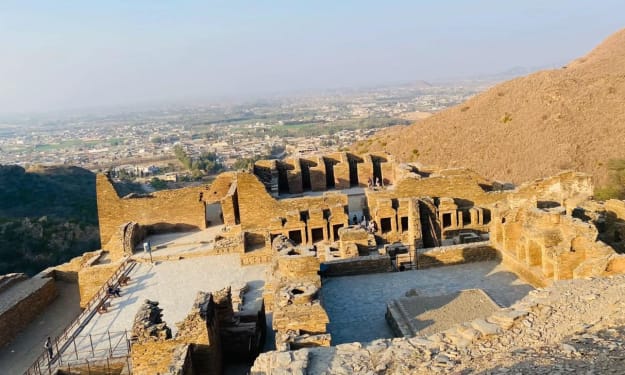
Takht Bhai, Echoes of an Ancient Monastery.
Narrator (voice-over): In the heart of Khyber Pakhtunkhwa, Pakistan, lies a place where stones speak and winds carry stories of centuries past. This is Takht Bhai — one of the most remarkable Buddhist monastic complexes of the ancient Gandhara civilization.
By USA daily update about a year ago in History
The Montauk Chair
They said it never existed. That the base was just a relic. That the chair was just a myth. But some claim it wasn’t just real... it was powerful enough to crack open the very fabric of time. Welcome to Camp Hero, New York. Home of the Montauk Chair… and possibly the most dangerous experiment ever conducted in the shadows of history.
By Veil of Shadowsabout a year ago in History
🌍 The Mapmaker's Secret
🌍 The Mapmaker's Secret: A Hidden History of the World Long before satellites floated above the Earth, before explorers etched coastlines into parchment with trembling hands, there lived a mapmaker named Aurelian in the ancient city of Alexandria.
By Wings of Time about a year ago in History
Ancient Warfare’s Strangest Tactics:
Warfare has always been a reflection of human ingenuity often brutal, sometimes bizarre. Long before modern weapons reshaped the battlefield, ancient generals turned to more unconventional means to gain an edge. These tactics didn’t just rely on muscle or metal they weaponized nature, fear, fire, and even disease. While some of these methods sound like they belong in a historical fantasy novel, they were very real, often surprisingly effective, and at times deeply unsettling.
By Lynn Myersabout a year ago in History
2000 Years Old City Found Hidden in the Desert!
In the year 1812, a Swiss adventurer named Johann Ludwig Burckhardt was wandering through the desolate Arabian Desert. Disguised in local attire, he accidentally stumbled upon a narrow path nestled between high rock cliffs. He walked between these rocky walls for about 1.5 kilometers until the path widened—and what he saw next left him stunned.
By Chronicle of Powerabout a year ago in History
Apple iPhone 17 Pro Expected Features, Design, and Release Insights.
Sleek and Lightweight Design One of the biggest changes expected in the iPhone 17 Pro is a major shift in materials and thickness. Several credible sources, including well-known Apple analyst Ming-Chi Kuo, have reported that the iPhone 17 Pro will feature a redesigned, ultra-thin chassis, making it the thinnest iPhone yet. The device is rumored to use a new titanium alloy frame, which is lighter but just as strong as the titanium Apple introduced with the iPhone 15 Pro models.
By USA daily update about a year ago in History
Trump Overtime Tax, What It Means and Why It Matters.
What is Overtime Pay? Under the Fair Labor Standards Act (FLSA) passed in 1938 most hourly workers in the United States are entitled to overtime pay when they work more than 40 hours in a week. Overtime pay is typically 1.5 times the employee’s regular hourly rate. However, not all workers are eligible. Employees who earn above a certain salary threshold and perform certain types of managerial or professional duties are considered “exempt” from overtime rules.
By USA daily update about a year ago in History
The Rise and Fall of Ancient Egypt
Ancient Egypt remains one of the most fascinating civilizations in human history. Known for its grand pyramids, mysterious hieroglyphs, powerful pharaohs, and lasting cultural legacy, Egypt thrived for thousands of years along the Nile River. But like all great empires, it eventually declined and fell. This article explores the rise, achievements, and eventual fall of Ancient Egypt in a clear and engaging way.
By JAWAD HUSSAINabout a year ago in History
Benazir Bhutto
*Title:* "Benazir Bhutto: A Trailblazing Leader" *Subtitle:* "A Comprehensive Biography of Pakistan's First Female Prime Minister, Her Life, Politics, and Legacy" Here is the expanded article: Benazir Bhutto was a Pakistani politician who had a profound impact on her country's history. Born on June 21, 1953, in Karachi, Pakistan, she was the daughter of Zulfikar Ali Bhutto, a former Prime Minister of Pakistan, and Nusrat Bhutto, an Iranian-Pakistani woman of Kurdish descent. *Early Life and Education* Benazir Bhutto's early life was marked by privilege and politics. She attended Karachi Grammar School and later studied at Harvard University and the University of Oxford, where she honed her leadership skills and developed a passion for public service. Her time at Harvard and Oxford had a significant influence on her worldview and prepared her for the challenges she would face in her political career. At Harvard, Bhutto was exposed to the ideals of democracy, equality, and social justice. She was particularly drawn to the works of Mahatma Gandhi and Martin Luther King Jr., whose philosophies of non-violent resistance resonated with her. Her experiences at Harvard shaped her perspective on politics and governance, and she began to see the potential for positive change through democratic means. *Entry into Politics* Bhutto's entry into politics was prompted by her father's execution in 1979. Zulfikar Ali Bhutto had been overthrown in a military coup led by General Zia-ul-Haq, who subsequently had him tried and executed for murder. This event had a profound impact on Benazir Bhutto, who was deeply traumatized by her father's death. She became determined to continue her father's legacy and fight for democracy and human rights in Pakistan. *Rise to Power* Benazir Bhutto returned to Pakistan in 1986 and became involved with the Pakistan People's Party (PPP), which her father had founded. Her charisma and leadership abilities quickly propelled her to the forefront of the party. She became a vocal critic of General Zia's regime and advocated for democratic reforms. In 1988, Bhutto's party won the general elections, and she became the Prime Minister of Pakistan at the age of 35. She was the first female Prime Minister of Pakistan and a trailblazer for women in politics. *Prime Minister of Pakistan* Bhutto's tenure as Prime Minister was marked by significant challenges. She faced opposition from conservative elements in Pakistani society, who were opposed to a woman holding such a high office. She also faced economic challenges, including high inflation and unemployment. Despite these challenges, Bhutto implemented several significant reforms. She increased access to education and healthcare, promoted women's rights, and encouraged foreign investment. Her government also initiated several infrastructure projects, including the construction of new roads and bridges. *Assassination* Tragically, Bhutto's life was cut short by an assassination on December 27, 2007. She was killed in a suicide bombing and shooting attack during an election rally in Rawalpindi, Pakistan. The attack claimed the lives of 28 others and left over 100 wounded. Bhutto's assassination was widely condemned, and it sparked widespread protests and outrage across Pakistan. The investigation into her death was led by the Pakistani government, with assistance from international experts. *Legacy* Benazir Bhutto's legacy is complex and multifaceted. She was a pioneering leader who paved the way for women in politics and fought tirelessly for democracy and human rights. Her life and work continue to inspire people around the world. Bhutto's legacy is also marked by controversy. Her governments were criticized for corruption and mismanagement, and she faced several allegations of nepotism and cronyism. However, her commitment to democracy and her willingness to take risks to promote positive change are widely acknowledged. *Impact on Pakistani Society* Bhutto's impact on Pakistani society was significant. She challenged traditional norms and stereotypes, and paved the way for women to participate in politics and public life. Her leadership also helped to promote a more inclusive and tolerant society, where people of all backgrounds could feel valued and respected. *Conclusion* Benazir Bhutto's life was marked by her courage, conviction, and commitment to public service. Her legacy continues to shape Pakistan's politics and inspire future generations of leaders. Despite the challenges she faced, Bhutto remained committed to her ideals and worked tirelessly to promote democracy, equality, and social justice.
By Fazal Malikabout a year ago in History
Top 10 Most Powerful Countries in the World (2025)
Top 10 Most Powerful Countries in the World Power is more than just weapons — it’s about influence, innovation, resilience, and reach.A high-resolution political world map with flags of the top 10 powerful countries (USA, China, Russia, India, UK, France, Germany, Japan, South Korea, Saudi Arabia) glowing over their respective regions.
By Farooq Hashmiabout a year ago in History