Discoveries
The Serapeum of Alexandria: The Great Temple of Serapis
The Serapeum was the largest and most prestigious of all temples in the Greek quarter of Alexandria, built during the reign of Ptolemy III Euergetes, built with white marble, and was decorated with reliefs and statues between 246 and 222 BC. It was dedicated to the Egyptian god Serapis that was invented by Ptolemy I to bind the native Egyptians with the Greeks
By Ntokozo Mvuni3 years ago in History
Knossos
This prehistoric archaeological site is located just outside the island's capital city, erected by the Bronze Age Minoan civilization on Crete. Though there is nothing much left of the palace but exploring the ruins of this fascinating place sounds interesting.
By Ntokozo Mvuni3 years ago in History
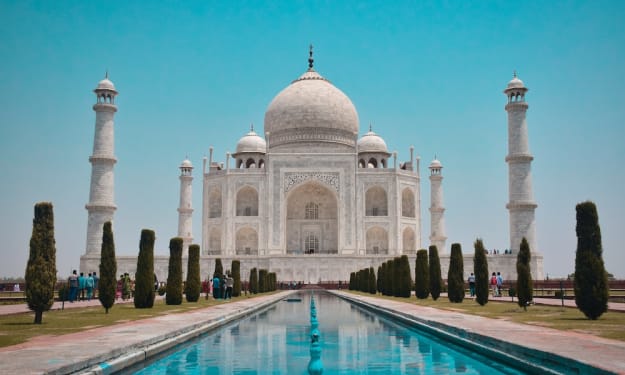
The Romantic, Heartbreaking Love Story Behind the Taj Mahal
The love story of Shah Jahan, the Mughal emperor of India, and Mumtaz Mahal is one of the most famous and romantic tales in history. It is primarily known for the construction of the Taj Mahal, a magnificent white marble mausoleum, which is considered one of the most beautiful buildings in the world and a symbol of enduring love.
By Gopalakrishna Chowdary3 years ago in History
Camille Monfort, The 1896 Legendary Tale of "The Amazonian Vampire”.
In 1896, Belém became rich by selling Amazonian rubber to the world, making the farmers overnight millionaires who built their rich mansions with European materials, while their wives and daughters sent their clothes to be washed in the old continent and imported mineral water from London for their baths.
By victor amah3 years ago in History
Charminar Hyderabad History and Attractions. Content Warning.
History of Charminar Charminar was built by Sultan Mohammed Quli Qutb Shah in 1591. It is said that this square shaped structure with four pillars and intricate carvings was built in honour of his wife, Bhagmati. However, the actual reason behind building Charminar is still not clear.
By Gopalakrishna Chowdary3 years ago in History
UAE astronaut on longest-ever Arab space mission: "A big responsibilIty"
The songs of the late Egyptian superstar Umm Kulthum have been played countless times in cabs and coffee shops around the Arab world because they are profound and soul-stirring. They have now made their way to the antiseptic white corridors of the International Space Station, owing to the musical preferences of a trailblazing Emirati astronaut. Sultan al-Neyadi, who will make history this weekend by completing the longest Arab space mission ever, told the Guardian from space that he believed it was important to convey a piece of Arab culture to space during the journey. Neyadi, who was floating in microgravity, stated in a recorded video message that "everyone is watching us; everybody is excited about space." Many of my coworkers have said how great it is to hear a foreign language on the station, I overheard. The majority of the few hundred people who have crossed the border of space have been Americans, and NASA-trained astronauts or Russian cosmonauts have dominated celestial flight for decades. Only six Arabs have been to space so far; they are now referred to as "aquanauts" after the Arabic word for star, "najm". Neyadi has used his six-month stay on the International Space Station (ISS), which orbits the Earth at a speed of around 17,500 mph (28,000 km/h) and an altitude of about 250 miles (400 km), to conduct crucial scientific experiments as well as to introduce the Arab world to the marvels of space. The 42-year-old flight engineer has frequently uploaded videos in Arabic to social media about life on board the space station, detailing his peculiar daily routine, which includes eating vacuum-packed food and exercising in a "weightless" environment with a machine that generates its resistance. When asked whether he felt pressure as one of a small group of aquanauts to encourage interest in space exploration and science among people in the Middle East and North Africa, Neyadi responded to the Guardian that there is a sizable audience in the Arab world that is "thirsty to learn more about space." We must impart information and present these results to them clearly and engagingly, he added. "In particular, the youth... I would like to be a resource for them—a source of knowledge and motivation. Therefore, it's a huge duty. Neyadi has also given the world's space enthusiasts a new point of view by snapping pictures of famous places and Middle Eastern cities that honor a region that is sometimes unfairly characterized in the West.
By Cyril Lord3 years ago in History
The Battle for the Future
In the heart of America's heartland, beneath a clear and starlit sky, a small town with a population barely scraping four digits played host to an event of monumental importance. The year was 2024, and this was where the future of the Republican Party was being debated, argued, and ultimately, decided. It was a time when the winds of change blew fiercely through the ranks of the GOP, and the key contenders in the Republican primary race had converged on this unassuming place to wage a battle for the party's soul.
By Damilola Adams Kayode3 years ago in History