Discoveries
Unsolved mystery of Jesus
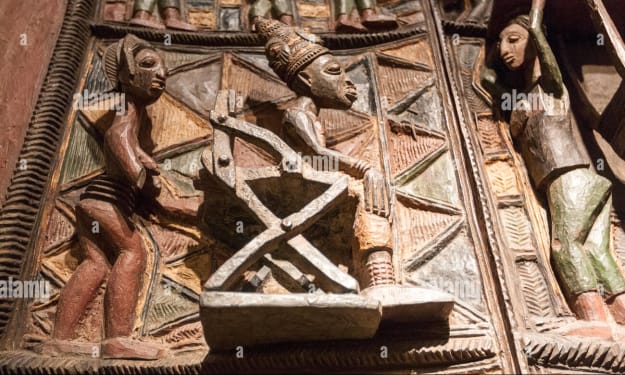
An ancient stone tablet has been discovered, and the deciphering of its secrets has the potential to challenge a fundamental belief of Christianity. The tablet appears to narrate the story of a messiah who is killed and resurrected after three days, a narrative that may sound familiar. However, it is important to note that this messiah may not be Jesus. Investigative journalist Simka Yakubovic has been unearthing the hidden secrets of Christianity, delving into deserts, tombs, and locations such as Rome and the Holy Land. Through her research, Simka seeks to uncover the truth behind historical myths, long-held beliefs, and some of the most significant biblical stories ever told.
By Rotondwa Mudzweda3 years ago in History
Redemption and Second Chances
In the heart of London, within the hallowed halls of Stamford Bridge, lived a story that transcended football. It was a story of shattered dreams, relentless determination, and the pursuit of redemption. Meet Daniel Mitchell, a footballer whose journey through adversity would inspire millions.
By Santigie Fofanah3 years ago in History
The Roman Empire
The Roman Empire stands as one of the most influential and enduring civilizations in human history. Its span of over 1,500 years, from its legendary founding in 753 BC to its ultimate decline and fall in 476 AD (or CE, Common Era), is a testament to its resilience, adaptability, and capacity to shape the world. This sprawling empire left an indelible mark on politics, culture, architecture, law, and countless other facets of human civilization. To comprehensively explore the Roman Empire's legacy, it is essential to delve into its origins, rise, governance, culture, contributions, and ultimate decline.
By solomon Christian3 years ago in History
WHY ORA PEOPLE DON'T BOW TO OBA OF BENIN
Okpameh (also called Uguan) the son of Oba Ewaure left the Benin kingdom after he was banned for committing murder. He went up to the Northern part and settled at a particular place he named Odorlerene (somewhere in present-day Ora). Okpameh was a very powerful and renowned hunter, who was respected for killing the dreaded Leopard (Ekpen), (see attached photo). He took a wife a Uokha Lady who bore him a Son he named Ora Ekpen (because of the circumstances surrounding his birth). Ora Ekpen later bore sons that make up the communities in today's Ora. Okpameh later received information of the death of his brother who before then was the Oba of Benin. It was told that the brother died without an heir to the throne.
By Joseph Bawaijen Godwin3 years ago in History
V News
A spring of gushing lava is one of the most unforgiving normal peculiarities on The planet. Your body would rapidly bubble up and vanish without a trace if you fell into its magma-filled core. Why aren't we using them to dispose of our garbage? This is Imagine a scenario where this would occur in the event that we unloaded our junk into volcanoes. Americans alone produce around 254 million tons of junk each year, and in spite of the fact that unloading it into volcanoes could seem like the ideal method for disposing of it, it wouldn't be simply simple. Volcanoes could seem to be nature's trash incinerators, yet truly, they're significantly more hazardous and temperamental, also much harder to get to. Could conquering these snags be worth the effort? Or would dumping trash in volcanoes only exacerbate existing environmental problems? Finding an active volcano that can perform the task would be the first challenge we would face in our search for volcanic garbage disposal. There are only about 1,500 volcanoes in the world that could be active, and most of them aren't near people for obvious reasons. That implies that getting all our waste to a functioning spring of gushing lava could end up being really costly, and when we arrive we might figure out it's not even the right sort of dynamic fountain of liquid magma. Yet, suppose we're sufficiently fortunate to get ourselves a decent dynamic safeguard fountain of liquid magma; before we stress over the coordinated factors of getting our rubbish there, we should sort out whether or not it's even smart to dump it inside. In the event that you were one of the primary waste gatherers recruited to drive up to the vent of a fountain of liquid magma, you'd rapidly begin to scrutinize your profession decisions. In 2002, a gathering of Ethiopian specialists tossed a 30 kg (66 lb) sack of rubbish into a well of lava, and the outcomes were hazardous. Because lava lakes are unstable, pressurized and acidic steam will explode in a chain reaction if you pierce their surfaces with something cold like trash. So might you at any point envision how enormous these blasts could be assuming you tossed a whole country's waste in there? Well to place it in context, rock falls into magma lakes in Hawaii have sent magma 85 m (280 feet) very high, so it'd presumably look something to that effect. Additionally, not all materials will totally separate in magma, and that implies that the dirtying remainders could emit out and pollute the encompassing scene. Add these ecological effects on top of the way that delivering all our rubbish to these volcanoes would essentially build the carbon impression of the garbage removal, and the situation seems to be a horrendous thought. Assuming we will consume our garbage, why not basically do it some place where we can utilize the intensity delivered through cremation to make new wellsprings of energy?
By Emily Ballard3 years ago in History
The Missing F-35
Introduction: The F-35 Lightning II, a fifth-generation multi-role stealth fighter jet, represents a pinnacle of modern military technology. Developed by Lockheed Martin and its international partners, the F-35 program has been hailed as a game-changer in the world of military aviation. However, it has also been marred by a series of controversies, including allegations of cost overruns, technical issues, and the mysterious disappearance of one of these high-tech marvels. In this article, we will delve into the fascinating story of the missing F-35, exploring the aircraft's history, capabilities, the controversies surrounding it, and the curious incident of its vanishing act.
By Clement Mwangi3 years ago in History
Lionel Messi: The Maestro of Modern Football
In the realm of football, one name stands above all others, inspiring awe and admiration: Lionel Messi. This is the story of a boy from Rosario, Argentina, who grew up to become the maestro of modern football, rewriting the record books and capturing the hearts of millions.
By ziyad ahmed3 years ago in History
scientist Samuel Finley Breese Morse
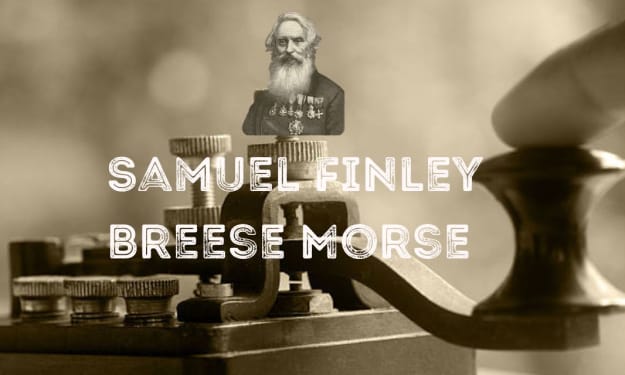
Samuel Finley Breese Morse (April 27, 1791-April 2, 1872) is renowned as the designer of the message and Morse Code, however what he truly needed to do was paint. He was a deeply grounded craftsman when his energetic interest in hardware reemerged, prompting the correspondences creation that changed mankind until it was eclipsed by the phone, radio, TV, and, at last, the web.
By fawas mohamed3 years ago in History
15 Fascinating and Bizarre Aspects of Ancient Egyptian Culture
Egypt, renowned for its majestic pyramids, intricate hieroglyphs, and captivating mythology, presents a mesmerizing tapestry of history. While these elements often steal the spotlight, it is equally important to explore the peculiar customs and rituals that might appear grim by today's standards. From scarification to mummification, the ancient Egyptians lived a unique life that simultaneously mesmerizes and terrifies. In this article, we delve into 15 of the most astonishing and unsettling aspects of ancient Egyptian culture, shedding light on their cultural significance.
By Frank John3 years ago in History
AFRICA from 16th to 21st century
Africa is a continent that boasts a rich and diverse history, which is not surprising given that it is the second largest continent after Asia and presently has the largest number of countries. The northern coast of Africa, which touches the Mediterranean Sea, is characterized by mountainous terrain, while just south of this lies the Sahara, the largest non-polar desert on the planet. The Sahara has played a significant role in shaping the history of Africa, as it has acted as a division between the North and sub-Saharan Africa. The civilizations that formed around the Nile River Valley came to dominate the North, while the sub-Saharan region is characterized by a variety of terrain, including grasslands, which slowly develop as one heads south, and tropical rainforests. The Niger River, which flows through the sub-Saharan region, has been an important river valley in African history, and the Congo Basin, which is home to the rainforests of the Congo Basin and the mighty Congo River, is also of great significance. In East Africa, which touches the Indian Ocean, the terrain is more mountainous, with plateaus and large lakes. It is believed that the Cradle of humankind is located in this region, in modern-day Kenya. In the south of Africa, there are dry deserts like in Namibia, but also hills and plateaus, which are home to some of the most valuable mineral resources in the world. While it is not certain where agriculture first began in Africa, it is believed to have been about 7,000 years ago in the Sahel, the area between the Sahara and the Savannah. While cultivation was easy in this region, the suboptimal soil and scarce rainfall made more intensive farming impossible, so populations remained relatively stable. This was not a problem, as they relied mainly on hunting and gathering. It was only after the Sahara became drier, turning into a desert, that some populations migrated south, deeper into the grasslands, spreading their farming techniques and leading to more diverse crops, such as tropical fruits, which are only able to grow in wetter climates. Other populations also migrated, leading to the diverse history of Africa that we see today.
By Rotondwa Mudzweda3 years ago in History