Discoveries
The Last Dragon of Eldoria
In the twilight of the ancient kingdom of Eldoria, the once mighty land of dragons, a heavy silence lay over the emerald hills and dark forests. The kingdom, once resplendent with the roars of dragons, now whispered only of their legends. The dragons, the keepers of Eldoria’s secrets and the guardians of its skies, had disappeared, leaving behind only myths and an empty sky. Yet, one dragon remained, unknown to all but the oldest and wisest of Eldoria’s inhabitants.
By Nahid Mahmud Shamsuzzaman2 years ago in History
The Vikings were obsessed with personal hygiene and weekly bathing
The Vikings have often been portrayed as fierce invaders, raiding towns and taking what they wanted, and often depicted as dirty unsophisticated barbarians. While they may have been skilled ferocious warriors, they were not dirty nor unsophisticated.
By sara burdick2 years ago in History
The Lost Letters of Maplewood
In the curious town of Maplewood, settled between moving slopes and old oak trees, there was a little, neglected mailing station. The structure was old and worn, with ivy crawling up its block facades, and its windows misted with the progression of time. Inside, the air was thick with the fragrance of matured paper and ink, and the flooring planks squeaked with each step.
By Nadia Tasnim2 years ago in History
Lets Go To China
NOTE!!! China, officially known as the People's Republic of China (PRC), is a vast and complex nation with a history that spans thousands of years, a diverse culture, and a rapidly evolving socio-economic landscape. It is the world's most populous country, with over 1.4 billion people, and the second-largest economy, making it a major global player. Understanding China requires delving into its rich history, political structure, economic development, cultural heritage, and its significant role on the world stage.
By Muhammad Sani Sani2 years ago in History
10 Most Interesting Facts about The Indian History
1. Indus Valley Civilization (ca. 1300–3300 BC) The Indus Valley Civilization, also known as the Harappan Civilization, was one of the world's first urban cultures. This nation, which flourished along the Indus River and its tributaries, was known for its urban planning, including organized cities such as Harappa and Mohenjo-daro. These cities had complex drainage systems, standard bricks for construction, and trade marks in distant regions. The community was peaceful, there was no sign of military service, and the health and hygiene of the people was very important.
By Vishnu Sharma2 years ago in History
The Last Scroll of Alexandria
In the core of old Egypt, the city of Alexandria remained as a signal of information. The Incomparable Library, with its transcending racks and vast parchments, was the pride of the old world. Researchers from each edge of the earth went to its marble corridors to study, learn, and add to the consistently developing store of human insight.
By Nadia Tasnim2 years ago in History
The Evolution of Domesticated Animals: From Wild Ancestors to Modern Companions
The domestication of animals is one of the most significant achievements in human history. Over thousands of years, various wild species have been transformed into domesticated animals that play essential roles in our lives today. This fascinating journey from wild ancestors to modern companions highlights both the adaptability of these animals and the ingenuity of early humans.
By Adeshola Motunrayo2 years ago in History
"The Onion’s Epic Saga: How This Humble Veggie Shaped History"
Onions are more than just a kitchen staple; they are a cornerstone of global cuisine, adding flavor and depth to a wide array of dishes. However, the significance of the onion extends far beyond its culinary uses. Its history, which spans thousands of years, reflects its vital role in human civilization, touching various aspects of culture, medicine, and even spirituality.
By Adeshola Motunrayo2 years ago in History
The Egyptian Discovery That Terrified Scientists
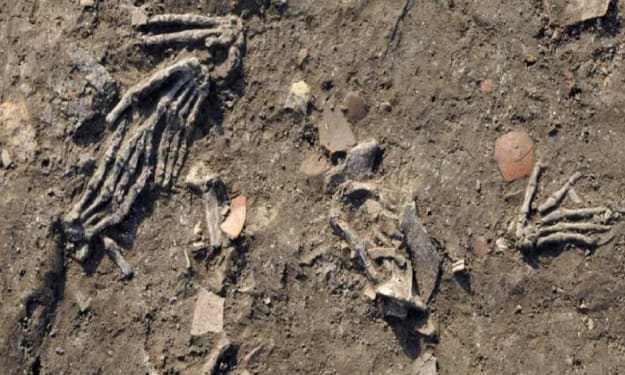
Years ago, a gruesome discovery was made in Egypt that startled scientists. 16 human hands, all right hands, carefully buried in four eerie pits. These hands were abnormally large, making them look less human at first, but they were indeed human hands. Curiously, no left hands were found. This discovery points to an ancient dark ritual, as depicted in old Egyptian art and tales. It was believed that warriors would present the right hand of their defeated adversaries as proof of victory in exchange for gold. The Egyptians believed in the afterlife, so cutting off someone's hand was thought to cut off their power forever, ensuring a complete and eternal defeat for their enemies. This practice is thought to have occurred during battles between the Egyptians and the Hyksos, who lived in what was once known as Canaan.
By Eunice Fasoranti2 years ago in History
Pushpa 2: The Rule – A Cinematic Powerhouse You Can't Miss
Pushpa 2: The Rule - A Gripping Sequel that Redefines the Action Genre Pushpa 2 The Rule : is more than just a sequel; it's an adrenaline-fueled journey that plunges deeper into the raw, untamed world of Pushpa Raj. Director Sukumar masterfully builds upon the gritty foundation laid in the first film, delivering a cinematic experience that is both exhilarating and emotionally charged.
By Hasina Bagome2 years ago in History
How Big Is The Universe?
Our planet Earth is a small, blue dot drifting in the vast cosmic ocean. It is home to everyone you've ever known and every human who has ever lived. Here, every story ever told has its origin. As we venture out from Earth, past the moon, and beyond the sun, we embark on an epic quest to comprehend the true scale of our universe.
By Rapelang Malebelle2 years ago in History