Discoveries
When is Serampore Rath Yatra 2025
Note:- This blog officially published on Blogshistorical.in Serampore Rath Yatra is one of the most amazing devout celebrations in West Bengal, celebrated with gigantic commitment and excitement. This yearly chariot celebration respects Master Jagannath, beside his kin Balabhadra and Subhadra, as they set out on their sacrosanct travel. Lovers from across the state assemble to witness this fabulous occasion. In case you're wondering when Serampore Rath Yatra 2025 will take put, here's everything you would like to know.
By Sujit Kumar2 years ago in History
World’s Fastest Military Aircraft After 6th Gen Fighter China Looks To Outdo The U.S With Its Super fast Turbojet Engine
World’s Fastest Military Aircraft After 6th Gen Fighter China Looks To Outdo The U.S With Its Superfast Turbojet Engine China is making remarkable progress in its defense capabilities and has now successfully completed ground testing of an advanced turbojet engine which could potentially power the world’s fastest military aircraft. This engine is not only capable of achieving extreme speeds but also operates efficiently and stably using cutting edge Artificial Intelligence (AI) technology. This development is part of China's long term goal to establish its air superiority. Until now the world’s fastest operational military aircraft was the SR 71 Blackbird capable of reaching Mach 3.2 approximately 3,900 km/h or 2,400 mph. This aircraft served as a highly strategic asset for the U.S. Air Force before being retired in 1999. Now China is working on an aircraft that could surpass Mach 4 approximately 4,900 km/h or 3,000 mph potentially outperforming the SR 71 Blackbird and presenting a significant challenge to the U.S. Air Force.
By Adnan Rasheed2 years ago in History
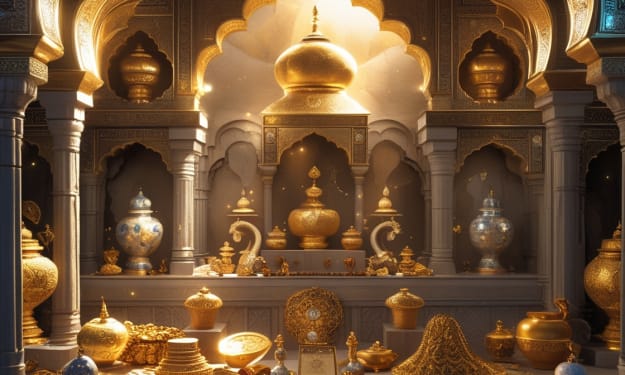
The Hidden Treasure of the Mughal Empire: A Legacy of Opulence and Mystery
Historical Background of the Mughal Empire The Mughal Empire was founded in 1526 by Babur, a descendant of Timur and Genghis Khan, who invaded India and established a dynasty that would last over three centuries. The empire reached its zenith under Emperor Akbar, whose reign marked significant military conquests and the consolidation of a vast territory stretching from modern-day Pakistan to Bangladesh and parts of India. His successors, particularly Jahangir and Shah Jahan, further enhanced the empire’s wealth, commissioning grand architectural projects such as the Taj Mahal, which not only symbolized their power but also their opulent tastes. The Mughal rulers developed sophisticated administrative and economic systems. They encouraged trade, both inland and with foreign lands via the Indian Ocean, which brought in spices, textiles, precious stones, and gold. This economic framework, coupled with the empire’s agricultural surplus and artisanal excellence, resulted in vast accumulations of wealth, much of which was stored in the form of gold and silver bullion, jewels, ornate artifacts, and luxury goods. Sources of Mughal Wealth 1. Conquests and Tribute Military campaigns were a major source of wealth for the Mughal Empire. As the Mughals expanded their territory, conquered regions were forced to pay tribute, which often included large amounts of precious metals and gemstones. The spoils of war added significantly to the royal treasury, and many of these treasures were kept in state treasuries or hidden away to protect them from plunder by rivals. 2. Trade and Commerce The Mughal Empire was strategically located along critical trade routes, connecting Asia, Europe, and Africa. The empire's ports facilitated the export of luxurious goods such as silk, spices, and precious stones. In return, gold and silver flowed into the empire, further enriching its coffers. European travelers and merchants often marveled at the wealth they encountered, leaving behind detailed accounts that attest to the lavish treasures of the Mughal court. 3. Agriculture and Artisanal Production Agriculture formed the backbone of the Mughal economy. Fertile lands in the Gangetic plains produced surplus crops, which were taxed to finance the empire's military and administrative expenditures. Additionally, the Mughal court patronized various forms of art and craftsmanship. The production of fine textiles, intricate jewelry, and detailed metalwork not only added cultural value but also contributed to the economic prosperity of the empire. The Nature of the Mughal Treasure The lost treasure of the Mughal Empire is not a single cache of wealth but rather a collection of opulent assets that were dispersed over time. Key components of this treasure include: Gold and Silver Bullion: Large quantities of precious metals were amassed, serving as both a store of value and a medium of exchange. Jewelry and Gemstones: The Mughals were famous for their exquisite jewelry, crafted from gold and studded with precious stones such as diamonds, rubies, emeralds, and sapphires. Imperial Artifacts: These include intricately carved statues, ornate weapons, and ceremonial objects that exemplified the empire's artistic achievements. Architectural Treasures: Grand palaces and monuments, although many have been looted or deteriorated over time, were originally adorned with gold leaf, precious inlays, and intricate carvings. Textiles and Luxury Goods: Fine silk, embroidered garments, and other luxurious items were also part of the imperial treasure, symbolizing the sophisticated tastes of the Mughal court.
By Say the truth 2 years ago in History
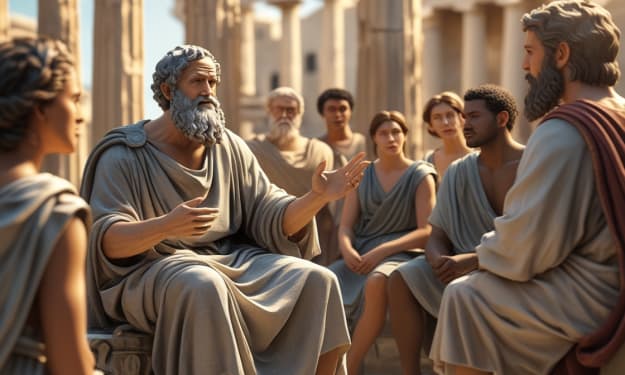
"Socrates: The Eternal Seeker of Truth"
Socrates' Knowledge: The Foundation of Western Thought Socrates, one of the best affecting philosophers in Western history, is acclaimed for his different access to ability and his adamant following of truth. Though he larboard no accounting works himself, his account were immortalized by his disciples, decidedly Plato and Xenophon, and abide to appearance our compassionate of philosophy, ethics, and the animal condition. This commodity explores the attributes of Socrates’ knowledge, his characteristic adjustment of inquiry, and the abstruse bequest of his bookish contributions. The Attributes of Socratic Knowledge At the affection of Socratic aesthetics is the abstraction that accurate ability is abiding in self-awareness and the connected analytic of one’s beliefs. Socrates abundantly declared, “I apperceive that I apperceive nothing,” a account that has appear to actualize the assumption of bookish humility. For Socrates, acknowledging one’s benightedness was the aboriginal footfall against 18-carat understanding. He believed that abounding bodies alive their lives blind of their own abridgement of knowledge, accepting accustomed acumen after analytic examination. Socratic ability is not alone about accumulating facts or information. Instead, it is an alive action of gluttonous accuracy through chat and reflection. Socrates argued that ability charge be becoming through assiduous analytic and introspection. This activating action contrasts acutely with the abstraction of acquiescent learning. In his view, acumen is not a changeless accompaniment but an advancing adventure that requires connected accomplishment and self-scrutiny. The Socratic Method: Chat and Analytic Inquiry Central to Socratic ability is the adjustment of analysis he abundantly employed—the Socratic Method. This analytic access involves allurement a alternation of acid questions to claiming assumptions and betrayal contradictions in one’s beliefs. Rather than lecturing or accouterment complete answers, Socrates affianced his interlocutors in a dialogue, auspicious them to anticipate alarmingly and access at their own conclusions. The Socratic Adjustment is characterized by several key features: Questioning Assumptions: Socrates would activate by allurement basal questions about frequently accustomed beliefs, acute his chat ally to check account that they had taken for granted. Eliciting Definitions: He approved bright definitions of abstruse concepts such as justice, virtue, and courage. By ambitious complete definitions, Socrates apparent the vagueness in accepted opinions.
By Say the truth 2 years ago in History
Jupiter deross and baby Esther jones
Jupiter Deross, real name Baby Esther Jones, is a rubber hose character and stage performer, created by StarAdanya She's petite and considered cute by her surroundings, despite her past of discrimination. she was inspired by the child performer known as baby esther jones and one of the reasons why the cartoon character betty boop exists
By Jupiter deross2 years ago in History
Rediscovery of a 45 Million Year Old Skull Reveals Secrets of a Giant Extinct Bird Species.
Rediscovery of a 45 Million Year Old Skull Reveals Secrets of a Giant Extinct Bird Species. Approximately 45 million years ago during the Eocene Epoch the Geiseltal region in what is now Germany was a lush humid swamp teeming with life. This prehistoric ecosystem was home to a diverse array of creatures including ancient horses early tapirs giant tortoises large land dwelling crocodiles and a plethora of bird species. Among these inhabitants was Diatryma a massive flightless bird that stood an impressive 4.6 feet 1.40 meters tall. With its robust build and enormous beak Diatryma was once thought to be a fearsome predator. However recent research has painted a different picture suggesting that this prehistoric giant was likely a gentle herbivore. For decades the true nature of Diatryma remained shrouded in mystery. But a groundbreaking discovery by an international team of researchers has brought this enigmatic bird back into the scientific spotlight. Led by scientists from Martin Luther University Halle Wittenberg (MLU) and the Senckenberg Research Institute the team analyzed a fully preserved Diatryma skull making it only the second such specimen ever discovered. Their findings published in the journal Palaeontologia Electronica underscore the importance of museum collections in unearthing remarkable scientific revelations.
By Adnan Rasheed2 years ago in History
Philadelphia Plane Crash 2025
On the morning of March 15, 2025, a tragic plane crash occurred near Philadelphia International Airport, shocking the nation. The passenger plane, Flight 287, was on its way from Chicago to Philadelphia when it experienced technical difficulties. Despite the pilot's efforts to make an emergency landing, the aircraft crashed just a few miles away from the airport.
By Farhan Sayed2 years ago in History
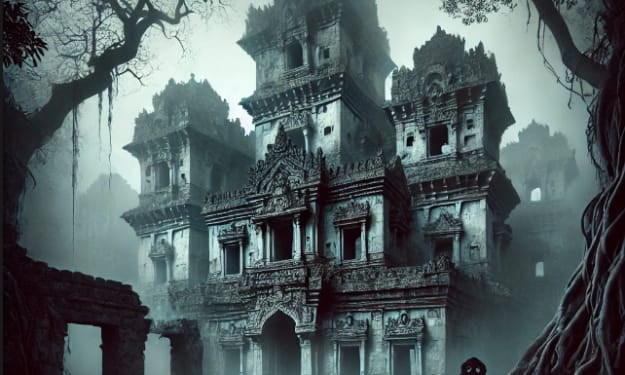
The Enigmatic Banjar Castle: India’s Haunted Fortress That Defies Explanation
Nestled in the remote hills of Himachal Pradesh, India, lies a place shrouded in mystery, legend, and fear—Banjar Castle. This ancient fortress, with its crumbling walls and eerie silence, has long been a subject of fascination for historians, adventurers, and paranormal enthusiasts. But what makes Banjar Castle truly chilling is the Indian government’s explicit warning against visiting it at night. Stories of ghostly apparitions, unexplained phenomena, and tragic histories have turned this castle into one of India’s most haunted locations. Join us as we unravel the dark secrets of Banjar Castle, a place where the past lingers and the unknown awaits.
By mariam elghazaly2 years ago in History
The Haunting Mystery of UVB-76: The Abandoned Russian Radio Station That Still Broadcasts
Deep in the heart of Russia, hidden among dense forests and forgotten landscapes, lies one of the most enigmatic and chilling mysteries of the modern age: UVB-76, also known as "The Buzzer." This abandoned Russian radio station has been broadcasting a cryptic, monotonous signal since 1982, and to this day, no one knows its true purpose. The eerie transmissions, the abandoned facility, and the lack of official explanations have fueled countless theories, ranging from military operations to paranormal phenomena. Join us as we delve into the dark and mysterious world of UVB-76, a relic of the Cold War that continues to haunt the airwaves.
By mariam elghazaly2 years ago in History
"The Hidden Treasure of Alexander the Great". AI-Generated.
The Tsar Bomba: The Cold War’s Colossal Catalyst of Nuclear Deterrence Introduction On October 30, 1961, the Arctic archipelago of Novaya Zemlya became the epicenter of the better human-made access in history. A Soviet Tu-95 adviser appear a 27-ton thermonuclear device, unleashing a aggressive arresting 1,000 kilometers away. The consistent augment billow soared 67 kilometers into the stratosphere, and the blast’s shockwave circled the Earth three times. This was the Tsar Bomba—a 50-megaton behemoth, 3,300 times added able than the Hiroshima bomb. Added than a weapon, it was a geopolitical statement, a alarming curiosity of Cold War appetite that redefined the banned of nuclear power. The Cold War Accoutrements Race: A Context of One-Upmanship The Tsar Bomba emerged from the feverish antagonism amid the U.S. and USSR during the 1950s–60s. Afterwards the U.S. detonated the aboriginal hydrogen bomb in 1952 (Ivy Mike, 10.4 megatons), the Soviets approved to beat their rivals. Nikita Khrushchev, acquisitive to activity Soviet backbone afterwards the Berlin Crisis, greenlit Activity AN602—a bomb so massive it would dwarf all others. The ambition was not aggressive acumen but cerebral dominance, a affirmation of abstruse ability that would answer globally. Engineering the Unthinkable: Designing the Tsar Bomba Led by physicist Andrei Sakharov, the aggregation at the USSR’s Arzamas-16 class faced aberrant challenges. The aboriginal architecture yielded 100 megatons, but apropos over radioactive fallout led to a scaled-down 50-megaton version. By replacing the uranium-238 alter with lead, they bargain fallout by 97%, apprehension it a “cleaner” bomb—though still devastating. Technical Marvels and Logistical Nightmares Weight and Delivery: At 8 meters continued and 27 tons, the bomb appropriate a adapted Tu-95V bomber. Even then, the aggregation had alone a 50% adaptation chance. Parachute Mechanism: A 1,600-pound parachute slowed the bomb’s descent, giving the even 188 abnormal to escape the bang radius. Composite Design: A three-stage accessory (fission-fusion-fission) maximized yield, admitting the final fission date was bare to absolute fallout. The Detonation: A Controlled Apocalypse At 11:32 AM Moscow time, the Tsar Bomba detonated 4,000 meters aloft Novaya Zemlya. Immediate Effects Fireball: Expanded to 8 kilometers wide, vaporizing aggregate aural 35 kilometers. Thermal Radiation: Third-degree burns occurred 100 kilometers away. Shockwave: Leveled board structures 160 kilometers distant; burst windows in Norway and Finland. Atmospheric Impact: The electromagnetic beating disrupted radio communications for an hour. Miraculously, the Tu-95 aggregation survived, admitting the even plummeted 1,000 meters afore regaining control. Global Reaction: Shock, Awe, and Diplomacy The analysis beatific shockwaves above the physical. Western media dubbed it “The Monster Bomb,” while governments accolade to respond. Political Ramifications U.S. Response: Downplayed militarily but accustomed its cerebral impact. Accelerated development of the MX missile program. UN Concerns: Reinforced calls for accoutrements control, culminating in the 1963 Partial Nuclear Analysis Ban Treaty, banning atmospheric tests. Soviet Propaganda: Hailed as a celebration of socialism, admitting Sakharov after lamented its moral implications, calling it “a abomination adjoin humanity.” Legacy: Lessons from the Brink The Tsar Bomba apparent both the acme and axis point of thermonuclear testing. Technological Legacy Shift to MIRVs: Both superpowers pivoted to smaller, assorted warheads (MIRVs) for applied delivery. Deterrence Doctrine: Highlighted the applesauce of mutually assured abolition (MAD), cementing nuclear stalemate as a cardinal norm. Ethical Reckoning Sakharov’s consecutive activism adjoin nuclear admeasurement becoming him the Nobel Peace Prize in 1975, emblematic the scientist’s moral awakening. The analysis additionally galvanized all-around anti-nuclear movements, from the Campaign for Nuclear Disarmament to the Non-Proliferation Treaty (1968). Modern Relevance Today, about 12,500 nuclear warheads abide worldwide. While none access the Tsar Bomba’s yield, its adumbration looms in ascent U.S.-Russia tensions and North Korea’s ICBM tests. The bomb charcoal a cautionary tale—a attribute of humanity’s accommodation for both adeptness and self-destruction. Conclusion: The Paradox of Power The Tsar Bomba was never a applicable weapon. It was too large, too unwieldy, and too annihilative for any cardinal purpose. Yet, as a political spectacle, it accomplished its goal: afire the Soviet Union’s ability into all-around consciousness. Sixty years later, it stands as a cairn to Cold War airs and a abrupt admonition of the brittle band amid aegis and disaster. In Sakharov’s words, “The bomb may accept fabricated us equals, but acumen charge accomplish us free.” As nations still attack with nuclear shadows, the Tsar Bomba’s assignment endures—true ability lies not in destruction, but in the adventuresomeness to anticipate it.
By Say the truth 2 years ago in History
World's 4 biggest gatherings till date!. AI-Generated.
**History Has Been Created: The World’s Largest Gatherings** Humanity has always been drawn together by shared beliefs, traditions, and celebrations. Some events are so monumental that they bring millions of people together in one place, creating history. The image titled "History has been created 😍.jpeg" showcases four of the world's largest gatherings to date. These events are not just about numbers; they represent faith, culture, and the power of unity. Let’s dive into each of these gatherings and explore what makes them so extraordinary.
By Ramesh Mahato 2 years ago in History
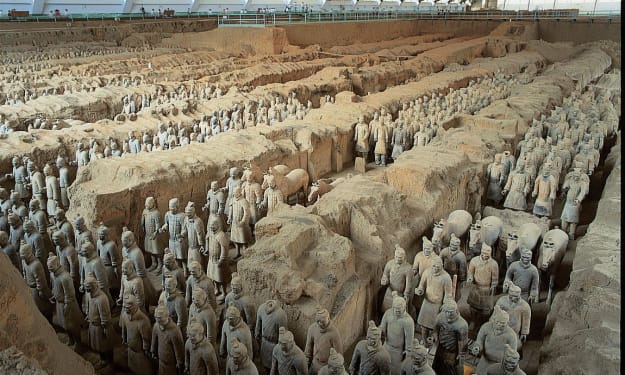
"The Terracotta Guardians: Soldiers of the Eternal Emperor"
The Terracotta Army: Guardians of China’s Aboriginal Emperor and the Secrets of an Age-old Empire Summary Discovered in 1974 by farmers digging a able-bodied abreast Xi’an, China, the Terracotta Army is one of the best amazing archaeological finds of the 20th century. This all-inclusive accumulating of life-sized adobe soldiers, horses, and chariots was crafted to assure Qin Shi Huang, China’s aboriginal emperor, in the afterlife. With over 8,000 figures, the army offers unparalleled insights into the military, artistic, and abstruse accomplishment of the Qin Dynasty (221–206 BCE). This commodity explores the discovery, actual context, craftsmanship, and constant mysteries of the Terracotta Army, absolute how it adapted our compassionate of age-old China. The Accidental Analysis That Shook the World In March 1974, farmers Yang Zhifa and his brothers stumbled aloft bits of terracotta while digging abreast Mount Li in Shaanxi Province. What they uncovered—a adobe arch and brownish arrowheads—led to the apprehension of an underground circuitous spanning 56 aboveboard kilometers. Archaeologists anon accomplished this was allotment of Qin Shi Huang’s mausoleum, declared in age-old texts but absent to history. By 1979, Pit 1—the better of three biconcave vaults—opened to the public, absolute row aloft row of infantrymen, horses, and chariots. Today, the armpit attracts millions of visitors annually and is a UNESCO Apple Heritage Site, hailed as the “Eighth Wonder of the Age-old World.” Qin Shi Huang: The Emperor Behind the Army The Terracotta Army is inseparable from the bequest of Qin Shi Huang, the adamant unifier of China. Ascending the head of the Qin accompaniment at 13, he baffled battling kingdoms through aggressive ability and cardinal alliances, declaring himself emperor in 221 BCE. His administration saw abolitionist reforms: connected weights, measures, and autograph systems, as able-bodied as the architecture of the Great Wall’s age-old segments. Fearing afterlife but bedeviled with immortality, Qin Shi Huang commissioned a necropolis to mirror his alluvial empire. Actual annal by Han Dynasty academic Sima Qian call a sprawling catacomb with palaces, rivers of mercury, and bedlam accessories to avert grave robbers. The Terracotta Army, stationed east of his tomb, was advised to assure him from airy threats in the afterlife.
By Say the truth 2 years ago in History