Discoveries
Chhava: The Untold Saga of Chhatrapati Sambhaji Maharaj - A Battle for Legacy and Honor
Chhava: The Epic Saga of Chhatrapati Sambhaji Maharaj Bollywood is set to bring another historical masterpiece to the big screen with Chhava, a film that promises to capture the bravery, sacrifice, and indomitable spirit of Chhatrapati Sambhaji Maharaj, the son of the legendary Maratha ruler Chhatrapati Shivaji Maharaj. Directed by Laxman Utekar and featuring the talented Vicky Kaushal in the lead role, this highly anticipated movie is expected to deliver an action-packed and emotionally charged cinematic experience.
By Ramesh Mahato 2 years ago in History
The Lost Tomb of Genghis Khan
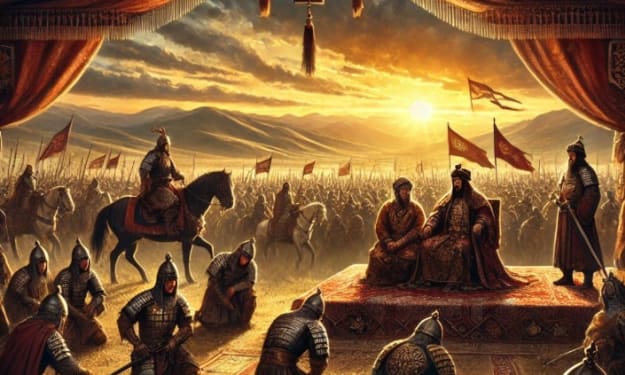
The Lost Tomb of Genghis Khan: A Mystery Unsolved Introduction Genghis Khan, the great Mongolian conqueror and founder of the Mongol Empire, left an indelible mark on world history. However, despite his legendary status, one of the greatest mysteries surrounding him remains unsolved—his final resting place. Unlike other great rulers who built grand mausoleums, Genghis Khan's tomb has never been found, making it one of the most elusive archaeological secrets in history. The Secretive Burial of Genghis Khan Unlike the grand tombs of emperors like China’s Qin Shi Huang or Egypt’s pharaohs, Genghis Khan's burial was intentionally kept secret. According to historical sources, he died in 1227, likely from an illness, during his campaign against the Western Xia Dynasty. His body was reportedly transported back to Mongolia, but where he was buried remains a mystery. Legends say that a special funeral procession took his body to an unknown location, ensuring secrecy by killing anyone who witnessed the burial. Some accounts suggest that a river was diverted over his grave to conceal it, while others claim thousands of horses trampled the land to erase any trace of his tomb. Theories on the Location of the Tomb For centuries, historians and archaeologists have speculated about the exact location of Genghis Khan’s tomb. Some of the most popular theories include: Burkhan Khaldun, Mongolia – This sacred mountain in the Khentii region is often cited as a possible burial site. Genghis Khan considered this area sacred and spent much of his life there. Ikh Khorig (The Great Taboo), Mongolia – This restricted area, covering over 240 square kilometers, was guarded for centuries by the Mongolian elite to prevent any outsiders from disturbing the site. The Orkhon Valley, Mongolia – Some believe his tomb lies near the historic Orkhon Valley, an important cultural and political center of the Mongol Empire. Underground Complex Theory – Some researchers suggest that an elaborate underground chamber was built to house Genghis Khan’s remains, filled with treasure and protected by deadly traps, much like the tombs of Chinese emperors. Historical Accounts and Expeditions Many historians and explorers have attempted to uncover the lost tomb, but all efforts have been in vain. Marco Polo (13th Century) – The Venetian traveler wrote that no one knew the location of Genghis Khan’s tomb, as those who buried him were executed. The Soviet Era (20th Century) – During the Soviet occupation of Mongolia, expeditions were launched to locate the tomb, but the efforts were largely unsuccessful. Modern Archaeology (21st Century) – Recent efforts, including satellite imaging and ground-penetrating radar, have been used to search for the tomb, but no definitive evidence has been found. Why Was the Tomb Kept Secret? The secrecy surrounding Genghis Khan’s tomb is rooted in Mongolian tradition. The Mongols believed that their great leader’s spirit should not be disturbed and that his final resting place should remain hidden from the world. The secrecy was likely enforced to prevent looting or desecration by rival factions or foreign invaders. Additionally, the Mongols followed a nomadic lifestyle and did not build grand temples or tombs like other civilizations. Instead, they believed in preserving the natural landscape, which may explain why Genghis Khan's burial site was never marked with a grand monument. Myths and Legends About the Tomb Several myths surround the tomb of Genghis Khan: The Cursed Tomb – Some legends claim that whoever finds and disturbs Genghis Khan’s tomb will suffer a terrible fate, much like the curse of the Egyptian pharaohs. Buried with Treasure – It is believed that the tomb contains an immense treasure, including gold, silver, and weapons from his conquests. The Ghostly Guardians – Folklore suggests that supernatural forces or spirits protect the tomb, preventing anyone from discovering its location. The Ongoing Search for the Tomb Despite centuries of mystery, the search for Genghis Khan’s tomb continues. Recent advances in technology, such as LIDAR (Light Detection and Ranging) and remote sensing, have given archaeologists new tools to explore the Mongolian landscape without disturbing sacred lands. Organizations like the National Geographic Society and Mongolian researchers have collaborated on expeditions, using modern techniques to scan possible burial sites. While some promising leads have been found, none have confirmed the exact location of the tomb. Conclusion The lost tomb of Genghis Khan remains one of the greatest archaeological mysteries of all time. Whether buried beneath a mountain, hidden under a river, or resting in an unmarked grave in the Mongolian wilderness, the final resting place of the great conqueror continues to captivate historians and explorers alike. Until definitive evidence is uncovered, the mystery of Genghis Khan’s tomb will persist, keeping his legacy shrouded in secrecy and legend.
By Say the truth 2 years ago in History
The Mysterious Death of Genghis Khan
The Mysterious Afterlife of Genghis Khan: Fact, Legend, and Theories Genghis Khan, the architect of the Mongol Empire, was one of the best able and feared rulers in history. Beneath his leadership, the Mongols baffled all-inclusive territories from China to Europe, creating one of the better empires anytime known. However, admitting his allegorical status, the exact affairs of his afterlife in 1227 abide active in mystery. Various accounts, actual records, and ballad action altered explanations for his demise, alignment from battlefield wounds to ache or akin assassination. The Official Record: A Sudden Death Most actual sources accede that Genghis Khan died in 1227 while arch a advance adjoin the Western Xia absolutism in China. The "Secret History of the Mongols," a key actual text, states that he died during this advance but provides no bright cause. Similarly, Persian and Chinese chronicles acknowledgment his afterlife but do not specify how it happened, abrogation historians with several aggressive theories. Theories on Genghis Khan's Death 1. Afterlife from Injuries in Battle One of the best broadly accustomed theories is that Genghis Khan suffered a baleful abrasion during the annoy of Western Xia. Some sources advance he was befuddled from his horse during an attack, comestible astringent centralized injuries. Given his advancing age (he was in his sixties), such injuries could accept led to complications and eventually his death. Another aberration of this approach suggests that an adversary archer blood-soaked him with an arrow, which afterwards acquired an infection. However, Mongol sources generally abhorred advertence action wounds to their leader, as they capital to bottle his angel as an bulletproof warrior.
By Say the truth 2 years ago in History
The Mysterious Death of Alexander the Great
The Mysterious Death of Alexander the Great: Causes and Theories Introduction The death of Alexander the Great remains one of the most intriguing mysteries in history. On June 10 or 11, 323 BCE, at the age of 32, the great conqueror breathed his last in the palace of Nebuchadnezzar II in Babylon. Despite his young age, his death shocked the ancient world and left a power vacuum that led to the eventual division of his vast empire. But what exactly caused his untimely demise? Historians and scholars have debated the cause for centuries, proposing various theories, from natural illnesses to assassination. Historical Accounts of His Death Ancient sources describe Alexander suffering a prolonged illness that lasted about 12 days. His symptoms reportedly included fever, severe abdominal pain, weakness, and an inability to speak in his final days. According to accounts by historians such as Arrian, Plutarch, and Diodorus Siculus, he remained conscious but increasingly debilitated, leading to his eventual death. However, these sources differ in their explanations of the exact cause. Theories on Alexander’s Cause of Death 1. Malaria or Typhoid Fever One of the most widely accepted natural causes for Alexander’s death is that he succumbed to an infectious disease such as malaria or typhoid fever. These diseases were common in ancient Mesopotamia, where stagnant water and warm conditions made it easy for mosquitoes and bacteria to thrive. Symptoms that match: High fever, abdominal pain, weakness, and eventual organ failure are consistent with malaria or typhoid. Historical accounts: Greek historian Plutarch mentioned that Alexander developed a high fever after attending a banquet, which supports the theory of an infection. Counterpoint: Malaria and typhoid typically cause death within a few days, yet Alexander was ill for nearly two weeks, making some scholars question this theory. 2. Poisoning by His Rivals Another popular theory is that Alexander was poisoned by his generals or political enemies who feared his growing power. Possible suspects: Some theories suggest that his half-brother Arrhidaeus, his general Cassander, or even his trusted officers Antipater and Ptolemy had motives to eliminate him. Plutarch’s account: He mentions that Alexander’s body showed no immediate signs of decomposition, which was seen as a divine sign but also raises the question of a slow-acting poison. Counterpoint: Poisoning is a common suspicion in historical deaths, but the lack of immediate death (since Alexander lived for nearly two weeks) makes it unlikely unless it was a slow-acting poison unknown to modern science. 3. Autoimmune Disorders Some researchers believe Alexander may have suffered from an autoimmune disease, such as Guillain-Barré Syndrome (GBS) or West Nile Virus. Symptoms that match: Fever, paralysis, weakness, and difficulty speaking are all associated with GBS. Modern analysis: Some experts suggest that Alexander's symptoms, such as progressive paralysis without loss of mental clarity, align with the effects of an autoimmune condition. Counterpoint: The ancient sources do not mention muscle spasms or nerve issues, which are common in such diseases. 4. Alcohol Poisoning or Overindulgence Some historians argue that Alexander’s heavy drinking and possible alcohol poisoning contributed to his demise. Alexander was known for excessive drinking, especially after the death of his close companion Hephaestion. Evidence: According to some accounts, he attended multiple banquets before falling ill. Possible complications: Pancreatitis or liver failure from excessive alcohol consumption could have led to multi-organ failure. Counterpoint: Although excessive drinking could have weakened his immune system, it is unlikely to be the sole cause of death. 5. Theories of Assassination by a Hidden Conspiracy Some believe that Alexander was assassinated as part of a larger political conspiracy. Macedonian generals: With no clear successor, his generals had everything to gain from his death. Persian resistance: Some theories suggest that remnants of the Persian elite sought revenge. Counterpoint: There is no concrete evidence proving foul play. The Mystery Continues Despite centuries of research, the true cause of Alexander the Great’s death remains elusive. Each theory has its strengths and weaknesses, and no single explanation has been universally accepted. What is certain is that his sudden death had profound consequences, leading to the fragmentation of his empire and the rise of the Hellenistic period. Conclusion The death of Alexander the Great continues to intrigue scholars, historians, and medical experts alike. Whether it was a natural disease, poisoning, or an undiagnosed medical condition, his passing marked the end of an era. Until new evidence emerges, the question of how one of history’s greatest military leaders met his end remains an unsolved historical enigma.
By Say the truth 2 years ago in History
When Engines Failed at 39,000 Feet
When Engines Failed at 39,000 Feet The story of Air Transat Flight 236 is nothing short of a miracle in aviation history. This incident occurred on August 24 2001 when an Airbus A330-243 aircraft was flying over the Atlantic Ocean and suddenly lost both of its engines. Despite this extremely dangerous situation Captain Robert Piché and his First Officer Dirk de Jager managed to avert a major disaster through their skill quick thinking and exceptional decision making. This event not only demonstrated the pilots' expertise but also became a rare example in the world of aviation. The flight was operated by Air Transat a Canadian airline and was traveling from Toronto Canada to Lisbon Portugal. There were 293 passengers and 13 crew members on board and everything seemed to be running smoothly. However, during the flight the crew noticed that the aircraft's fuel levels were depleting at an unusually rapid rate. Initially this appeared to be just a technical issue but soon it became evident that the aircraft was experiencing a fuel leak.
By Adnan Rasheed2 years ago in History
The Mysterious Disappearance of Five Children in 1945 The Sodder Family Case.
The Mysterious Disappearance of Five Children in 1945 The Sodder Family Case. Some events in history never fade away instead they raise more questions over time. One such mystery is the disappearance of five Sodder children on Christmas Eve December 25 1945 in Fayetteville West Virginia USA.
By Adnan Rasheed2 years ago in History
Prison Break of the Century The Legendary Alcatraz Escape
Prison Break of the Century The Legendary Alcatraz Escape Alcatraz Prison considered one of the most secure prisons in the United States witnessed a shocking event in 1962 when three inmates Frank Morris Clarence Anglin and John Anglin successfully escaped from what was believed to be an impenetrable fortress. Located on an island in the San Francisco Bay Alcatraz was designed to be escape proof. Yet these three prisoners devised an ingenious plan that astonished the world and remains a mystery to this day. This escape was not a spur of the moment decision but the result of months of meticulous planning patience and keen observation. The inmates carefully studied the prison’s internal structure and discovered that there was a ventilation shaft behind their cells that led to the roof. Using makeshift tools such as spoons forks and other small objects they began chiseling away at the walls of their cells. The prison walls weakened by time and exposure to salty air made it easier for them to dig through.
By Adnan Rasheed2 years ago in History
Flight 571 An Incredible Tale of Survival
Flight 571 An Incredible Tale of Survival The story of Flight 571 is an extraordinary example of human determination the will to survive and the struggle to stay alive in the harshest conditions. This was not just an ordinary plane crash it was a test of endurance that forced survivors to endure 72 days in extreme cold hunger and seemingly impossible circumstances. This is a tale of courage resilience and an unbreakable human spirit. The tragic accident occurred on October 13 1972 when Uruguayan Air Force Flight 571 was en route to Chile. The flight carried 45 passengers mostly members of the Old Christians Club a Uruguayan rugby team along with their family members and friends. The plane took off from Montevideo Uruguay and was headed to Santiago Chile. However due to bad weather and navigational errors the pilot miscalculated the plane's position. As they descended through the Andes Mountains the aircraft struck a snow covered peak and crashed into a remote icy region.
By Adnan Rasheed2 years ago in History
Dinosaurs are not technically extinct, since birds are considered by science as a type of dinosaur.. AI-Generated.
Dinosaurs Aren't Extinct: How Birds Prove They Still Roam the Earth Believe it or not, dinosaurs are not entirely a thing of the past. Sure, you won't see a T-Rex strolling down Main Street. But science reveals that dinosaurs are still among us. For years, people thought a massive extinction event wiped them out. This idea is not entirely accurate. We'll explore how birds are actually living dinosaurs, which changes everything. The Traditional View of Dinosaur Extinction: A Misconception? We often hear about dinosaurs dying out millions of years ago. But the story is more nuanced. What happened to those giant reptiles? The traditional view focuses on one major event. The K-Pg Extinction Event Explained About 66 million years ago, the K-Pg extinction event occurred. A huge asteroid struck Earth. It caused massive destruction. Dust blocked the sun. This led to major climate changes. The event drastically altered life on our planet. Why Most Dinosaurs Couldn't Survive The asteroid impact created harsh conditions. Large dinosaurs struggled to adapt. They needed lots of food. The climate shift affected their food supply. Smaller animals had a better chance. Size, diet, and metabolism played critical roles. Some species just couldn't make it. Birds: The Living Dinosaurs Among Us Here's the twist: birds are direct descendants of dinosaurs. Scientists now agree on this point. This means dinosaurs never truly disappeared. They evolved into the birds we see today. It's a surprising connection that changes our understanding of prehistoric life. Theropods: The Dinosaur Ancestors of Birds Birds evolved from a group of dinosaurs called theropods. Theropods were mostly carnivorous. Think T-Rex and velociraptors. They shared many traits with birds. These include hollow bones and a three-fingered hand. This connection is critical. Key Anatomical Similarities Between Birds and Dinosaurs Birds and dinosaurs share many features. Their skeletal structures are quite similar. Both have a wishbone, or furcula. Their respiratory systems also share unique traits. These similarities provide strong evidence of their link. Studying these traits helps us understand bird evolution. The Evolutionary Journey: From Theropod to Bird The transformation from theropod to bird took millions of years. Small changes added up. These adaptations helped them survive. What are some of the major milestones in this journey? The Development of Feathers: A Key Adaptation Feathers are a defining characteristic of birds. But they didn't start out as flight tools. Early feathers were simple filaments. Over time, they evolved into complex structures. These structures were great for insulation. From Scales to Feathers Dinosaurs, generally portrayed with scales, actually had feathers too. Feathers served many purposes. Some dinosaurs likely used them for display. Others used them for warmth. Eventually, feathers enabled flight. Feathers helped them adapt. The Evolution of Flight How did dinosaurs learn to fly? There are two main ideas. One is the "ground-up" theory. It suggests that dinosaurs began by running and flapping. The other is the "trees-down" theory. Dinosaurs jumped from trees and glided. Both theories help us understand bird origins. Why This Matters: Changing Our Perception of Dinosaurs Understanding that birds are dinosaurs has big implications. It changes how we view evolution. It also impacts conservation efforts. This recognition rewrites paleontology. Rewriting Paleontology Textbooks This discovery changes dinosaur classification. It shows evolution isn't always linear. Birds aren't just related to dinosaurs. They are a type of dinosaur. This affects how we study prehistoric life. Conservation Implications If birds are dinosaurs, how does that change things? Recognizing this link can boost conservation. It provides a new reason to protect birds. This could influence how we manage habitats. It can also impact funding for bird research. Protecting birds preserves a piece of dinosaur history. Common Objections and Misconceptions Some people find it hard to believe birds are dinosaurs. They raise valid points. Let's address some common arguments. "Birds Are Too Different from Dinosaurs" Birds look very different from dinosaurs. But evolution explains these changes. Birds adapted to new environments. They got smaller and developed wings. These changes don't erase their dinosaur ancestry. "If Birds Are Dinosaurs, Why Aren't Other Reptiles?" Birds evolved from a specific dinosaur lineage. Other reptiles branched off earlier. Crocodiles, for instance, share a common ancestor. But they didn't follow the same evolutionary path. This is why birds are unique. Conclusion Dinosaurs are not truly extinct. Birds are their direct descendants. This changes how we see prehistoric life. It also shows the power of evolution. Understanding this scientific consensus is critical. Let's explore and protect these living dinosaurs. Discover more about dinosaur and bird evolution. It's a fascinating area of study.
By Story silver book 2 years ago in History
The Mystery of the Yeti.
The Mystery of the Yeti. The world is full of mysterious tales and unsolved puzzles but few stories captivate the imagination as much as that of the Yeti also known as the Abominable Snowman. This creature, said to roam the snow capped peaks of the Himalayas, has been the subject of countless legends eyewitness reports and scientific investigations. Some claim it to be a towering hairy beast while others dismiss it as mere folklore. So the question remains: Is the Yeti real or just a figment of human imagination
By Adnan Rasheed2 years ago in History