Discoveries
Miracle at 17,000 Feet: The Pilot Who Was Sucked Out and Survived Flight 5390.
Miracle at 17,000 Feet: The Pilot Who Was Sucked Out and Survived Flight 5390. On June 10, 1990 British Airways Flight 5390 was on a routine journey from Birmingham England to Málaga,l Spain. What began as a normal flight soon turned into one of the most extraordinary survival stories in aviation history. At 17,000 feet in the sky the cockpit window suddenly blew out and in an instant the captain was sucked halfway out of the aircraft. What followed was a remarkable display of bravery quick thinking and human determination that saved the lives of everyone on board. The BAC One Eleven aircraft was under the command of Captain Tim Lancaster a seasoned and respected pilot. As the plane climbed smoothly through the sky no one anticipated the terrifying turn events would take. Without warning a loud explosion echoed through the cabin.
By Adnan Rasheedabout a year ago in History
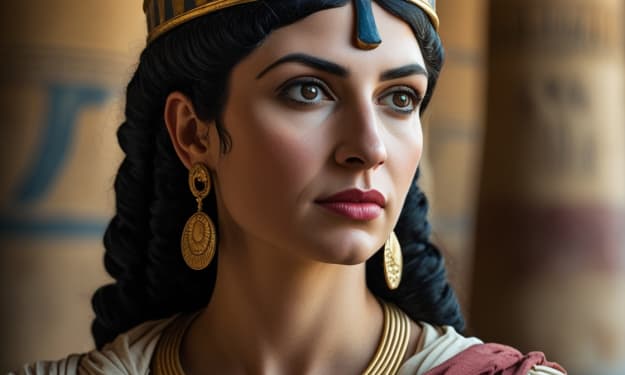
The Lost Treasure of Cleopatra: The Hidden Wealth of Egypt's Last Pharaoh. AI-Generated.
The Lost Treasure of Cleopatra: The Hidden Wealth of Egypt's Last Pharaoh Cleopatra VII, the last Pharaoh of Ancient Egypt, has fascinated historians, archaeologists, and storytellers for centuries. Celebrated for her political brilliance, romantic liaisons with Julius Caesar and Mark Antony, and dramatic demise, Cleopatra was more than just a queen—she was an empire unto herself. But behind the myth and majesty lies one of history’s most enduring mysteries: what happened to Cleopatra’s treasure? When Cleopatra ruled Egypt from 51 to 30 BCE, she presided over one of the richest and most powerful kingdoms of the ancient world. The Nile’s fertile banks, bustling trade ports, and immense natural resources made Egypt a glittering prize. Cleopatra inherited a kingdom that was both culturally sophisticated and financially robust. But how much wealth did she truly possess—and where did it all go? A Fortune Fit for a Pharaoh Cleopatra’s net worth, when adjusted to modern terms, is impossible to calculate with precision, but scholars estimate it may have been equivalent to hundreds of billions of dollars today. Some even suggest that she could have been among the richest women in history. As queen, Cleopatra had control over Egypt’s vast grain reserves, which were critical to feeding the Roman Empire. She also held dominion over immense reserves of gold, silver, spices, gemstones, and rare artifacts that poured in from Africa, India, and the Middle East through trade. The famed Library of Alexandria alone, stocked with untold knowledge and priceless scrolls, could be considered a cultural treasure beyond valuation. But Cleopatra didn’t just inherit wealth—she expanded it. She was a shrewd economist and administrator who reformed Egypt’s taxation systems, encouraged commerce, and maintained a luxurious but strategically necessary court. The Treasure of Antony and Cleopatra One of the most intriguing aspects of Cleopatra’s wealth is what became of it after her death. Following the defeat of Antony and Cleopatra at the Battle of Actium in 31 BCE, Octavian (later Augustus Caesar) moved to annex Egypt and absorb its riches into the Roman Empire. According to ancient sources like Plutarch and Cassius Dio, Cleopatra took steps to hide or destroy some of her wealth to keep it from falling into Roman hands. The most popular legend claims that before her suicide in 30 BCE, Cleopatra had her most precious treasures—including gold, jewelry, and sacred artifacts—sealed and hidden, possibly beneath the Nile or in secret tombs in or near Alexandria. Some versions of the legend suggest that Cleopatra’s loyal followers transported the treasure to a hidden location, possibly one of the many Ptolemaic burial chambers in the desert or under the ocean floor near the ruins of ancient Alexandria. Others say she may have built a secret vault beneath her palace or in the Temple of Isis at Taposiris Magna, where some archaeologists believe she might be buried alongside Antony. The Treasure Hunt: Fact or Fantasy? Modern treasure hunters, archaeologists, and explorers have spent decades searching for Cleopatra’s lost wealth. One of the most active sites of excavation is Taposiris Magna, located about 45 kilometers west of Alexandria. There, archaeologists have uncovered coins bearing Cleopatra’s face, royal statues, and ceremonial objects—all suggesting that the temple may have been closely associated with her. In 2020, the Egyptian Ministry of Antiquities revealed that dozens of mummies were found buried with golden tongues in the area, suggesting ritualistic burials possibly linked to royal or elite lineages. Still, no definitive signs of Cleopatra’s final resting place—or her treasure—have been discovered. In Alexandria itself, much of the ancient city now lies submerged beneath the Mediterranean due to centuries of earthquakes and tsunamis. Divers exploring these underwater ruins have uncovered sphinxes, columns, and statues, but again, no massive treasure troves. The Real Treasure: Cleopatra’s Legacy While the literal treasure of Cleopatra remains hidden, her greatest wealth may be her enduring legacy. Cleopatra defied the stereotypes of her time. She was not merely a seductress or puppet queen—she was a ruler who spoke nine languages, studied philosophy and science, and commanded loyalty from her people and respect from her enemies. Her image, enshrined on coins, in Roman propaganda, and through Shakespearean drama, continues to captivate the world. Cleopatra has been portrayed as both goddess and villain, but her story is ultimately one of survival, ambition, and unmatched charisma.
By Say the truth about a year ago in History
Cleopatra’s Lost Fortune: The Untold Mystery of Egypt’s Last Queen. AI-Generated.
Cleopatra’s Lost Fortune: The Untold Mystery of Egypt’s Last Queen In the grand tapestry of ancient history, few figures evoke as much intrigue and fascination as Cleopatra VII, the last Pharaoh of Egypt. Known as much for her intellect and political acumen as her beauty, Cleopatra ruled at a time of both immense opportunity and growing Roman influence. But beyond her tragic love stories and royal lineage lies an enduring enigma: what happened to Cleopatra’s legendary wealth? When Cleopatra ascended the throne of Egypt in 51 BCE, she inherited a nation whose coffers overflowed with the riches of millennia. Egypt, strategically located at the crossroads of Africa, the Middle East, and the Mediterranean, was the breadbasket of the ancient world. Its fertile Nile Delta, thriving trade ports like Alexandria, and ancient tombs packed with gold and artifacts made the kingdom one of the wealthiest on Earth. The Ptolemaic dynasty, of Macedonian Greek origin and founded by one of Alexander the Great’s generals, had ruled Egypt since 305 BCE. By Cleopatra's time, it had amassed wealth through trade in grain, papyrus, perfumes, and exotic luxuries. The Library of Alexandria was not only a hub of knowledge but also a symbol of Egypt’s cultural and economic dominance. Cleopatra herself was no passive heiress. Fluent in nine languages and deeply involved in administrative affairs, she revitalized Egypt’s economy through reforms, devaluing currency to stimulate trade and stabilizing grain distribution to avoid famine. Her personal wealth grew alongside the state’s, and she was said to be one of the richest individuals of her time. However, her fortunes would become entangled with two of Rome’s most powerful men: Julius Caesar and Mark Antony. With Caesar, she formed a political alliance and romantic relationship that helped secure her throne. After his assassination in 44 BCE, she turned to Mark Antony, with whom she had three children and shared power in the eastern Roman territories. Mark Antony and Cleopatra’s combined wealth was legendary. Together, they held dominion over vast swathes of territory rich in resources, and their court in Alexandria was said to rival or even surpass that of Rome. Historical sources describe opulent feasts, golden thrones, and ships laden with treasure. Cleopatra reportedly possessed not just gold and silver, but emerald mines, pearls, and artistic masterpieces. But this golden age was short-lived. In 31 BCE, their forces were defeated by Octavian (later Augustus Caesar) at the Battle of Actium. With their political and military power collapsing, Antony and Cleopatra retreated to Egypt. One year later, facing inevitable defeat, they both died by suicide—Cleopatra famously through the bite of an asp, although that account is debated. And then, the trail of her treasure vanishes. Roman records suggest Octavian seized much of Cleopatra's wealth upon his conquest of Egypt. It is said he used it to fund his rise as Emperor and stabilize the Roman economy. But many historians believe not all of it was captured. Cleopatra, ever cunning and strategic, may have hidden a portion of her treasure in anticipation of defeat. Legends persist of treasure-laden tombs buried beneath the sands of Egypt, or sunken hoards beneath the waters near Alexandria. In particular, the lost city of Thonis-Heracleion, recently discovered submerged off the Egyptian coast, has yielded some clues about Egypt’s vast maritime wealth, but no definitive link to Cleopatra’s missing fortune. Another mystery lies in the location of her final resting place. Ancient sources suggest Cleopatra and Antony were buried together in a grand mausoleum near Alexandria. Archaeologists, including renowned Egyptologist Dr. Zahi Hawass, have spent years searching for this lost tomb, hoping it may contain not only their remains but possibly the last cache of Cleopatra’s riches. The allure of Cleopatra’s lost wealth continues to captivate adventurers and scholars alike. Could it be hidden in a secret chamber beneath ancient temples? Was it smuggled out of Egypt by loyalists? Or did it truly pass into the hands of Rome, vanishing into history? What remains undeniable is that Cleopatra’s legacy, like her fortune, has withstood the test of time. Her tale is not merely one of love and tragedy, but of power, strategy, and a mysterious treasure that may still lie hidden beneath the sands of her fallen kingdom.
By Say the truth about a year ago in History
The Golden Depths of India: The Untold Narrative of Kolar Gold Fields
Ancient Beginnings: Gold Prior to Empire The history of gold extraction in the Kolar area extends back more than 2,000 years. Archaeological findings indicate that the early inhabitants of South India were cognizant of the gold beneath their feet and had devised rudimentary methods of extraction. Ancient temples and writings reference the dazzling wealth of the Kolar region, and some historians even speculate that gold from these mines may have embellished the courts of the Chola and Vijayanagara empires. Nonetheless, it was during the British colonial period that KGF evolved from local artisanal mining into an industrial behemoth. Colonial Exploitation and the Emergence of an Industrial Colossus In the late 19th century, British engineers and geologists discerned the immense potential concealed beneath Kolar’s rugged landscape. In 1871, Michael Lavelle, an Irish soldier, acquired the rights to mine gold in the vicinity. Although his initial endeavors yielded modest profits, it was his discovery that ignited interest from British enterprises, particularly the John Taylor and Sons Company, which would ultimately dominate gold production in KGF for decades. By the early 1900s, KGF housed one of the deepest mines worldwide, descending more than 3,000 meters (over 10,000 feet) into the earth. It was equipped with state-of-the-art technology for the era: electric lifts, subterranean railways, and advanced ventilation systems. British colonial authorities established a township surrounding the mines complete with bungalows, clubs, churches, and even a golf course earning KGF the moniker “Little England. ” Golden Glory: Wealth, Labor, and Heritage During its peak production years, particularly between 1900 and 1956, KGF yielded nearly 800 tonnes of gold. It significantly contributed to the British economy and subsequently to the reserves of independent India. However, this gold was acquired at a considerable human cost. Tens of thousands of Indian laborers many hailing from Tamil Nadu and Karnataka labored in arduous underground conditions. They endured long hours, perilous cave-ins, substandard air quality, and exposure to mercury and other hazardous substances utilized in refining processes. Despite the adversities, KGF fostered a vibrant cultural life. It became one of the earliest locales in India to achieve full electrification (in 1902), thanks to the nearby hydroelectric facility at Shivanasamudra. Schools, hospitals, and churches prospered in the region, forming a distinctive Anglo-Indian community that remains proud of its heritage. The Decline of the Gold Giant By the 1970s, the Kolar mines began to exhibit indicators of depletion. The deeper the miners excavated, the more challenging and costly it became to extract gold. The government of India, which had assumed control of operations through Bharat Gold Mines Ltd (BGML), found it progressively difficult to justify the expenditures. In 2001, following several years of deficits and labor conflicts, the mines were officially closed. Thousands of laborers lost their employment, and the once-thriving KGF township descended into deterioration. Myth, Legacy, and Contemporary Pop Culture Even after their closure, the myth of KGF persisted. Locals recounted stories of untouched gold deposits and concealed chambers buried deep underground. These narratives fueled tales of hidden wealth, inspiring literature and cinema. In recent times, the Kannada-language film series “KGF” has reignited interest in the region’s history, depicting a dramatized version of the gold rush, mafia conflicts, and uprising. Although the films took artistic liberties, they highlighted the stark realities and splendor of a bygone age. Reopening the Gold Veins? Recently, efforts have been made to revive gold mining in the Kolar region. The Indian government has proposed plans to auction the mines to private enterprises, hoping that contemporary technology may render extraction viable once more. Environmental issues, land rights, and economic feasibility continue to pose significant obstacles. Nonetheless, if even a fraction of KGF’s estimated remaining gold reserves purported to be valued in the billions can be mined, it could once again transform the region’s prospects. Conclusion The narrative of Kolar Gold Fields transcends mere gold. It encompasses ambition, colonization, innovation, sacrifice, and pride. The mines may be quiet today, but the legacy of KGF runs deep within the hearts of those who once called it home and in the substrata of the land that may still shimmer with secrets waiting to be discovered.
By Say the truth about a year ago in History
The Secret Behind Japan’s Economic Boom in the 1960s and 70s
Imagine a country reduced to rubble, its cities flattened, its economy shattered, and its people devastated by war. Now, imagine that same country becoming the second-largest economy in the world within just two decades. Sounds impossible? This is not a fairy tale — it’s the real story of Japan. And the secret behind its stunning transformation lies not in luck, but in vision, discipline, and relentless innovation.
By MystiTech Hubabout a year ago in History
Yahangala
Yahangala Yahangala is known as another special ancient place in Sri Lanka. You can understand at a glance that it is a beautiful area full of fertile fields, streams, and trees. It is said in folklore that it has a very close connection with the 5000-year-old history of the great Ravana. When researching the facts, it can be revealed that many stories have been built about Yahangala. This place was the site of the god Gale Bandara. It is true that many evidences of the true history of 5000 years are still preserved and preserved today. This place can be reached through Udawela and Ududumbara. Although it is called Yahangala, this place is also known as Yahangala and Yahan Ward. The villagers say that the paddy field below the center of the Yahangala mountain is the paddy field under the care of the god Gale Bandara. The special reasons for this There is. The old name of this place was,,Yahan Ward.. The reason for the name Yahan Ward is that,,the weapons and armor of the great King Ravana were deposited here..Because those weapons and armor were deposited here,,it is called Yahan Ward.But the name Yahan Ward is known today as Yahangala.The villagers say that there are several reasons for the name Yahangala.
By Story Worldabout a year ago in History
Did Dire Wolves Really Return from Extinction? Shocking DNA Discovery Revealed.
Did Dire Wolves Really Return from Extinction? Shocking DNA Discovery Revealed. The dire wolf, a name that sends chills down the spine of any fan of prehistoric predators or “Game of Thrones” enthusiasts is one of the most iconic extinct creatures of the last Ice Age. These massive powerful canines once roamed North and South America hunting large prey and dominating the landscape. But after disappearing around 10,000 years ago they were considered lost to history until recently. Rumors and viral social media posts have stirred up a controversial question Did dire wolves just come back from extinction.
By Adnan Rasheedabout a year ago in History
The Solar System
The Sun, eight planets and their moons, as well as a variety of smaller celestial objects like asteroids, comets, and dwarf planets, make up the vast and fascinating solar system. Although it is a small region of the Milky Way galaxy, it is our home—a beautiful and intricate system that has captivated humanity for centuries. At the heart of the solar system lies the Sun, a massive star composed primarily of hydrogen and helium. It accounts for more than 99% of the solar system’s total mass and provides the light and heat that make life possible on Earth. The delicate balance that governs our cosmic neighborhood is maintained by keeping all other celestial bodies in orbit around the Sun because of its gravity. The planets of the solar system are divided into two main categories: terrestrial (rocky) planets and gas giants. Mars, Mercury, Venus, and the four inner planets are all terrestrial planets. They are mostly made of rock and metal and have solid surfaces. Mercury, the closest to the Sun, is a small, cratered planet with extreme temperatures. Venus is the hottest planet in the solar system due to its thick, toxic atmosphere and similar size to Earth. Earth, our homeworld, is the only known planet with liquid water, a protective atmosphere, and moderate temperatures that support life. Mars, also known as the "Red Planet," is a chilly desert planet that has piqued the interest of researchers due to evidence of ancient rivers and possibly living organisms. Beyond Mars lies the asteroid belt, a region filled with rocky debris and minor planets. The largest object in this region is the dwarf planet Ceres. The asteroid belt serves as a boundary between the inner, rocky planets and the outer, gas giant planets. The outer solar system is made up of the gas giants Jupiter and Saturn and the ice giants Uranus and Neptune. Jupiter is the largest planet, with a powerful magnetic field and dozens of moons, including Ganymede, the largest moon in the solar system. The well-known Great Red Spot, a massive storm that has raged for centuries, can be seen in its atmosphere. Saturn is known for its stunning ring system, made of ice and rock particles. Additionally, it has a large system of moons, one of which is Titan, which has lakes of liquid methane. Uranus and Neptune, often called ice giants due to their icy compositions, are far colder and more mysterious. Uranus has a unique tilt, rotating almost on its side, and a faint ring system. Neptune, the farthest known planet, is a deep blue world with strong winds and storms, including the Great Dark Spot, similar to Jupiter's storm systems. Beyond Neptune lies the Kuiper Belt, a region populated by icy bodies and dwarf planets such as Pluto, Haumea, and Makemake. Pluto, once considered the ninth planet, was reclassified as a dwarf planet in 2006 by the International Astronomical Union. The belt extends into the scattered disc and eventually gives way to the Oort Cloud — a theoretical shell of icy objects that may mark the boundary of the Sun’s gravitational influence. The solar system is constantly in motion, with planets orbiting the Sun at different speeds and distances. For instance, one orbit of Earth takes approximately 365.25 days, whereas Neptune takes more than 165 Earth years. Even smaller objects, such as asteroids and comets, follow distinct paths influenced by gravitational forces as they orbit their planets. Telescopes, spacecraft, and robotic missions continue to be used by scientists to investigate the solar system. Extending beyond the outer planets, probes like Voyager 1 and 2 have returned valuable data. Rovers on Mars, orbiters around Jupiter and Saturn, and future missions to moons and asteroids help us understand more about the formation, evolution, and possibilities of life beyond Earth. In conclusion, the solar system is a dynamic and diverse system, rich in history and mystery. It invites us to explore the vast universe beyond, telling the story of our origins from the blazing Sun to the icy Oort Cloud fringes.
By Mahamudul Hasanabout a year ago in History