Discoveries
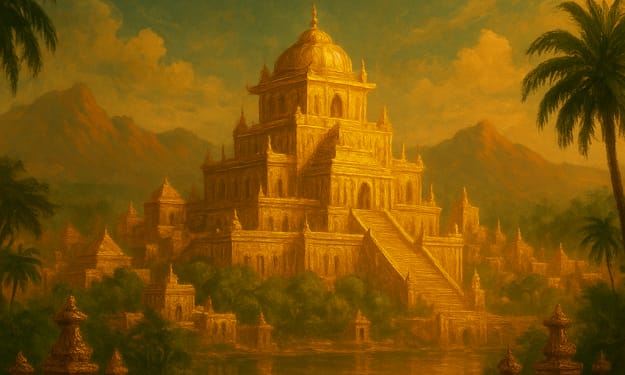
“The Golden Mirage: Unveiling the Legend of El Dorado’s Hidden Palace” . AI-Generated.
The Golden Mirage: Chronicle of the Golden Palace in El Dorado For centuries, the myth of El Dorado, the legendary city of gold concealed deep within South America, has sparked the imagination of explorers, historians, and adventurers. Central to this legend is the Golden Palace, a radiant fortress purportedly decorated entirely with goldits walls, floors, thrones, and even sacred altars. Although no concrete evidence of its existence has ever been discovered, the legacy of the palace continues to cast a golden hue throughout the annals of history. Origins of the El Dorado Legend The narrative of El Dorado stems from the indigenous Muisca populace of contemporary Colombia. “El Dorado,” which translates to “The Gilded One” in Spanish, initially denoted not a metropolis, but a ceremonial rite. According to early Spanish narratives, the Muisca would coat their new leader in gold dust and place him on a raft in Lake Guatavita, where he would present offerings of gold and emeralds to the deities by casting them into the waters. This spectacle of gold captivated the Spanish conquistadors, who perceived the ceremony as an indication of a prosperous kingdom governed by a gilded monarch. As the tale proliferated, the concept of El Dorado evolved from a singular entity into an entire cityor, more ambitiously, a golden empire. The Quest for the Golden Palace Driven by aspirations of wealth and renown, countless expeditions navigated the dense jungles and perilous landscapes of the New World during the 16th and 17th centuries. Conquistadors such as Gonzalo Pizarro, Francisco de Orellana, and Sir Walter Raleigh embarked on treacherous journeys in search of this elusive city. Raleigh was convinced that El Dorado, with its golden palace, was situated near Lake Parime in what is now Venezuela or Brazil. He depicted the city of Manoa, which he asserted gleamed with golden towers and luminous temples. These endeavors, however, were laden with peril. Severe climates, famine, illness, and violent confrontations with indigenous tribes claimed numerous lives. Despite the exorbitant toll, the allure of an extravagant palace, allegedly capable of rivaling any European court, sustained the legend.
By Say the truth about a year ago in History
"The Billion-Dollar Gorge: Unveiling the History and Net Worth of the Grand Canyon". AI-Generated.
"The Grand Legacy: Investigating the History and Worth of the Grand Canyon" The Grand Canyon, one of the planet's most stunning natural marvels, possesses not only geological significance but also considerable cultural, historical, and economic importance. This article explores the profound history of the canyon, from ancient civilizations to contemporary tourism, and evaluates its extraordinary value in terms of natural resources, tourism income, and ecological significance. The Grand Legacy: Investigating the History and Worth of the Grand Canyon Extending 277 miles in length, up to 18 miles in width, and exceeding a mile in depth, the Grand Canyon is not solely a striking geological formation it is a testament to the might of natural forces and the lasting legacy of time. Sculpted over millions of years by the powerful Colorado River, the Grand Canyon presently stands as one of the most recognizable symbols of natural beauty, adventure, and heritage in the United States and globally. A Journey Through Ancient Time The narrative of the Grand Canyon commenced nearly two billion years ago when ancient rocks, such as Vishnu Schist, were formed deep beneath the planet's crust. The area was once an ocean floor, which underwent numerous uplifts and erosions. Approximately 5 to 6 million years ago, the Colorado River initiated its course, gradually carving its path through layers of rock and sediment. This erosion process produced the intricate landscapes we now admire. Indeed, some rock layers visible in the canyon walls date back as far as 1. 8 billion years, ranking them among the oldest exposed rocks on the planet. This has established the Grand Canyon as a crucial research site for geologists and earth scientists examining the Earth’s history. Indigenous Heritage and Cultural Origins Long before the Grand Canyon transformed into a national park or a tourist hotspot, it served as the home to various Native American tribes. The Ancestral Puebloans (also referred to as Anasazi), who occupied the area over 12,000 years ago, left behind archaeological proof of their culture, including structures and artifacts. Even today, the canyon is regarded as sacred by numerous Native tribes, including the Havasupai, Hualapai, Hopi, and Navajo peoples. Their traditions, narratives, and spiritual ties to the canyon continue to shape its identity and remind visitors that this land possesses a profound and intricate human history. Exploration and Conservation The first documented European to witness the Grand Canyon was Spanish explorer García López de Cárdenas in 1540, but it wasn’t until the 19th century that American explorers and settlers began to systematically map and investigate the region. In 1869, John Wesley Powell led the first successful expedition through the canyon by river, chronicling its grandeur and advocating for its scientific relevance. President Theodore Roosevelt, a fervent proponent of conservation, visited the Grand Canyon in 1903 and subsequently declared parts of it a national monument in 1908. In 1919, it was formally designated as a National Park one of the earliest established within the U. S. National Park Service ensuring its preservation for future generations. The Economic and Ecological Worth The Grand Canyon is not merely a visual spectacle; it is also a substantial economic engine. As reported by the National Park Service, the Grand Canyon National Park attracts over 5 million visitors each year, generating approximately $1. 5 billion annually in tourism-related income, encompassing accommodations, excursions, dining, and retail. When evaluating the canyon's "net worth," one must take into account its: Tourism Revenue: Exceeding $1. 5 billion each year. Ecosystem Services: The canyon's safeguarded ecosystems sustain wildlife, water filtration, and air quality services valued at potentially hundreds of millions. Geological and Scientific Importance: Inestimable, due to its distinctive and ancient rock formations. Cultural and Historical Relevance: Priceless, owing to Native American heritage, historical explorations, and its significance in conservation history.
By Say the truth about a year ago in History
"The Blade of Legends: Unveiling the History of Alexander the Great's Sword"
The Blade of Legends: The History of Alexander the Great’s Sword The sword of Alexander the Great serves as more than merely a weaponit represents authority, heritage, and victory. This article explores the extensive history of his renowned blade, tracing its inception, importance, and its influence in the formation of one of history’s most significant empires. Introduction The sword belonging to Alexander the Great, the Macedonian conqueror responsible for creating one of the largest empires the world has ever witnessed, continues to be a mythical artifact of ancient history. Although the precise location of this sword has been lost through the ages, historical documentation, narratives from ancient authors, and archaeological findings offer a vivid depiction of a weapon that not only assisted in the subjugation of empires but also emerged as a symbol of divine right and invincibility. The Origin of Alexander’s Sword It is believed that Alexander’s sword was a kopis or a xiphos, the conventional swords of Greek warriors. The kopis featured a curved, single-edged blade engineered for powerful slashing strikes, frequently favored by cavalry units, while the xiphos was shorter, double-edged, and straightoptimal for hand-to-hand combat. Historical literature indicates that Alexander had a preference for the xiphos, due to its lightweight, efficiency in compact formations, and better suitability for the close-quarter tactics of Macedonian phalanx warfare. It is also suggested that Alexander's personal sword may have been crafted by a master artisan from Damascus or Persia, potentially adorned with gold or inlaid with precious gemstones, signifying his royal lineage. Symbol of Divine Right The importance of Alexander’s sword transcended mere practicality and held significant symbolic meaning. In the ancient era, rulers were frequently believed to be divinely appointed, a concept that Alexander embraced earnestly. Following his conquest of Egypt, he was proclaimed the son of Amun-Ra, the Egyptian deity. In numerous illustrations and legends, Alexander’s sword was regarded as a celestial weaponimbued with the might and authority of the gods. One of the most iconic narratives involves Alexander’s severing of the Gordian Knot. Faced with the intricate knot that prophecy stated only the future ruler of Asia could undo, Alexander boldly drew his sword and cut through it. This gesture represented his audacity, decisiveness, and destined rulership. The Sword in Campaigns Alexander’s sword accompanied him throughout his significant campaigns: from the Granicus River to Issus, and from Gaugamela to Hydaspes. On each occasion, it served not merely as a weapon of combat, but as a focal point for his forces. Ancient historians like Plutarch and Arrian frequently noted how Alexander would personally lead his charges, sword in hand, positioned at the forefront, which elevated the spirits of his troops and fostered loyalty. It is said that Alexander consistently carried his sword with him, even while sleeping, underscoring the value he placed on personal courage and leadership. Craftsmanship and Legacy Although no verified physical remnant of Alexander’s sword exists today, numerous historical blades are displayed in museumsallegedly claimed by some to be his or designed after his weapon. The most reliable accounts describe an iron blade featuring a gold-inlaid hilt and a pommel shaped like a lion's head, potentially signifying strength and nobility. Myths within Persian and Arabic traditions also reference a "sword of the two horns" (alluding to Alexander’s frequent portrayal as “Dhul-Qarnayn” in Islamic texts). While this may be primarily legendary, it contributes to the cross-cultural heritage of the weapon. In the centuries following Alexander’s passing in 323 BCE, many monarchs endeavored to replicate his achievements. Some asserted they possessed his sword or utilized replicas as emblematic tokens of legitimacy. Even Julius Caesar drew inspiration from Alexander, keeping a statue of him in his quarters, perhaps reflecting the fascination with the sword and its wielder. The Sword in Cultural Recall In contemporary society, Alexander’s sword is a prominent theme in film, literature, and video games. It frequently embodies the capacity to conquer, the weight of leadership, and the intricacies of legacy. The sword has evolved into a metaphornot merely for warfare, but for audacious actions in the face of insurmountable challenges. In Islamic, Persian, and Eastern narratives, Alexander’s portrayal as a sagacious king and formidable conqueror adds spiritual and philosophical layers to his sword, comparing it to Excalibur or other legendary blades. Estimated Value (Theoretical) Should Alexander’s original sword be unearthed today, its net worth would be incalculable. As an invaluable historical relic associated with one of history's greatest military strategists, its worth would undoubtedly exceed $100 million, potentially ascending to hundreds of millions depending on its condition, provenance, and materials. Private collectors, royal institutions, and nations could vie for its possession. Conclusion Although obscured by time, the sword of Alexander the Great continues to be one of the most intriguing artifacts in human history. It transcends mere steel and goldit encompasses destiny, leadership, and the relentless pursuit of greatness. In numerous respects, the sword of Alexander traverses centuries not just as an implement of combat, but as a representation of a lasting legacy that continues to motivate the world today.
By Say the truth about a year ago in History
"The Ottoman Legacy: Uncovering the Greatest Treasure in Muslim History". AI-Generated.
The Concealed Treasures of Islam: Revealing the Most Significant Wealth in Muslim History Throughout Islamic chronology, numerous valuables have been amassed, uncovered, and safeguarded by various Muslim dynasties. Notably, the treasury of the Ottoman Empire is distinguished as the most precious and extensive. Featuring relics associated with the Prophet Muhammad, war spoils, royal jewels, and generous offerings from across the Islamic realm, the Ottoman Imperial Treasury remains one of the most remarkable assemblages of Islamic affluence ever gathered. This article examines its historical context, importance, and appraised worth. The Wealthy Heritage of Muslim Civilization From the illustrious period of the Abbasids to the pinnacle of the Ottoman Empire, Islamic civilization has been a nucleus of wisdom, architecture, cultureand substantial riches. Among the myriad treasures that Islam generated or acquired through epochs of conquest, commerce, and diplomacy, one rises above the rest: The Ottoman Imperial Treasury. Currently located in Istanbul's Topkapi Palace, this assemblage transcends a simple exhibition of gold and gemsit epitomizes centuries of Islamic authority, devotion, and distinction. Origins of the Ottoman Treasure The accumulation of treasure commenced in the 14th century as the Ottoman Turks, evolving from a modest Anatolian principality, began to expand into Byzantine and Balkan domains. As they subjugated territories, they absorbed wealth from local sovereigns and collected offerings from allied states and vassals. By the era of Suleiman the Magnificent in the 16th century, the Ottoman Empire had attained its zenith. Istanbul had transformed into not only the political center but also a spiritual and economic nucleus of the Muslim world. Lavish gifts streamed in from Persia, Egypt, India, and even Europe. The treasures also included the spoils of victorious military campaigns, especially against the Safavids and the Habsburgs. The Prophet’s Relics: A Sacred Treasure What distinguishes the Ottoman treasure from other royal hoards is the presence of revered Islamic relics. The Sultans, as Caliphs of the Muslim realm, were guardians of articles believed to have belonged to the Prophet Muhammad: The Prophet’s Mantle (Hırka-i Saadet) His Sword and Bow The Sacred Seal A Hair from His Beard These relics were kept with profound respect, watched over by dedicated Quran reciters who would continuously chant in their vicinity. For many Muslims, these were not merely treasures but sacred artifacts symbolizing their faith and identity. Jewels, Gold, and Gifts In addition to relics, the treasury included ornate weaponry, jewel-encrusted thrones, ceremonial armor, and gold Qurans. One of the most emblematic items is the Topkapi Dagger, an exquisite creation in emerald and gold, signifying Ottoman opulence and artistic genius. Another notable piece is the Spoonmaker’s Diamond, an 86-carat gemstone encircled by numerous smaller diamonds. This treasury also encompasses thousands of ceremonial garments, china from China, manuscripts, and ceremonial bannersmany of which were invaluable gifts from other Muslim monarchs or sultans. Estimated Net Worth While the precise value is challenging to ascertain due to the historical and religious significance of numerous artifacts, the net worth of the Ottoman Imperial Treasure is approximated to surpass $10 billion USD, with certain experts estimating it to be nearer to $20 billion when factoring in the cultural and historical context. The Spoonmaker’s Diamond alone is valued at more than $100 million. The worth of the sacred relics is, naturally, considered immeasurable in monetary terms by devotees. Preservation and Legacy Following the collapse of the Ottoman Empire after World War I, the Republic of Turkey implemented measures to safeguard this treasure, inaugurating Topkapi Palace as a museum in 1924. The Imperial Treasury remains one of the most frequented sections of the palace, drawing millions of visitors each year. More than mere wealth, this collection signifies a link between spiritual reverence and imperial strength. It stands as a testament to a civilization that once bridged East and West, governed three continents, and left an indelible impact on world history. Conclusion The treasure of the Ottoman Empire transcends the simplistic notions of diamonds, gold, and ceremonial items. It embodies a confluence of faith, history, politics, and identityall encompassed within the magnificence of the Islamic world’s most dominant dynasty. Its preservation today attests to the lasting legacy of Islamic civilization, and it remains arguably the greatest treasure ever possessed in Muslim history.
By Say the truth about a year ago in History
2025 Youth & Health: Discover the Fountain of Youth. AI-Generated.
2025 Youth & Health: Discover the Fountain of Youth Looking ahead to 2025, we all want to stay young and healthy. The idea of finding the "fountain of youth" has changed. Now, it's about the newest wellness trends and tech that help us live longer.
By Junayed Ahmedabout a year ago in History
Tutankhamun: The Boy King and the Forgotten Truth of the Sphinx
Tutankhamun: The Boy King and the Forgotten Truth of the Sphinx When Tutankhamun, the boy pharaoh, was discovered in 1922 by Howard Carter, his tomb stunned the world. Sealed for over 3,000 years, it was a time capsule from a forgotten era. Gold, art, and strange symbols filled the chambers. But what the world saw was just the surface.
By The Secret History Of The Worldabout a year ago in History
A Genocide Ignored: The World Must Act to Stop Israel’s Assault on Gaza
A Cry for Justice: Humanity Must End the Violence in Gaza On March 18, a new wave of destruction struck Gaza as continuous airstrikes resumed, resulting in the deaths of over 730 Palestinians and injuries to more than 1,300 others within just one week. For countless individuals in Gaza, this latest round of violence is not a standalone event—it is part of a prolonged history of turmoil under an 18-year blockade that has gradually diminished hope, infrastructure, and the very essence of a society striving to endure under siege.
By Mubarak Hossain Akashabout a year ago in History
"Beneath the Surface: The Myth, Mystery, and Millions of the Underground Silver Lake" . AI-Generated.
"The Concealed Wealth: Investigating the Legend and Enigma of the Subterranean Silver Lake" Beneath the earth's exterior, within remote caverns and forsaken passageways, resides a mythical body of water purported to glisten with silveran underground lake whose roots, structure, and value have bewildered adventurers and researchers for centuries. This article reveals the narrative, geological features, folklore, and estimated financial worth of the legendary Subterranean Silver Lake. Introduction: An Unseen Wonder Beneath Our Ground From the summits of the Himalayas to the depths of the Mariana Trench, our planet harbors secrets that surpass human comprehension. Among these mysterious marvels is a less familiar yet equally intriguing phenomenon: the Subterranean Silver Lake. Concealed in accounts from miners, geologists, and native populations, this lake is said to reside deep beneath the earth's surface, its waters shimmering with silver-enhanced minerals and rare earth components. Although its precise position has never been revealedor verifiedmany speculate it rests beneath the silver mines of South America or possibly within an unblemished cavern framework in Central Asia. This article examines the potential history, scientific conjecture, and mythical affluence of this elusive underground treasure. The Myths and Folklore The earliest allusions to an underground silver lake trace back to the 15th century, originating from the highlands of Peru and Bolivia. Spanish conquerors recorded narratives from the Quechua and Aymara tribes about a “Lake of Stars” concealed beneath the ground, reflecting silver even in full darkness. According to local folklore, it was a revered lake protected by spirits, where no individual who entered ever returned. By the 18th century, analogous legends surfaced from Eastern Europe, particularly within the Carpathian Mountains. Miners in that region spoke of a “silver mirror beneath the earth,” a vast underground chamber filled with silver-infused waters bright enough to blind a person from its sheer luminosity. Scientific Feasibility: Might It Be Authentic? Contemporary geologists have deliberated whether such a lake could truly exist. Technically, underground lakesalso referred to as subterranean aquifers or water-filled cavernsare commonplace. Some, like Dragon’s Breath Cave in Namibia, are extensive, oxygen-rich, and seldom explored. What distinguishes the Silver Lake is its purported high concentration of dissolved silver and heavy minerals, bestowing it with a metallic luster. This occurrence is geologically uncommon, yet not unattainable. In regions with significant mineral deposits, groundwater can become saturated with metallic ions, imparting a sparkling or reflective quality. Hydrothermal vents or subterranean geothermal processes could facilitate this mineral enrichment. Attempts at Discovery and Investigation Throughout the past century, numerous expeditions have been initiated to unveil the reality behind the legend. In 1903, a British explorer named Charles Winton asserted he had witnessed a lake beneath a collapsed silver mine in Bolivia. His account, published in The Explorers’ Journal, described "a tranquil lake the hue of molten metal, encompassed by stalactites that shone like blades. " In 1984, a Soviet mining expedition in the Ural Mountains encountered a substantial subterranean cavity containing water with elevated silver concentration. The site was sealed for undisclosed reasons, yet the occurrence reignited interest in the legend. To this day, no official verification of the Underground Silver Lake existshowever, scientific communities continue to be fascinated, and treasure seekers persist in their pursuit. Economic Assessment: What Might It Be Valued At? If the Underground Silver Lake were authentic, its worth could be astronomical. Let us analyze it: Silver Concentration: If the lake holds water with even 1% silver concentration (10,000 ppm), and assuming an average lake volume of 5 million cubic meters, that amounts to roughly 50,000,000 kg of silver. Current Market Valuation: With silver valued at approximately $25 per ounce, or $880 per kilogram, that translates to an astounding $44 billion USD in silver alone. Incorporate Rare Earth Elements: If the lake contains additional trace elements such as lithium, platinum, or palladium, which frequently accompany silver ores, its total net value could easily exceed $60–80 billion USD. Environmental and Ethical Implications The existence of such a treasure evokes ethical dilemmas. Extracting resources from a delicate underground ecosystem could result in irreversible harm. The silver lake, if established as real, might become a focal point for both environmental advocates and mining enterprises. Would it be conserved as a natural marvel or exploited as a commercial bonanza? Conclusion: Treasure, Myth, or Natural Wonder? Whether the Underground Silver Lake is genuine or merely a sparkling narrative passed through generations, its tale continues to enthrall dreamers and scientists alike. It signifies more than concealed wealthit is a representation of how much remains undiscovered beneath the surface of our planet. As technology progresses, and exploration probes deeper into Earth's crust, we may someday validate the existence of this silvery subterranean lake. Until then, it endures as a sparkling enigmaone of Earth’s most alluring secrets awaiting revelation.
By Say the truth about a year ago in History
The Forgotten Opulence: The Abandoned Mansion of the Coca-Cola Heir. Content Warning. AI-Generated.
Nestled in the quiet outskirts of Atlanta, Georgia, shrouded by towering pines and creeping ivy, stands the skeletal remains of a once-glorious estate—Glenridge Hall. This hauntingly beautiful mansion, with its crumbling columns and boarded-up windows, holds a secret history tied to one of America’s most iconic fortunes: Coca-Cola.
By MD TANVIR HOSSAINabout a year ago in History
Pohela Boishakh: How the Bengali New Year Became a Celebration of Identity
Pohela Boishakh: How the Bengali New Year Became a Celebration of Identity From Emperor Akbar’s calendar reform to Rabindranath Tagore’s cultural revival, discover how Pohela Boishakh evolved into Bengal’s most inclusive and beloved festival—uniting people beyond religion, region, and time.
By MystiTech Hubabout a year ago in History
“Earth’s Golden Vein: The Untold Wealth Beneath the Most Expensive Land on Earth” . AI-Generated.
Earth’s Golden Vein: The Untold Wealth Beneath the Most Expensive Land on Earth The surface of the Earth dazzles us with mountains, forests, deserts, and rivers. But beneath that surface lies a wealth that has driven empires, launched wars, and created unfathomable fortunes. Among all the lands blessed by nature’s hand, a few stand above the rest—not for their beauty, but for what they hide beneath. One such area, located in Eastern Siberia in Russia, spans across the mineral-rich regions of Krasnoyarsk and Irkutsk. Together, this land covers millions of hectares, yet it remains sparsely populated. Why is it so valuable? Because it sits atop one of the densest concentrations of untapped natural resources on the planet. The Depth of Natural Wealth This stretch of land contains an extraordinary mix of: Gold reserves (estimated over 5,000 tons) Diamonds (including proximity to Yakutia’s Mir and Udachny mines) Oil and natural gas Rare earth metals Uranium Coal Timber forests the size of small nations Freshwater reserves through lakes like Baikal In recent years, mineral analysts and geologists have tried to estimate the cumulative worth of these natural resources. The answer? Trillions. Net Worth Estimate Combining official estimates and underground reserves, here’s a rough breakdown of this region’s value: Gold: $300–400 billion Diamonds: $150 billion Oil & Gas Reserves: $1.5–2 trillion Rare Earth Metals (e.g., lithium, cobalt): $500 billion Coal & Uranium: $200 billion Timber & Biodiversity: $100–150 billion Freshwater: Invaluable—but monetarily estimated at $50 billion in ecological utility Total Estimated Net Worth: Over $3.5 Trillion USD This makes the land under Siberia arguably the most expensive and strategically critical patch of Earth. History and Secrecy During the Soviet era, much of Siberia’s land was closed off to foreigners. This wasn’t just political paranoia—it was to protect the vast treasure troves hidden there. Secret drilling operations and military-controlled mining towns dotted the region. Even today, access to certain sites requires special permissions. This scarcity and restriction add to the land’s mystique and geopolitical power. Geopolitical Significance Control of these resources has always been a major reason why countries like the U.S., China, and Russia engage in silent resource diplomacy. With China’s hunger for rare earth minerals, the competition has only intensified. Russia has used this land not only as an economic backbone but also as a political tool, offering contracts, mining rights, and pipeline deals in exchange for loyalty or leverage on the global stage. Cultural and Ecological Footprint But the story of this land isn’t just about wealth—it’s also about balance. Indigenous communities like the Evenks and Yakuts live in these regions, relying on the forests and rivers for survival. As mining operations expand, so do conflicts between preservation and profit. Lake Baikal, one of the oldest and deepest lakes in the world, lies in the same zone. With 20% of the Earth’s unfrozen freshwater, it represents a resource far more critical than gold or oil in the long term. Conclusion While skyscrapers in Hong Kong or Dubai may boast billion-dollar price tags, they are but stones compared to the hidden crown beneath Earth’s crust. The mineral-laden fields of Eastern Siberia—quiet, frozen, and remote—may very well be the world’s most expensive land. And as global economies shift from oil to lithium and from gold to data, the true value of this land will only rise. Not all treasure glitters. Some lie beneath the frost, waiting to reshape the world. Image Prompt (for illustration): A high-detail digital painting showing an expansive Siberian landscape with snow-covered mountains, a massive open-pit diamond mine, gold veins glowing beneath rocky terrain, oil rigs, and a glimmering Lake Baikal in the distance. Blend realism with slight fantasy, with golden light highlighting the hidden resources beneath the earth.
By Say the truth about a year ago in History