Ancient
"US Soldiers and the Gaza War: Could Washington Face War Crimes Charges?"
"US Soldiers and the Gaza War: Could Washington Face War Crimes Charges?" The war in Gaza has raged for nearly two years, leaving cities in ruins and civilians caught in relentless cycles of bombardment. While Israel has faced widespread condemnation for strikes that many experts call violations of international law, a new dimension of responsibility is now under the spotlight: the role of the United States.
By Wings of Time about a year ago in History
The Secret Blueprints of the Sphinx: Lost Evidence of a Forgotten Age?
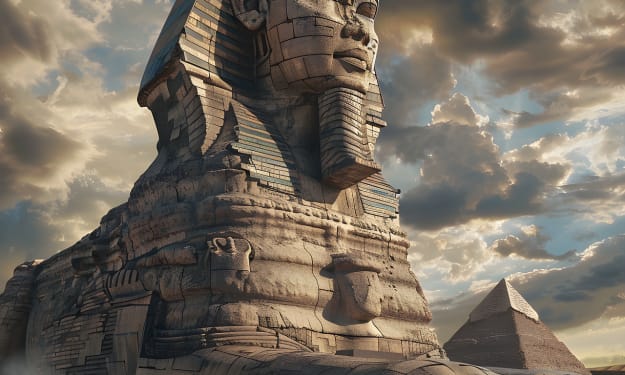
Lost Evidence of a Forgotten Age? The Great Sphinx of Giza has long stood as one of the most mysterious monuments in human history. Half lion, half man, it watches over the Giza plateau, older than the pyramids and cloaked in mystery. While much attention has been given to the missing records of the Great Pyramid, the Sphinx holds its own puzzle: where are its blueprints, inscriptions, or records of construction?
By The Secret History Of The Worldabout a year ago in History
The Lost Archives of the Great Pyramid: Hidden Knowledge of a Forgotten Civilization?
Hidden Knowledge of a Forgotten Civilization? From the deserts of Giza rises the Great Pyramid, a monument that has endured for over 4,500 years. Yet one of the greatest mysteries remains unanswered: where are its architectural records? The ancient Egyptians documented nearly every aspect of life, from farming to astronomy, but not a single papyrus, tablet, or inscription exists that describes the construction of the most astonishing monument in human history.
By The Secret History Of The Worldabout a year ago in History
The World of Ancient History
1. Foundations of Civilization Mesopotamia: The Cradle of Written History Mesopotamia, nestled between the Tigris and Euphrates rivers, stands as the birthplace of urban society. The Sumerians pioneered cuneiform writing around 3100 BC—revolutionizing record-keeping, communication, and cultural continuity. The Code of Hammurabi, one of humanity's earliest law codes, introduced foundational legal principles still recognizable in modern jurisprudenc. Additionally, the Mesopotamians’ developments in mathematics and astronomy—a base-60 system and early calendars—continue to underlie our timekeeping and geometry.
By Nizam Archaeologistabout a year ago in History
Why Germany Did Not Develop the Atomic Bomb. AI-Generated.
The Second World War was not only a conflict of soldiers and armies but also a war of science, engineering, and technology. Among the most transformative developments of the twentieth century was the atomic bomb, whose successful construction by the United States under the Manhattan Project changed the course of history. Yet Germany, despite having some of the world’s leading physicists such as Werner Heisenberg, Max Planck, and others, failed to build the weapon. The question of why Nazi Germany did not develop an atomic bomb remains one of the most compelling debates in the history of science and war. To understand this failure, one must examine the interplay of political ideology, scientific challenges, resource limitations, and the role of individuals—especially Heisenberg—who stood at the center of the German nuclear program.
By INAM ULLAHabout a year ago in History
The Legend of Tin Hinan:
In the heart of the Sahara Desert, where endless dunes meet the horizon and silence speaks louder than words, there lives a story that has survived for centuries. It is the story of Tin Hinan, the woman who became both a legend and a queen, remembered by the Amazigh as the ancestral mother of the Tuareg people. Her tale blends myth, history, and poetry, making it one of the most captivating narratives in North African heritage.
By Youssef Khabchiabout a year ago in History
The Fortress That Time Almost Forgot
M Mehran If you stand at the edge of the old town today, you might notice a pile of weathered stones half-hidden beneath weeds and dust. To the casual eye, they look like nothing more than the remains of abandoned houses. But lean closer, touch the rough limestone, and you’ll feel the heartbeat of a story—one that began almost a thousand years ago. This is the story of a fortress that once shone like gold at sunrise, a fortress that protected merchants, poets, and children, and a fortress that fell—not to cannon fire or earthquakes—but to betrayal. It’s a story our town nearly forgot. But history has a way of whispering back to those willing to listen. --- The Dream of Malik Shahnur The tale begins in the 12th century, with a young ruler named Malik Shahnur. Unlike many leaders of his age, Shahnur was not born into vast wealth or power. He had inherited a fragile valley—surrounded by mountains, threatened by rival kingdoms, and positioned along one of the busiest trade routes in the region. Shahnur knew that without protection, his people would never survive. And so, he dreamed of a fortress—one that would rise like a crown from the valley floor, its walls impenetrable, its gates a symbol of pride. The chronicles tell us that construction began under the light of torches, with farmers, artisans, soldiers, and children all working together. Oxen dragged heavy limestone blocks from distant quarries, while women prepared meals for the laborers. The air was filled with the clang of chisels and the low chants of workers who believed they were building not just walls, but a future. At the eastern gate, the masons carved intricate verses into the stone: “Strength in unity, hope in heart.” Beneath the arch, treasures were buried—grain, coins, and amulets—blessings for prosperity. This was not merely a military stronghold. It was a community’s promise to itself. --- The Crown of the Valley For centuries, the fortress thrived. Inside its walls, life was not just safe, but dazzling. Markets overflowed with merchants selling spices from the east, silk from faraway lands, and pottery crafted by local hands. Poets recited verses in candlelit courtyards. Scholars filled the libraries with knowledge, and musicians strummed lutes while children played under lanterns strung across narrow streets. Travelers who arrived at dawn often wrote about the way the fortress glowed in the rising sun, its walls shimmering like molten gold. One poet from the 15th century called it “the crown of the valley, kissed by heaven itself.” These were years of peace, prosperity, and joy. The fortress wasn’t just stone—it was a beating heart. --- The Siege in Winter But history, as always, turned. In the late 17th century, rival kingdoms looked hungrily at the valley’s wealth and strategic location. And so, on a bitter winter night, an army appeared on the horizon. The siege began. The fortress gates slammed shut. For weeks, the people resisted. Bakers turned their ovens into makeshift forges, creating weapons. Shepherds carried secret messages through hidden mountain paths. Women poured boiling water onto invaders trying to climb the walls. Songs from that time tell of a boy no older than 12 who guided soldiers through a tunnel, saving an entire battalion. Legends claim that lanterns were hung across the battlements each night, tricking the enemy into believing reinforcements had arrived. But courage, no matter how fierce, can be undone by betrayal. A noble inside the city—promised riches and land—opened a hidden passageway. Under the cover of darkness, the enemy poured through. By dawn, the fortress was in flames. Markets turned to ash. Libraries crumbled. Families fled into the mountains. What had taken decades to build was lost in a single night. --- Silence and Shadows In the years that followed, the fortress became a ghost. The conquerors abandoned it after draining its wealth. Rain seeped into cracks, vines snaked across walls, and stones collapsed into themselves. Children played among the ruins, unaware of the blood once spilled there. Farmers stole blocks of limestone to build homes and barns. Slowly, the fortress disappeared—not only from the land but from memory. By the 20th century, only fragments remained: a section of the eastern wall, a half-buried tower, and a scattering of stones no one bothered to count. Many believed the fortress was nothing but legend, a story told by grandmothers on cold nights. And yet, the elders remembered. They whispered of the golden glow at sunrise, the bustling markets, and the defenders who refused to yield. Their voices kept the fortress alive when the stones could not. --- The Digging of Memory Then, a few decades ago, something extraordinary happened. A group of archaeologists began excavations near the ruins. What they uncovered stunned everyone: pottery painted with intricate designs, coins stamped with ancient seals, weapons forged in the heat of siege, and—most incredible of all—a long section of limestone wall, still standing strong after centuries. Suddenly, the fortress was no longer just a story. It was real. Local schools began bringing children to the site, teaching them that these weren’t just broken stones—they were pieces of their identity. Artists painted the ruins as they might have once looked. Historians pieced together chronicles, legends, and songs into a tapestry of memory. The forgotten fortress was reborn—not in stone, but in pride. --- What the Walls Teach Us So what do these broken walls mean to us today? They teach us that strength doesn’t come from stone or steel, but from community. It was the people—the bakers, the shepherds, the children—who held the fortress together. They remind us that betrayal can destroy walls, but it cannot erase memory. Even when the fortress fell, its story endured, carried in whispers from one generation to the next. And most of all, they show us that history is never truly lost. It waits, patient and silent, until someone decides to listen. --- The Fortress Lives On Now, when you walk past the ruins, pause for a moment. Close your eyes. Can you hear it? The laughter of children running through lantern-lit streets? The bargaining cries of merchants in the market? The strum of a lute echoing in the courtyard? The defiant shouts of defenders on the wall? If you listen carefully enough, you’ll hear the heartbeat of a city that once called itself the crown of the valley. And you’ll understand: the fortress was never forgotten. It was only waiting—for us to remember.
By Muhammad Mehranabout a year ago in History
The Woman Who Lived 10 Years Alone in the Amazon
The Woman Who Lived 10 Years Alone in the Amazon A Tale of Survival, Silence, and Self-Discovery When most people imagine the Amazon rainforest, they think of endless greenery, exotic birds, venomous snakes, and rivers that wind like serpents through a living world of mystery. Few, however, would imagine making it their permanent home without a village, without modern tools, and without another human voice for a decade. Yet, that is exactly what happened to Elena Marquez, a woman who chose solitude deep in the Amazon and lived alone there for ten years.
By Farooq Hashmiabout a year ago in History
“The Girl Alone at Night: The Door That Wouldn’t Stay Closed”
“The Girl Alone at Night: The Door That Wouldn’t Stay Closed” It was past midnight when Nimra, a 20-year-old university student, realized she was the only one left at home. Her parents were away visiting relatives, and her younger sister was at a friend’s sleepover.
By Wings of Time about a year ago in History