Ancient
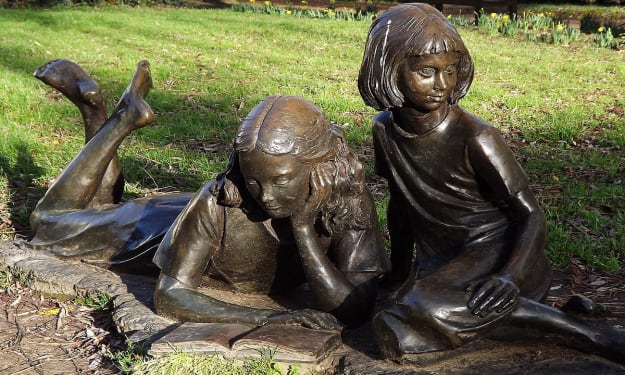
The haunting true story behind Alice in Wonderland
Lewis Carroll, the pen name adopted by Charles Lutwidge Dodgson, traces his origins to England, where he was born in 1832. At the age of 18, Dodgson embarked on a journey that led him to Oxford University, becoming a pivotal chapter in his life that spanned two decades. Within the hallowed halls of Oxford, Dodgson donned various roles, transitioning from a student to a professor and establishing himself as a prominent mathematician.
By mostefaoui fayssal3 years ago in History
Top 10 Biggest Mysteries in World History
History may paint a vivid picture of the past, but its canvas is far from complete. Scattered across its margins lie enigmas that have kept minds boggled for centuries—whispers of the unknown that refuse to be silenced. Buckle up, fellow truth-seekers, as we delve into the 10 biggest mysteries in world history, where fact rubs shoulders with fantasy and the thrill of the unsolved reigns supreme!
By Maimun Riansyah3 years ago in History
Egypt's Astonishing Revelation: A Discovery That Sends Shivers To Scientists
Throughout history, Egypt has been renowned for its mysteries and incredible feats of structural engineering that captured the imagination of the ancient world. Despite ongoing discoveries, much of Egypt's ancient past remains elusive, hidden among the endless scorched sands. The secrets held by this fascinating land are often well-preserved, with only occasional glimpses into its enigmatic history.
By Jheanne Franz Malto3 years ago in History
Ancient Egypt: A Marvel of Majesty and Intrigue
Ancient Egypt: A Marvel of Majesty and Intrigue Ancient Egypt, situated along the Nile River, stands as an enduring fascination with its grand monuments, deep spirituality, and mysterious legacy. Flourishing for over three thousand years, this civilization has left an indelible imprint on history, influencing art, architecture, religion, and societal structures. This essay embarks on a journey through the sands of time, unravelling the wonders and enigmas that define the timeless allure of ancient Egypt.
By Yaseen Pahad3 years ago in History
The Unseen Planet In Our Solar System
For millennia, humans were aware of only five planets: Mercury, Venus, Mars, Jupiter, and Saturn, observable with basic telescopes or the naked eye under favorable conditions. In the late 18th century, Sir William Herschel, a renowned astronomer, discovered a new planet—a frosty blue one initially mistaken for a star—later recognized as Uranus. It orbits the Sun 19 times farther than Earth and takes 84 years to complete one revolution. Herschel also detected double stars and nebulae. In the mid-1800s, astronomers detected anomalies in Uranus' orbit, leading to the discovery of Neptune in 1846. Despite theories about another planet between Mercury and the Sun, known as Vulcan, corroborated by the peculiar behavior of Mercury's orbit, no concrete evidence surfaced. Einstein's theory of general relativity later explained Mercury's orbit irregularity, suggesting space-time curvature by massive celestial bodies like planets alters orbits. While the Vulcan theory persisted, Einstein's explanation gained traction, and tests during solar eclipses aimed to validate his theory. Additionally, hypotheses about an undiscovered Planet 9 or Planet X beyond Neptune, affecting objects in the Kuiper Belt, emerged. The Nibiru myth, claiming a doomsday scenario in 2012, proved baseless, as calculations disproved its existence. Moreover, the 2011 Comet Elenin briefly misconstrued as Nibiru, dissipated harmlessly. These astronomical mysteries continue to intrigue, shaping our understanding of the solar system's complexities.
By Cudjoe Justice3 years ago in History
"Weaving Identities: Exploring the Tapestry of Cultural Heritage"
Our cultural legacy gives us a feeling of identity and a link to our past, which makes us feel like we belong. We will examine the complex web of cultural legacy in this investigation, piecing together the historical, traditional, and customary elements that make up the rich tapestry of many global communities. We hope to shed light on the distinct identities that comprise our global community by learning more about the histories, significance, and cultural practices of the many objects, historical locations, and historical practices we come across on this voyage. Come along with us as we explore cultural heritage in depth and celebrate the diversity and beauty that make the world a better place.
By Isabel Martinez3 years ago in History