Analysis
Terrifying Moments: Ukraine Drones Destroy Russian Troops Near Avdiivka
In 2022, the Kremlin can afford to lose about 50 tanks per month without depleting its overall arsenal of around 3,000 frontline tanks. However, currently the Russians are losing 60 tanks per month, and that number may increase as the 239th tank regiment enters battle. The tank units face dangers such as minefields, artillery, and drone kill zones. In October, the Russian Field armies around Avdiivka held back their armor and sent in infantry on foot due to heavy losses.
By Nduki Darlington3 years ago in History
History of maths
The history of mathematics is a rich tapestry that spans across cultures and centuries, influencing various aspects of human development. Here's a concise overview: 1. **Ancient Mesopotamia (3000 BCE - 600 BCE):** The earliest roots of mathematics can be traced to Mesopotamia, where the Babylonians developed a system of counting and early forms of geometry for practical purposes like land surveying. 2. **Ancient Egypt (3000 BCE - 600 BCE):** Ancient Egyptians used mathematics for practical applications such as architecture and agriculture. They had a well-developed understanding of geometry, crucial for construction projects like the pyramids. 3. **Ancient Greece (600 BCE - 300 BCE):** Greek mathematicians, including Pythagoras, Euclid, and Archimedes, made significant contributions. Pythagoras' theorem, Euclidean geometry, and the method of exhaustion developed by Archimedes are enduring components of mathematical knowledge. 4. **Ancient India (600 BCE - 600 CE):** Indian mathematicians made strides in number theory, trigonometry, and algebra. Aryabhata, Brahmagupta, and Bhaskara II were notable contributors. 5. **Islamic Golden Age (8th - 14th centuries):** During this period, Islamic scholars preserved and expanded upon ancient Greek and Indian mathematical knowledge. Al-Khwarizmi's work laid the foundation for algebra, and advancements were made in trigonometry and geometry. 6. **Renaissance and the Scientific Revolution (14th - 17th centuries):** European mathematicians like Leonardo Fibonacci, Nicolaus Copernicus, and Johannes Kepler contributed to the development of mathematical ideas, laying the groundwork for the scientific method. 7. **17th to 19th Centuries:** The era saw the rise of calculus, pioneered independently by Isaac Newton and Gottfried Wilhelm Leibniz. Euler's contributions to graph theory and number theory were noteworthy. Meanwhile, the development of probability theory took place. 8. **19th to Early 20th Centuries:** The foundations of modern mathematics were established with the formalization of set theory by Georg Cantor. Non-Euclidean geometries emerged, challenging traditional views. David Hilbert proposed a list of unsolved mathematical problems, guiding research for decades. 9. **20th Century:** The century witnessed profound developments in various branches, including abstract algebra, topology, and mathematical logic. Computers played an increasingly vital role in mathematical research. The Four Color Theorem was proven, and Andrew Wiles solved Fermat's Last Theorem in 1994. 10. **Contemporary Era:** Mathematics continues to evolve with contributions to fields like cryptography, chaos theory, and mathematical biology. The exploration of new mathematical structures and the interplay with other disciplines remains a vibrant area of research. The history of mathematics reflects a continual quest for understanding patterns, structures, and relationships, shaping the way we comprehend the world around us.
By J.Balakrishnan3 years ago in History
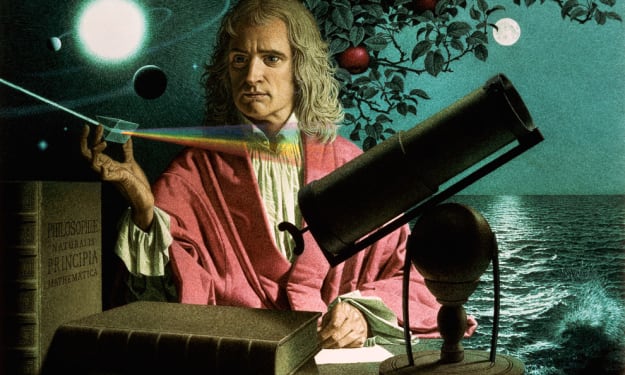
Secrets of Isaac Newton
He disappointed his mother by not pursuing her dream of becoming a farmer. His relationships with others were so complex that he ended up living a solitary life. However, his passion for alchemy led him to become one of the most renowned scientists in history. Yes, I'm referring to Isaac Newton, the famous English physicist and mathematician who revolutionized modern physics. Newton was born in the small village of Wol Thorp in 1643. Unfortunately, he never had the chance to meet his father, who passed away before his birth. Around the same time, another brilliant scientist, Galileo Galilei, took his last breath in Florence. Little did Newton know that he would later build upon Galileo's ideas and make them legendary. From the very beginning, Isaac faced challenges as he was born prematurely and had to fight for survival. He was so tiny that he could fit inside a large mug. His mother remarried shortly after his birth, and he ended up living with his grandmother, separated from his mother for nine years. This solitude had a lasting impact on his life. Years later, when reflecting on his past, he even confessed to having fiery thoughts about his stepfather, such as wanting to burn down the house. On the bright side, his isolation sparked his interest in books on mechanics and technology. He even developed a highly accurate system of sundials. Recognizing his intellectual potential, his uncle and school headmaster encouraged him to pursue his studies instead of tending to the family property. Despite his mother's initial resistance, she eventually gave in, and Newton returned to grammar school. At the age of 18, he was admitted to Trinity College, Cambridge. To support his education, Newton worked and studied, waiting tables and taking care of other students' rooms.
By Angelo Valentino Krause3 years ago in History
Buried Secrets of the Bible
The narratives within the Bible encompass some of the most captivating stories in human history, portraying themes of right and wrong, good versus evil. My curiosity led me to explore the origins of these tales, recognizing their cultural significance that has shaped the lives of billions over millennia.
By Paulo Nabuco3 years ago in History
Do You Believe in Subliminals?
History of Subliminal Messaging: The roots of subliminal messaging can be traced back to the late 19th century when psychologists and researchers began studying the subconscious mind. However, it wasn’t until the 1950s and 1960s that subliminal messaging gained widespread attention. One of the most famous instances occurred in 1957 when marketing researcher James Vicary claimed to have increased sales of Coca-Cola and popcorn in a movie theater by flashing subliminal messages on the screen. Despite later admitting that his study was a hoax, the idea of subliminal messaging had already taken root in popular culture.
By Nirmatha Arumugam3 years ago in History