Analysis
Were Two First Shots Fired at Gettysburg?
Almost exactly 160 years ago, the first shot was fired at Gettysburg, one of the most horrific battles of the Civil War. Both Illinois and New York claim their cavalry unit made the move. Stay with me, and I’ll tell you some fascinating stuff about Gettysburg and about why it really doesn’t matter who was on first when these stories have lives of their own.
By Maryan Pellandabout a year ago in History
Step Inside 6 Luxury Ranches Across America: Where Opulence Meets the Wild West
Step Inside 6 Luxury Ranches Across America: Where Opulence Meets the Wild West The allure of the American West has long captivated those seeking adventure, tranquility, and a connection to nature. However, a new breed of high-end retreats has emerged for those who desire the rustic charm of ranch life without sacrificing luxury. These luxury ranches combine Western heritage with five-star amenities, ranging from sprawling estates in Wyoming to chic hideaways in Texas. Here, we take you inside five of the most exclusive ranches across the U.S., where wide-open spaces meet world-class hospitality.
By parves mosharafabout a year ago in History
Saddam Hussein and the Geopolitics of Power: A Turbulent Legacy of War and Dictatorship. AI-Generated.
Saddam Hussein’s Leadership and Dictatorship Saddam Hussein rose to power in 1979, becoming the President of Iraq and cementing himself as the country’s absolute ruler. His rule was marked by a highly centralized and oppressive governance system. The text repeatedly emphasizes Saddam’s dictatorial style, portraying him as a ruthless and feared leader. He controlled the state apparatus with an iron grip, suppressing dissent through surveillance, purges, and military force. His personality cult was carefully constructed, with extensive use of propaganda portraying him as both a strong nationalist and a protector of Iraq's sovereignty.
By Zain Ul Abidin Khanabout a year ago in History
Drones: The New Soldiers of War
The Rise of the Drone Soldier Throughout military history, few innovations have altered the face of combat quite like unmanned aerial vehicles—better known as drones. What started out as tools for reconnaissance have now taken center stage in warfare, executing surgical strikes, gathering vital intelligence, and even engaging in air combat. Their rise isn’t just a technological upgrade—it’s a reimagining of what warfare looks like, where machines increasingly shoulder roles once reserved for humans.
By Rukka Novaabout a year ago in History
The Man Who Learned a Complete Language in 15 Days
In an era where learning a new language takes years of dedication, imagine mastering one in just 15 days. This is not a fictional tale but a true story from the golden age of Islam. One man, a devoted companion of the Prophet Muhammad (peace be upon him), learned an entirely new language in just over two weeks — an astonishing feat of intelligence, commitment, and divine inspiration.
By Keramatullah Wardakabout a year ago in History
"Gadsby": A Wierd Novel Without the Letter "E" by Ernest Vincent Wright
"Gadsby": A Wierd Novel Without the Letter "E" by Ernest Vincent Wright The Inspiration and Origins of "Gadsby" The concept of constrained writing has fascinated authors for centuries, serving as a playground for linguistic experimentation. Among the most iconic examples is "Gadsby," a novel that boldly omits the letter 'e'—the most commonly used letter in English. Written by American author Ernest Vincent Wright in 1939, "Gadsby" stands as a cultural and literary marvel, symbolizing that language, despite its complexity, can be bent and shaped by sheer ingenuity and discipline.
By History Seekerabout a year ago in History
🐸Australia Lost a War against the Cane Toads
🐸Australia Lost a War against the Cane Toads Origins of the Invasion – A Misguided Introduction In the early 20th century, Australia's sugar cane industry faced a significant threat from cane beetles, which were devastating crops in Queensland. In an attempt to control these pests, 102 cane toads (Rhinella marina) were imported from Hawaii in June 1935 and released into the fields of northern Queensland. The hope was that these toads would prey on the beetles and protect the sugar cane. However, this biological control strategy was based on limited understanding of the toads' behavior and ecology. The cane toads did not significantly impact the beetle population, as they preferred other prey and could not reach the beetles high on the cane stalks. Instead, the toads found the Australian environment highly conducive to their survival and reproduction, leading to an unforeseen ecological disaster.
By History Seekerabout a year ago in History
The Kingdom of Benin
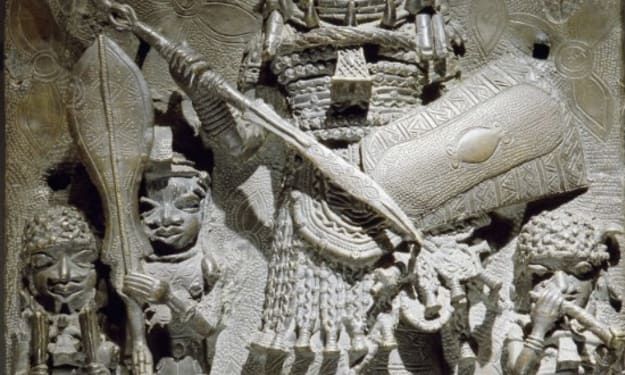
The historical Kingdom of Benin was established in the forested region of West Africa in the 1200's CE. It was a powerful and sophisticated dynasty, located in what is now southern Nigeria. It flourished from around the 11th century until it was annexed by the British Empire in 1897.
By Antoni De'Leonabout a year ago in History