
Sultan Salahuddin Ayyubi: The Lion of Justice and Mercy
A story of courage, faith, leadership, and forgiveness during the Crusades
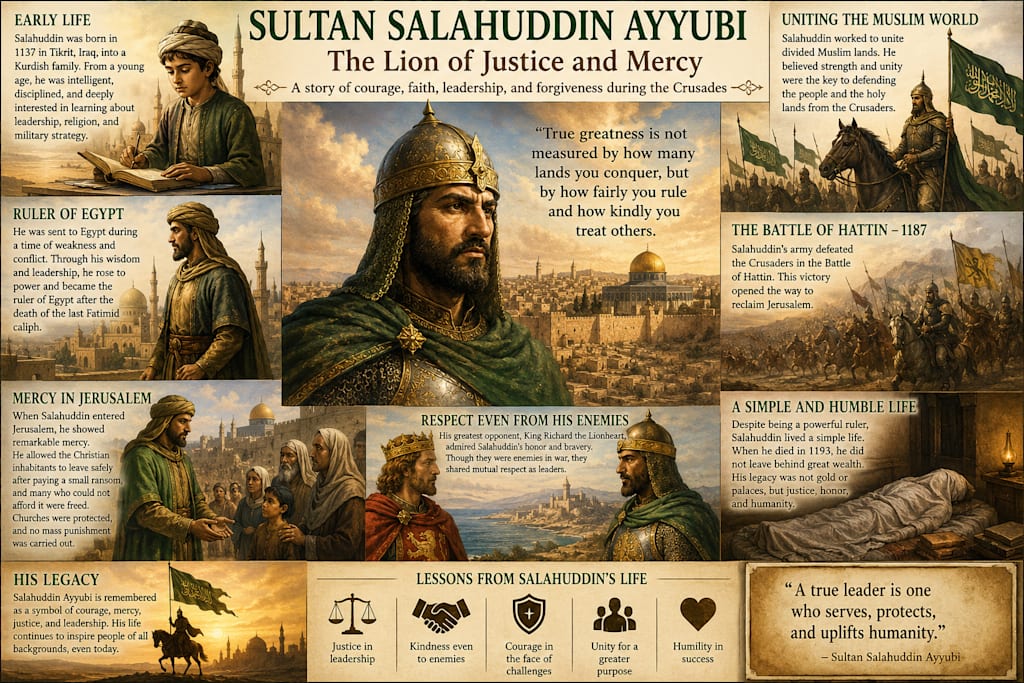
In the pages of Islamic history, few names shine as brightly as Salahuddin Ayyubi, known in the West as Saladin. He was not just a warrior who won battles, but a ruler who won hearts. His life is a powerful example of how justice, mercy, and strong faith can change the course of history.
Salahuddin was born in 1137 in Tikrit, in present-day Iraq, into a Kurdish family. From a young age, he was known for his intelligence, discipline, and calm nature. Unlike many children of his time who were attracted to luxury or games, Salahuddin was deeply interested in learning about leadership, religion, and military strategy. His uncle, Shirkuh, was a respected military commander, and through him, Salahuddin entered the world of politics and warfare.
As he grew older, he became part of the army serving under the powerful Muslim leader Nur ad-Din. During this time, Egypt was facing internal conflict and weak leadership. Salahuddin was sent to Egypt as part of a military mission, but destiny had greater plans for him. Through his wisdom and leadership skills, he gradually rose in power and eventually became the ruler of Egypt after the death of the last Fatimid caliph.
What made Salahuddin different from many rulers of his time was his sense of justice. He believed that leadership was not about luxury or personal gain, but about serving the people and protecting their rights. He worked hard to unite the Muslim world, which was divided at that time. His goal was clear: to bring strength and unity among Muslims so they could defend themselves against the Crusaders who had taken control of Jerusalem and other holy lands.
Salahuddin spent years preparing for this mission. He trained his army not just in fighting skills, but also in discipline and morality. He discouraged unnecessary violence and encouraged kindness even towards enemies. His soldiers respected him deeply because he led by example.
The most famous moment of his life came in 1187, during the Battle of Hattin. In this battle, Salahuddin’s army defeated the Crusaders in a decisive victory. This opened the way for him to reclaim Jerusalem, a city that held deep religious importance for Muslims, Christians, and Jews alike.
When Salahuddin entered Jerusalem after its conquest, the world witnessed something extraordinary. Unlike many conquerors in history who destroyed cities and harmed civilians, he showed remarkable mercy. He allowed the Christian inhabitants to leave safely after paying a small ransom, and many who could not afford it were freed without payment. Churches were protected, and no mass punishment was carried out. This act of mercy surprised even his enemies, who expected revenge and destruction.
His kindness earned him respect even among the Crusaders. One of his greatest opponents, King Richard the Lionheart of England, admired Salahuddin’s honor and bravery. Although they were enemies in war, they shared mutual respect as leaders.
Salahuddin’s life was not only about war. He lived a simple life despite being a powerful ruler. It is said that when he died in 1193, he did not leave behind great wealth. In fact, there was not enough money in his treasury to pay for his funeral. His legacy was not gold or palaces, but justice, honor, and humanity.
He taught the world that true greatness is not measured by how many lands you conquer, but by how fairly you rule and how kindly you treat others. Even today, centuries after his death, Salahuddin Ayyubi is remembered as a symbol of courage, mercy, and leadership.
In a world often filled with conflict, his story continues to inspire people of all backgrounds. It reminds us that strength and kindness can exist together, and that the greatest victory is not over enemies, but over injustice and cruelty.
Salahuddin’s life remains a timeless lesson: a true leader is one who serves, protects, and uplifts humanity.
About the Creator
Enjoyed the story? Support the Creator.
Subscribe for free to receive all their stories in your feed.
Comments
There are no comments for this story
Be the first to respond and start the conversation.