
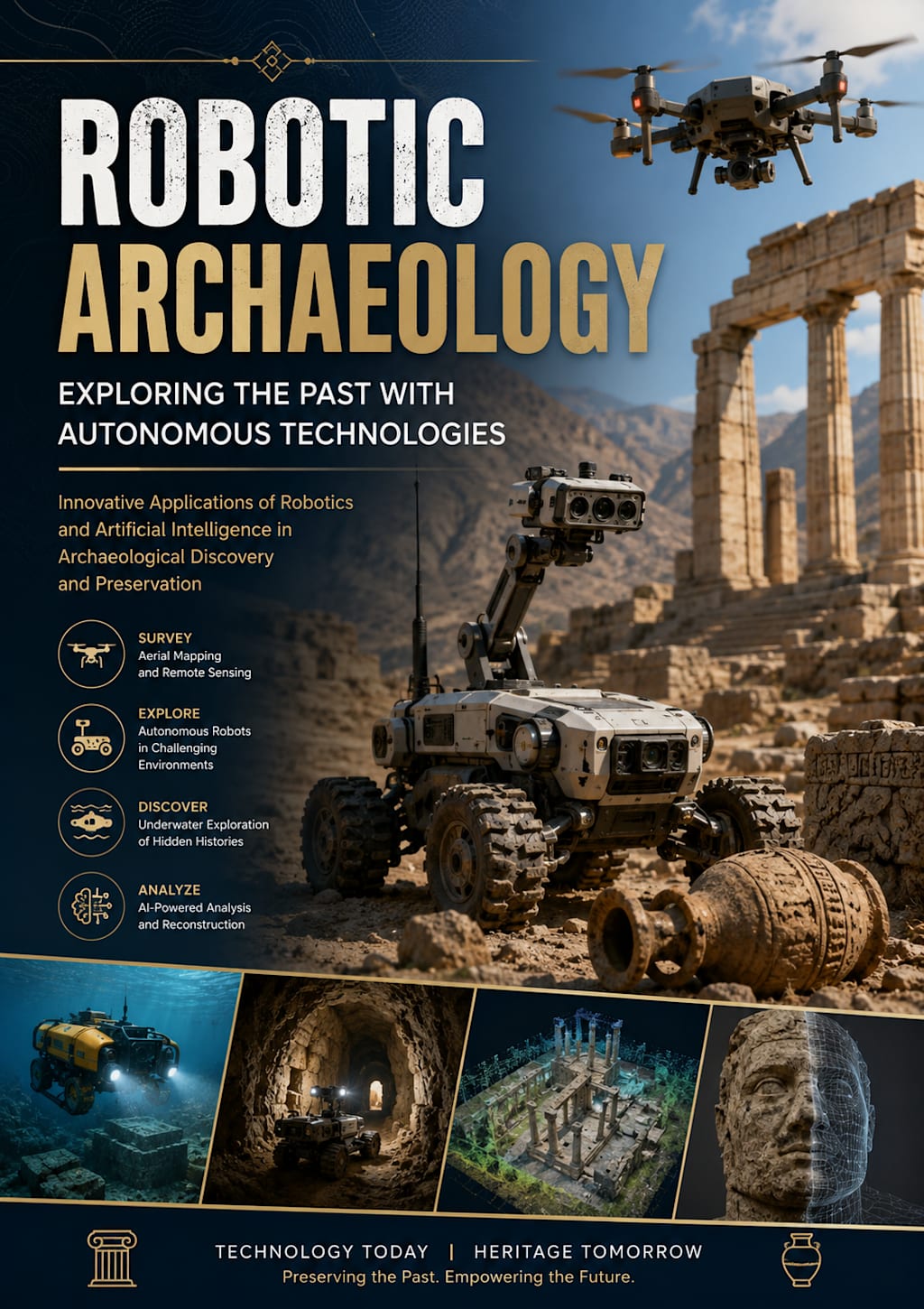
Robotic Archaeology: Exploring the Past with Autonomous Technologies
Innovative Applications of Robotics and Artificial Intelligence in Archaeological Discovery and Preservation

Introduction
Archaeology is the scientific study of human history and prehistory through the excavation and analysis of artifacts, structures, and cultural landscapes. Traditionally, archaeological research has relied heavily on manual excavation, field surveys, and human observation. While these methods have provided valuable insights into ancient civilizations, they can be time-consuming, expensive, and sometimes risky. With the rapid advancement of technology, a new interdisciplinary field known as Robotic Archaeology has emerged, combining robotics, artificial intelligence (AI), remote sensing, and digital mapping to revolutionize the way archaeologists explore and preserve the past.
The Evolution of Robotic Archaeology
The integration of robotics into archaeology began with the use of remote-controlled devices for underwater exploration. As robotic technologies advanced, archaeologists started employing drones, autonomous vehicles, and AI-powered systems to improve data collection and analysis. Today, robotic archaeology has become an essential tool for investigating ancient ruins, submerged cities, caves, tombs, and other hard-to-reach locations.
Modern robotic systems can navigate complex environments, capture high-resolution images, create detailed three-dimensional (3D) maps, and even identify potential archaeological features using machine learning algorithms. These capabilities significantly enhance the efficiency and accuracy of archaeological research.
Key Technologies Used in Robotic Archaeology
1. Drones and Unmanned Aerial Vehicles
Drones have transformed archaeological surveying by providing aerial perspectives of excavation sites and landscapes. Equipped with high-resolution cameras, LiDAR sensors, and thermal imaging systems, drones can quickly scan large areas and generate detailed maps.
Benefits of drone technology include:
Rapid site surveying and documentation
Detection of buried structures through vegetation patterns
Reduced surveying costs and time
Monitoring and preservation of archaeological sites
2. Ground Robots
Ground robots are designed to operate on land and explore areas that may be unsafe or inaccessible for humans. These robots can enter narrow tunnels, collapsed structures, and fragile excavation zones without causing significant disturbance.
Ground robots are often equipped with
Cameras and imaging sensors
Laser scanners
Environmental monitoring systems
GPS and navigation technologies
3. Underwater Robots
Many important archaeological sites lie beneath oceans, lakes, and rivers. Exploring these submerged locations can be dangerous and technically challenging for divers. Underwater robots, including Remotely Operated Vehicles (ROVs) and Autonomous Underwater Vehicles (AUVs), have become invaluable tools in maritime archaeology.
4. Artificial Intelligence and Machine Learning
Artificial intelligence enhances robotic archaeology by enabling automated analysis of large datasets. AI algorithms can recognize patterns, classify artifacts, and identify potential archaeological features from aerial imagery and sensor data.
Machine learning applications include:
Artifact recognition and classification
Predictive modeling of archaeological site locations
Automated image processing
Reconstruction of damaged structures and artifacts
5. 3D Scanning and Digital Reconstruction
Robotic systems often integrate 3D scanning technologies to capture highly detailed representations of archaeological sites and objects. These scans allow researchers to create virtual models that can be studied without physically handling fragile artifacts.
In ancient tombs and burial chambers, robots have been used to investigate hidden passages and unexplored rooms without disturbing delicate environments. In desert regions, drones help identify ancient settlements buried beneath sand. Underwater robots have explored shipwrecks and submerged cities, revealing valuable information about trade routes, naval history, and cultural interactions.
Advantages of Robotic Archaeology
The adoption of robotic technologies offers numerous benefits:
Improved Safety
Robots can operate in dangerous environments such as unstable ruins, deep underwater locations, and confined underground spaces, reducing risks to human researchers.
Greater Efficiency
Autonomous systems can survey large areas quickly and collect vast amounts of data in a short period Enhanced Accuracy Advanced sensors and AI-driven analysis provide precise measurements and detailed documentation.Preservation of Fragile Sites Robots minimize physical contact with sensitive archaeological materials, helping prevent accidental damage.
Cost Effectiveness
Although initial investments may be significant, robotic systems often reduce long-term excavation and survey costs by increasing productivity.
Future Prospects
The future of robotic archaeology is highly promising. Advances in artificial intelligence, autonomous navigation, sensor technology, and robotics are expected to further expand the capabilities of archaeological exploration. Future robotic systems may be able to perform more complex excavation tasks, collaborate in teams, and provide real-time analysis of discoveries.
Conclusion
Robotic archaeology represents a significant advancement in the study and preservation of human history. By combining robotics, artificial intelligence, remote sensing, and digital reconstruction technologies, archaeologists can explore previously inaccessible locations, improve research accuracy, and better protect fragile cultural heritage sites. While challenges remain, the continued development of autonomous technologies promises to transform archaeological research and open new opportunities for understanding the civilizations of the past. As technology continues to evolve, robotic archaeology will play an increasingly important role in uncovering and preserving humanity's shared historical legacy.
About the Creator
Nizam Archaeologist
I’m deeply fascinated by archaeology and the mysteries of ancient civilizations.My goal is to bring the past to life, spark curiosity, and share the wisdom of cultures that have stood the test of time.
Enjoyed the story? Support the Creator.
Subscribe for free to receive all their stories in your feed.
Comments
There are no comments for this story
Be the first to respond and start the conversation.