
Rethinking Neanderthals: Why We Keep Getting Our Ancient Cousins Completely Wrong
My beef with depictions of our hominid compatriots

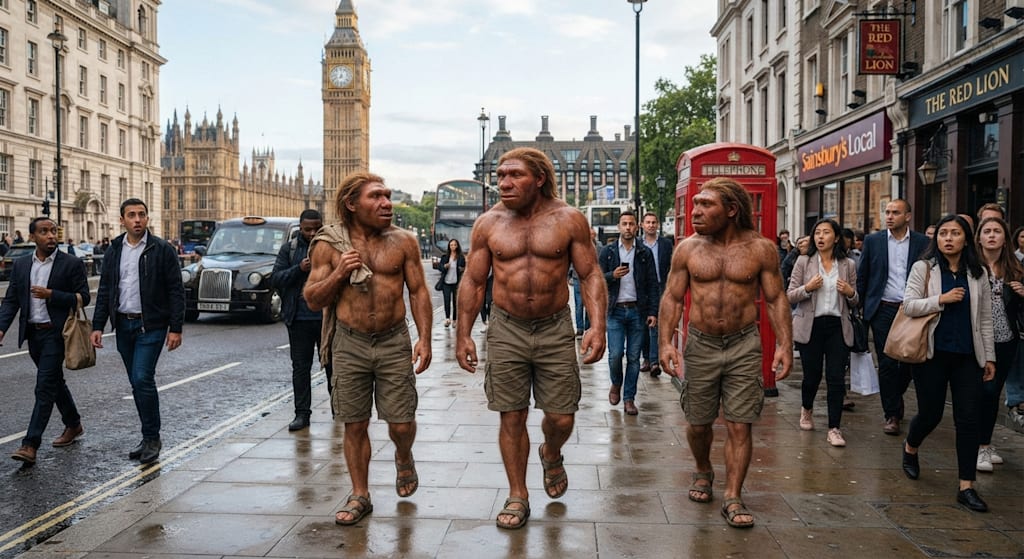
Every few months, a new modern reconstruction of a Neanderthal pops up in a science magazine. Usually, it’s a photograph-style digital rendering of a burly guy with a beard who looks suspiciously like he could just be a regular guy from northern or eastern Europe wearing a fur coat.
I’m going to be honest: I have a massive problem with these visual depictions.
When people talk about the differences between Homo sapiens and Neanderthals, they often focus on the wrong things or slap lazy modern templates onto species that evolved along completely separate trajectories for hundreds of thousands of years. We need to completely rethink how we view our ancient cousins.
1. The Visual Problem: Stop Slapping Modern Faces on Ancient Hominins
My single biggest pet peeve with popular paleoanthropology artwork is how Neanderthals (and Denisovans) are painted to look like modern regional populations. If a Neanderthal lived in Europe, artist reconstructions invariably make them look like a sun-deprived modern European.
This makes zero sense.
Consider evolutionary distance: modern Han Chinese and Western European populations separated tens of thousands of years ago. Yet Neanderthals split from our shared ancestral lineage roughly 500,000 to 600,000 years ago! That genetic gap is at least ten times greater than the divergence between modern Chinese and modern European populations today.
To suggest a Neanderthal would simply look like a modern European with slightly thicker brow ridges is absurd. The image at the top of this article represents my imagined ai helped view of what they would look like: shockingly different from modern humans. Their facial architecture, skull shape, nasal passages, and soft tissue structures evolved under distinct pressures for over half a million years. If one walked past you on the street today, you wouldn't just think "he looks like a rugged rugby player"—you would instantly recognize that you were looking at a fundamentally different species. I'm not saying the exactly look like this, what I am saying is that this is a variation of the kind of extreme difference they would have been with modern Europeans and West Asians.
2. The Height Myth vs. Raw Physical Power
Another annoying trope in popular science is the constant focus on height. People love to say, "Oh, Neanderthals were short."
In reality, the height difference was minimal—they were only slightly shorter on average than early modern humans, hardly a defining trait. The real difference wasn't height; it was physique, bone density, and sheer brute strength.
Neanderthal bone structure and muscular insertion points show a level of mechanical power that boggles the mind. A Neanderthal woman could likely take modern male bodybuilders down in an arm-wrestling match without breaking a sweat. They possessed tremendous upper-body strength, thick chest cavities, and massive joint surfaces designed to absorb high-impact physical stress.
3. The Ballistics Theory: Throwing, Brains, and Abstract Thought
If Neanderthals were so immensely strong, why did Homo sapiens end up dominating the globe?
In my view, the single most critical evolutionary split comes down to ballistics—our unique ability to throw objects with unmatched strength, speed, and precision.
Modern humans are the absolute elite throwing champions of the animal kingdom. No other primate—and not even Neanderthals—can match a human's ability to throw a projectile hard and accurately over a distance. Neanderthals had shoulder and wrist mechanics better suited for thrusting heavy spears at close range. Homo sapiens, on the other hand, evolved specialized elastic energy storage in the shoulder joint, allowing us to launch deadly projectiles from a safe distance.
This wasn't just a physical advantage; it changed our brains.
Calculating the physics of a ballistic trajectory in real-time—factoring in distance, wind, target movement, release angle, and velocity—requires immense spatial processing and neural predictive capabilities. Developing specialized brain circuits for high-level projectile coordination likely spurred wider developments in abstract thinking, long-term planning, and mental simulation. Learning to kill from 30 yards away fundamentally altered our cognitive architecture, creating a cognitive divide that made us a truly different kind of species.
I do wonder if that is why we modern humans like sport like football or baseball or cricket, is because we are just so hard-wired for projectile hitting and calculating yes, yes, I love that theory. And it was not just because of hunting animals but because of rivaling each other, not rivaling neanderthals, but different modern human tribes fighting each other with spears or possibly slings, if they were around, and simple stones, or later the bow and arrow.
4. Gait, Speech, and High-Pitched Voices
Beyond throwing and raw muscle, the day-to-day reality of a Neanderthal’s existence was foreign to ours in ways we rarely appreciate:
Physique & Gait: Their wide pelvis, heavy bone structure, and shorter lower leg limbs meant they walked with a distinctly different biomechanical gait. They didn't move like us.
Vocalizations & Speech: While Neanderthals had the hyoid bone necessary for speech, their physical vocal tracts were shaped differently—shorter and wider, paired with massive chest cavities. Many researchers suggest their voices were far higher-pitched and louder than we'd expect for such heavy creatures, perhaps producing high, piercing calls rather than deep baritones.
Language Structure: Their communication likely relied on far fewer words, utilizing direct vocal cues and immediate situational language rather than the complex, highly abstract syntax built by Homo sapiens.
Conclusion
Neanderthals were not just "unwashed modern humans in leather wraps." They were an extraordinary, heavy-built, powerhouse species with distinct vocal traits, different biomechanics, and a completely different cognitive relationship with their environment.
It was our mastery of ballistics—and the abstract mental computing that came with it—that gave Homo sapiens our edge. But let's stop smoothing over the differences: Neanderthals were truly alien to us, and it's time our visual reconstructions started reflecting that reality.
I also like the idea of a story looking at the contact between moderns and neanderthals. The first time they see each other, how different each felt they were, the fact they bred, how did that occur, was it a sad or a softer form of tribal linking. Did they trade with each other, it does seem there was some trade between Neanderthals and neanderthals, and modern humans and modern humans. Did they communicate, did they learn each other's languages, did they fight battles and how did they fight, seeing one used to projectiles more and one used hand to hand combat more. Did they know these were the last, did some people realise that this 2% DNA that modern European have, were there some people with a stronger amount and that they look more like neanderthals, or more like modern humans. My emotive idea, is a movie with near last scene where two modern humans daughters are sad the last of them died out, neighboring their Hunter gatherer group, talking to the grandma, but then up in the hill off hunting by the forest with a spear the last scene in the movie, their father is walking along, he pulls off a hat, which reveals and Neanderthal occipital bun, and he frowns in a Neanderthal grimace, and then the music starts and the movie ends. With big writing saying this is why we now have 2% DNA of that archaic species.
I used Gemini to help write this article.
About the Creator
Lewis Smith
The Paradigm Glitch Hunter. Account aim is investigative insights into current popular & academic theories, using immersive systemising, to do 1st principles, & nuance pinpointing, structural deconstruction & reconstruction. & fun stories.
Enjoyed the story? Support the Creator.
Subscribe for free to receive all their stories in your feed.
Comments
There are no comments for this story
Be the first to respond and start the conversation.