

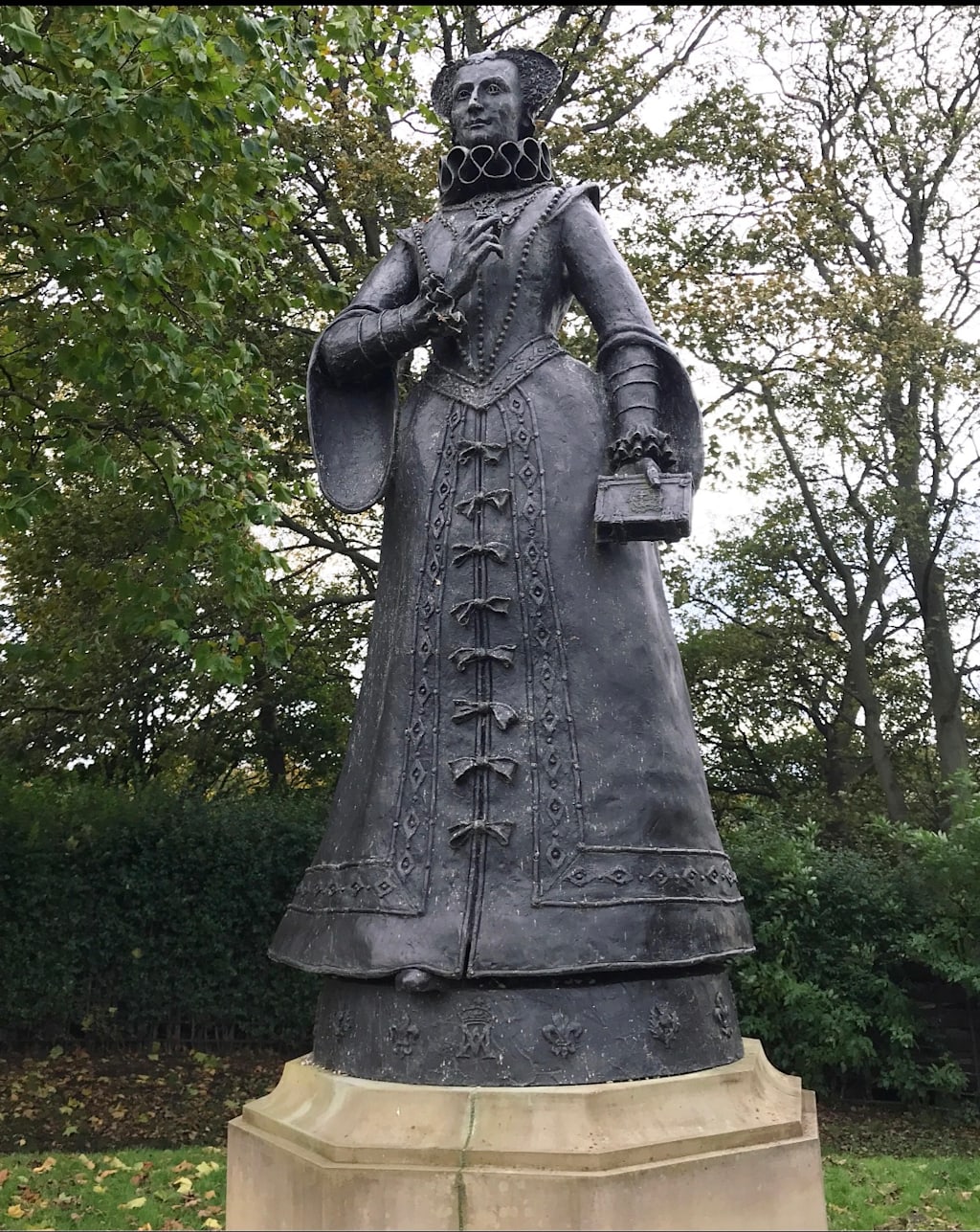
There’s a long history of queens writing poetry, for many different reasons. If we look at the poetry of Queen Elizabeth I, we see controlled rhetoric, but when we read the poetry of Mary, Queen of Scots, we are met with lament and the language of suffering.
It’s comprehensible, the two different positions of these cousins, one of whom fled to the other, seeking refuge but met with imprisonment. Eighteen years of house arrest, monitored by intelligence because someone felt threatened. It’s a good way to create an enemy, imprisoning someone who comes to you for refuge. Elizabeth I had Mary Stuart beheaded, following her father’s tradition of executing family members who don’t please the monarch. The irony, of course, is that Mary’s son, James I, succeeded Elizabeth’s throne.
Many remember James I, as his name appears in the title of one of the bestselling books of all time, The Holy Bible, King James Version, which was first published in 1611. James I did not translate it, but he decreed the translation as an effort to have a uniform English translation for the Church of England. Anyone who studies English literature from 1611 to the twentieth century is expected to be familiar with it, as many canonical authors, poets, and playwrights allude to it and borrow from it across the centuries.
The son of an exiled and imprisoned queen (who was executed before an invited audience in Northamptonshire on February 8, 1587) wanted the people of England to understand the basic text of Christianity and shut down the dithering over which English translation should be the version the Church used. As we all know, without understanding Ancient Hebrew and Ancient Greek, it’s impossible to read this text out of translation. At that time in history, there was no agreed-upon standard English edition of the Bible and much dissent about which translation should be read and studied. The son of an exiled and imprisoned queen is the man who saw a need for an end to debate in this matter.
Translation carries interpretation, much like the production of a play includes the director’s interpretation. We need look no further than Shakespeare to see myriad examples of this. My Shakespeare professor told the class about the varied interpretations he’d seen, including A Midsummer Night’s Dream performed on trapezes and Measure for Measure set in an S&M club. He also screened the BBC’s production of Taming of the Shrew starring John Cleese as Petruchio for our class (highly recommend). 1999’s 10 Things I Hate About You, starring Heath Ledger and Julia Stiles, is a modernized production of the same play, another interpretation, set in a late twentieth century high school. Shakespeare was favored by Elizabeth I. They were both poets and writers.
Elizabeth I is best-known for two of her public speeches, The Golden Speech (1601), orated to Parliament, and The Speech to the Troops at Tilbury (1588), but she was also an accomplished poet. Here is the text of one of Elizabeth I’s most famous poems:
The Doubt of Future Foes
Elizabeth I (estimated 1569-70)
The doubt of future foes exiles my present joy,
And wit me warns to shun such snares as threaten mine annoy;
For falsehood now doth flow, and subjects’ faith doth ebb,
Which should not be if reason ruled or wisdom weaved the web.
But clouds of joys untried do cloak aspiring minds,
Which turn to rain of late repent by changed course of winds.
The top of hope supposed the root upreared shall be,
And fruitless all their grafted guile, as shortly ye shall see.
The dazzled eyes with pride, which great ambition blinds,
Shall be unsealed by worthy wights whose foresight falsehood finds.
The daughter of debate that discord aye doth sow
Shall reap no gain where former rule still peace hath taught to know.
No foreign banished wight shall anchor in this port;
Our realm brooks not seditious sects, let them elsewhere resort.
My rusty sword through rest shall first his edge employ
To poll their tops that seek such change or gape for future joy
Mary, Queen of Scots (or Mary Stuart, depending on your perspective) wrote in French. I must confess that my French, which was never especially strong, has weakened from lack of use (apologies to Dr. Blanchard), and I would be far out of my league and lane to attempt to translate, so I will give you a link to one of her poems instead, albeit in translation, as the link to the Mary Stuart Society page is not secure.
Most of Mary Stuart’s poetry was composed after the death of her husband, while she was held captive and monitored by her cousin, the reigning queen.
Link to The Lamentation of Mary, Queen of Scots:
Another great irony is that Elizabeth I was imprisoned by her half-sister, Mary I, often referred to as Bloody Mary, who showed mercy in the eleventh hour, sparing her sister’s life (religion was the source of contention). Elizabeth I did not pay that mercy forward when her cousin’s life was in her hands, but perhaps it was a mercy after all, ending the suffering of having her life controlled by the crown.
About the Creator
Harper Lewis
Intrusive rhyme bothers me, except as a weapon.
Intertextuality is my passion.
Formalist/ New Critical are my guiding theories.
My words are mine, not a robot’s.
MA English literature, CofC
Enjoyed the story? Support the Creator.
Subscribe for free to receive all their stories in your feed. You could also become a paid subscriber, letting them know you appreciate their work.
Comments
There are no comments for this story
Be the first to respond and start the conversation.