
Murdering Mothers: America Reopens Its Most Terrifying Stories
There are crimes where a person spends a long time thinking about whether it is even possible to understand the person who committed them. And then there are crimes that simply refuse to be understood at all.
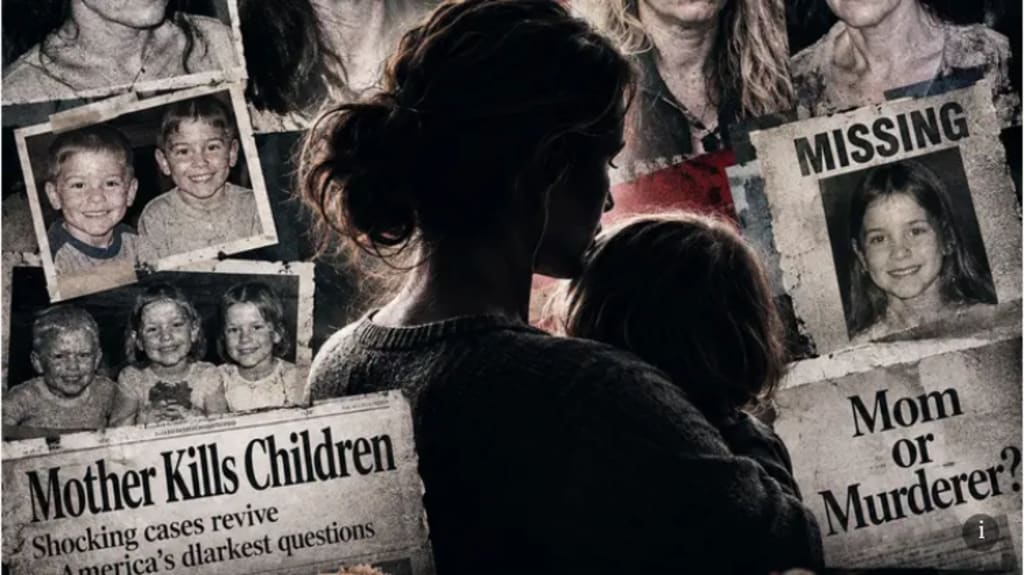
The Crimes We Cannot Understand
When a mother kills her own child, society seems to lose the ability to use ordinary words for a moment. A mother is supposed to protect. She is supposed to stand behind her child when they are afraid. She should hold their hand when they are sick. And she should be the last person in the world a child should ever have to be afraid of.
Yet American history knows a number of cases where the mother herself became the murderer of her own children.
And in recent days, Americans have been talking about these cases intensely again.
The reason is the case of Lindsay Clancy from Massachusetts. The woman accused of murdering her three small children defended herself by saying that she was suffering from severe postpartum psychosis at the time of the crime. After an almost six-week trial, the jury was unable to reach a verdict. The court therefore declared a mistrial on September 4, 2026, and the case remains open. Clancy is still receiving psychiatric care, and it is not clear whether there will be another trial.
And so America is once again returning to the women whose names have long become part of the history of American true crime.
Some killed because of men.
Others because of money.
Some apparently lived inside a world created by severe mental illness.
And in several cases, the most frightening question remains the same: what actually happened inside a person's mind?
Diane Downs: The Woman Who Arrived at the Hospital With Her Shot Children
It is May 1983.
A young woman named Diane Downs arrives at a hospital in Oregon. In her car are her three children – eight-year-old Christie, seven-year-old Cheryl and three-year-old Danny.
All three have been shot.
Cheryl is dead. The other two children are fighting for their lives. Diane herself is also injured.
And this is where a story begins that will fascinate America for months.
Downs told the police that a strange man with bushy hair had stopped her on an isolated road. According to her story, he wanted her car. When she refused to give it to him, he started shooting.
But little by little, her story stopped making sense to the investigators.
Some things simply did not fit. Her behaviour was not what investigators expected from a mother who had just lost one of her children. And the more the police investigated, the less they believed that the mysterious shooter had ever existed.
Eventually, it became clear that the children had been shot by their own mother.
In 1984, Downs was convicted of murdering Cheryl and attempting to murder her two other children. She was sentenced to life in prison plus another 50 years.
The case received enormous attention partly because Downs did not look like the stereotypical image of a cold-blooded killer.
She was young.
She was a mother.
And that frightened Americans perhaps even more than the shooting itself.
Susan Smith: Nine Days of Crying in Front of the Cameras
Eleven years later came a case that became one of the biggest American media stories of the 1990s.
October 1994, South Carolina.
Susan Smith reported that someone had stolen her car while her two sons were inside it. Michael was three years old. Alexander was only fourteen months old.
America watched the television news.
People searched for the children.
Photographs of the boys appeared in the media.
Their mother cried in front of the cameras and begged for her children to be brought back.
But after nine days, everything changed.
Smith confessed.
There had been no kidnapper.
She had strapped her sons into their car seats, allowed the car to roll into a lake, and the children died inside.
Investigators later concluded that one of the motives was her desire to start a new life and have a relationship with a man who did not want children.
The case was extremely shocking because of what happened after the murders.
It wasn't only about the crime itself.
It was about nine days.
Nine days of a public search, television appearances, tears and hope – while the truth was somewhere completely different.
Smith received a life sentence.
And in November 2024, thirty years after the murders, her request for parole was denied.
Her case remains one that Americans know almost by heart.
Marybeth Tinning: Nine Children and the Same Terrifying Pattern
An even stranger story began in New York in the 1970s.
Marybeth Tinning had children.
And her children gradually began to die.
One.
Then another.
And another.
In total, nine of her children died over a period of several years.
The first death had a natural explanation.
But later, doctors began noticing something that was becoming harder and harder to consider a coincidence.
The children died in different circumstances, but one strange element kept repeating itself: their mother was nearby.
Some children were said to be ill. Others supposedly suffocated or suddenly stopped breathing.
And still, for a long time, nothing happened.
Not even after several children had died.
After the death of the ninth child, little Tami Lynne, however, someone decided to call the police.
According to reports from the time, an anonymous phone call contained one terrifying question:
How many more children have to die before you do something?
The investigation finally began in earnest.
Tinning was eventually convicted of murdering Tami Lynne.
She was not convicted for the other deaths, even though she was suspected in many of them.
And this is where one of the most frightening things about the entire case appears.
Nobody really knows exactly where coincidence ended and crime began.
Marie Noe: Eight Children Who Died as “Victims of Sudden Infant Death Syndrome”
If there is a case that sounds like something from a horror movie, it is the story of Marie Noe from Philadelphia.
Between 1949 and 1968, eight of her children died.
All eight were very young.
And according to the available records, all of the children had been healthy when they were born.
Medicine at the time had an explanation for such deaths: sudden infant death syndrome, then commonly called “crib death.”
But eight similar deaths in one family were no longer simply a tragedy.
It was a statistical nightmare.
Suspicion had existed for a long time. Doctors discussed it among themselves. The family was even mentioned at professional meetings.
But there was no evidence.
And so decades passed.
It was not until 1998 that the case was reopened.
Marie Noe was accused of suffocating the children. She later confessed to eight murders and in 1999 accepted a plea agreement.
She received a surprisingly light sentence – twenty years probation, with the first five years to be served under house arrest. Psychiatric treatment was also part of the agreement.
Why such a light sentence?
Because the crimes had happened decades earlier, Noe was already seventy years old when she was sentenced, and the case also had significance for research into repeated infant deaths.
But for the public, one question remained:
How can a mother survive the deaths of eight of her own children and still remain in the middle of the story as their grieving mother every single time?
Andrea Yates: The Case That Changed How America Looked at Postpartum Mental Illness
And then came Andrea Yates.
Her case is different.
And that is exactly why it remains so important.
In June 2001, she killed her five children in her home in Houston.
The youngest was six months old.
The oldest was seven.
Yates did not claim that she had not killed the children.
Quite the opposite.
She explained that she believed they had to die because she could not protect them from Satan and hell.
She had suffered from serious psychological problems for a long time. She had already been hospitalized for psychiatric treatment and had attempted suicide. Her defence based the entire case on severe postpartum psychosis.
At the first trial, she was convicted.
But the verdict was later overturned, and during a new trial in 2006, the jury reached a completely different conclusion.
Andrea Yates was found not guilty by reason of insanity.
She was placed in a psychiatric hospital.
And this opened a question that America still returns to today:
When is a woman who kills her children a murderer – and when is she primarily a patient whose illness nobody was able to stop?
Deanna Laney: The Mother Who Believed God Had Ordered Her to Do It
Another case happened in Texas.
In 2003, Deanna Laney attacked her sons with a large stone.
Eight-year-old Joshua died.
Six-year-old Luke died as well.
Her youngest son, fourteen-month-old Aaron, survived the attack.
Laney said that she had acted under the influence of a religious delusion.
According to the defence, she believed that God had ordered her to kill her children.
Just as in the case of Andrea Yates, the court was therefore not dealing only with the question:
Did she kill her children?
That was obvious.
The court had to deal with a much more complicated question:
Did she understand what she was doing at the moment of the crime? And did she understand that it was wrong?
In 2004, she was found not guilty by reason of insanity.
Another woman.
More children.
And once again, the same thin line between crime and psychosis.
Lori Vallow: This Time, It Wasn't Only About Mental Illness
The case of Lori Vallow feels completely different.
Her children, Tylee and Joshua “JJ” Vallow, disappeared in 2019.
The case gradually became one of the strangest American criminal stories of recent years.
There were lovers, religious beliefs about “zombie” people, apocalyptic visions, money and a series of suspicious deaths.
The children's bodies were eventually found on the property of Chad Daybell.
In 2023, a jury found Vallow guilty of murdering her two children and also of participating in the murder of Daybell's previous wife.
Here, postpartum psychosis was no longer the main issue.
It was a story of manipulation, religious extremism, a relationship between two people and, according to prosecutors, money as well.
And that is exactly why it is so interesting to compare Vallow with Yates.
Both were mothers.
Both killed children.
But the story that led them to their crimes was completely different.
Lindsay Clancy: A Story That Is Still Being Written
And now we return to the present.
Lindsay Clancy was a nurse who worked on a maternity ward.
In January 2023, her three children died – five-year-old Cora, three-year-old Dawson and eight-month-old Callan. Clancy then attempted suicide.
Her defence says she was suffering from severe postpartum psychosis.
The prosecution says that she knew what she was doing and that the act was intentional.
And America has been watching the trial in recent weeks.
Psychiatrists presented different opinions.
Her family spoke about her worsening mental condition.
Her former husband, Patrick Clancy, described her psychological problems in court and her repeated attempts to get help.
But in the end, the jury could not agree.
And perhaps this is the most interesting point of the whole current case.
After almost six weeks of trial, twelve people could not find a common answer to one question:
Is it possible to punish a person for an act committed at a moment when their own mind had stopped working in the way a healthy person's mind normally works?
On September 4, 2026, the court therefore declared a mistrial.
No victory for the prosecution.
No final victory for the defence.
No full stop.
Is It an Epidemic?
In reality, no.
There is no reason to claim that America has suddenly developed an epidemic of mothers who murder their children.
There is, however, an epidemic of media attention.
And it has a strange characteristic.
Whenever a new case appears, the media immediately brings back an old one.
Lindsay Clancy reminds America of Andrea Yates.
Susan Smith returns to the media whenever people begin talking about mothers who murder their children and then try to convince the public of a different version of the story.
Diane Downs reminds us that such a case can have a completely different motive.
Lori Vallow showed again that murder does not necessarily come from psychosis, but can come from a mixture of manipulation, a relationship, money and fanatical beliefs.
And the cases of Marie Noe and Marybeth Tinning show something else.
Sometimes the most frightening thing is how long the people around a family can refuse to accept that they may be watching a series of crimes instead of a series of tragic coincidences.
And Maybe That Is Why America Keeps Coming Back to Them
These stories are not the same.
And it would be dangerous to put them all into one box.
One woman was, according to psychiatric experts, severely psychotic.
Another received a life sentence for murder connected with a relationship.
Another was convicted of murdering one child, while suspicion remained around the deaths of the others.
And another woman was convicted of murdering her children in a case involving money, a relationship and religious delusions.
Still, all of these cases have one thing in common.
They all destroyed one of the strongest ideas that society has created about motherhood.
The idea that a mother is automatically the protector of her child.
But human beings are not automatic machines.
Not even mothers.
And that is exactly why these cases are so frightening.
Not because we should turn them into stories about “monstrous women.”
But because they force us to ask a much more uncomfortable question:
How much can a person hide behind the closed doors of their home before somebody notices that something is no longer right?
And in the case of Lindsay Clancy, America is still waiting for the answer.
Just as it is waiting for the answer that the court will eventually give.
Because the story is not over yet.
Sources
Reuters – reporting on the Lindsay Clancy trial, the arguments of the prosecution and defence, and the court's decision to declare a mistrial.
Associated Press – coverage of the Lindsay Clancy case, including the disagreement among jurors and questions surrounding her mental state.
Associated Press – Susan Smith, the disappearance of her two sons, her confession and her later parole hearing.
Washington Post / Associated Press – Diane Downs and the investigation into the shooting of her three children.
Associated Press – Andrea Yates and the 2006 verdict finding her not guilty by reason of insanity.
CNN / Associated Press – Deanna Laney and the court's decision concerning her mental state.
Associated Press – Lori Vallow Daybell and her conviction for the murders of her children.
U.S. Department of Veterans Affairs and medical sources concerning postpartum psychosis and severe psychiatric illness.
I’m sorry for any mistakes in my English. I’m using this way of writing to improve my English, so please be patient with me and thank you for your understanding.
About the Creator
Enjoyed the story? Support the Creator.
Subscribe for free to receive all their stories in your feed.
Comments
There are no comments for this story
Be the first to respond and start the conversation.