
Most Epic Revenge Stories in History
extreme revenge stories from history


Today we're going over more extreme revenge stories from history. Peter I of Portugal. It's 1340 and Peter, the son of the king of Portugal, is unexitedly awaiting the arrival of his future bride. This marriage wasn't one Peter was looking forward to. In fact, this was all his father, King Alfonso's idea. See, at the time, Portugal was a relatively small kingdom that shared a border with Castile, a large and powerful nation. Understanding it was probably better to make friends and not

enemies, Alfonso negotiated a deal to have his son marry the daughter of a powerful Castilian noble. The contracts were signed and the king felt great that his son's marriage would help keep his kingdom safe and secure. Never in a thousand years could he imagine what would happen next. The royal procession from Castile arrives and outsteps the most beautiful woman Peter had ever seen. His jaw hits the floor and he can't stop staring. Karumba, she is stunning. A total 10 out of 10 baddy.
And the future king instantly falls madly in love. But there was just one problem. The woman he was staring at was actually not his bride. She is a woman named Enes Diccastro, his future wife's lady in waiting. His real fianceé, Constanza, exits the carriage next and approaches Peter to introduce herself. She's nice and all, but as hard as the prince tries to focus on the woman who would soon be his queen, he just can't take his eyes off. Peter and Constanza get married to fulfill the contract

signed by their fathers, and they go on to have a very unhappy marriage. The entire time, Peter is not so secretly hooking up with Eness, and rumors of their affair quickly spread through the court. Consanza grows increasingly frustrated with her husband's infidelity, and eventually she tries to get him to name Eness the godmother to one of her children. This was something that in that period would basically make the affair incestuous. But that child died within a week of birth, so Eness dodged that bullet. As frustrated as
Constanzo was with Peter, his father, Alfonso, was even more upset. His stupid son couldn't keep it in his pants, and now his affair was putting the entire kingdom at risk. See, an important detail in this story is that Enessa's brothers were powerful, but now exiled Castile noblemen, who quickly befriended Peter when he started hooking up with their sister. Peter started to give them important roles in his court. and Alfonso worry that his idiot son might get dragged into some Castellian
political war. The king starts trying to banish Eness from Portugal, sending her to various regions in the Iberian Peninsula, but his son just spends all of his time writing letters to her. In the end, all of his efforts to break up his son and side chick fail, and Alfonso is forced to keep us closer to him in Lisbon to keep an eye on both of them. Consanza dies in 1349 due to complications from childbirth. Peter is still performing his royal duties of making new heirs, by the way. And when this happens, Peter is overjoyed.
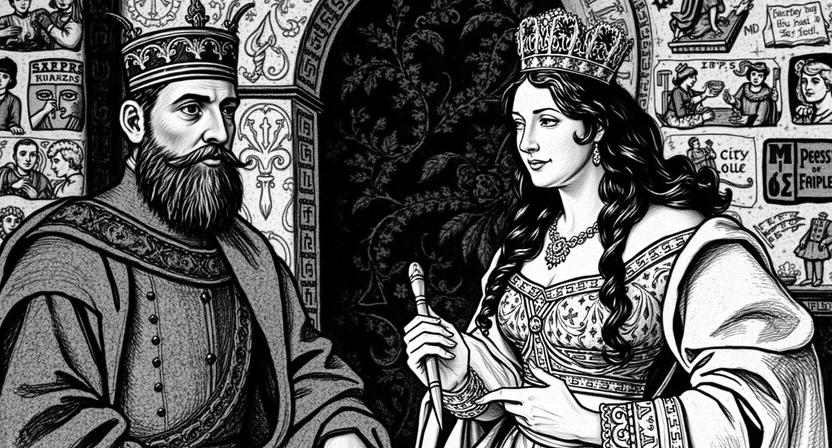
Finally, he can officially marry Eness and live happily ever after. But King Alfonso is having none of it. He banishes Eness to Coimra and explicitly forbids Peter from marrying her. Peter unsurprisingly tells his dad to shove it and follows Eness to Coimra where they live together and have four children. Alfonso is now at his wit's end. These illegitimate heirs could one day try to make a claim for the throne and Portugal could spiral into a civil war. Enough was enough. Enes had been nothing but
trouble since she arrived 15 years ago. His son must choose Portugal or this woman. And so Alfonso hatches a plan to ensure Peter picks correctly. In 1355, King Alfonso sends three men to Coimra. They find Eness in a monastery and in front of her young children they cut off her head and leave. Peter returns and finds the love of his life dead and he is [music] destroyed. He cries loudly overwhelmed by feelings of grief and guilt for not being able to protect her. But soon his tears burn hot with hatred
and anger towards his father. Peter raises an army and begins attacking and terrorizing areas in northern Portugal. In his efforts to prevent a future civil war, the king had accidentally caused exactly what he had feared. The forces of Peter and Alfonso fought for nearly the entire year. And in the end, Peter loses. His mother, the queen, is able to negotiate a truce between father and son, but the prince never forgives his father. Two years later, Alfonso dies and Peter becomes the new king of
Portugal. He immediately orders that the men who murdered Eness be captured and brought to him. The assassins are hunted for years until two of them are finally apprehended in Castile in 1361. The two assassins are dragged before Peter and with contempt in his eyes, the king stares at the men who killed his beloved Eness. The men are put on trial in public and found guilty. As punishment, Peter orders their hearts to be ripped out while they are still alive. Some sources say that he himself participated
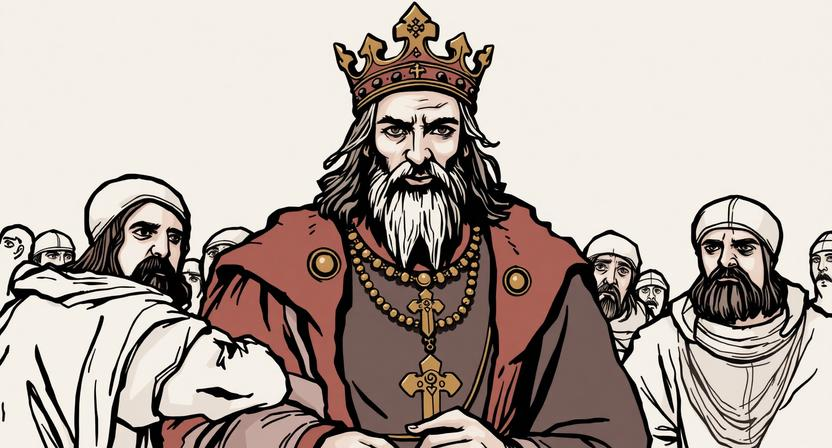
in the execution, screaming, "You have done the same to my heart." What usually comes next in this story is apocryphal, meaning it may not have actually happened, but it is said that Peter then declared to the crowd that he had married Eness before she died and that she was his rightful queen. He has Eness's body exumed, dresses her corpse in the finest [music] clothing, and places her on the throne, lovingly staring at the remains of his mistress. [music] He crowns Enes the Queen of
Portugal. He then forces every single nobleman to swear his loyalty to his queen by kissing her rotting hand. Following this coronation story, which may or may not be true, Peter then had Enessmbed in the Alubasa monastery. In his final will, Peter orders that when his time comes, he also be laid to rest there with Eness. Inscribed in the marble of his tomb are the words ate dumundo until the end of the world. And that is where they both are to this very day. Xiinch. The early half of the 20th century was a time of complete chaos in
China. In 1912, due to political pressures, the six-year-oldq-Qing Emperor Pui abdicated his throne, officially ending the 268-year-old dynasty. Within just four years, the country that was once the most powerful nation in Asia devolved into a land of constant violence, with areas governed by regional warlords fighting for control over the now toothless government in Beijing. This era is known today as the warlord era. And amidst the mayhem, a young woman would make history when she set out on a decadel long quest
to avenge the death of her father. It's the 1920s and Shigolan is a college student in Tanzin. Unlike most people who were suffering greatly in the warlord era, Gulan's life had taken quite the opposite turn. Her father, Xi Kongbin, had enlisted in the local military, and he quickly rose through the ranks. By 1925, he had gone from being the son of a simple farmer and tofu seller to a brigade general serving a powerful warlord aligned with the funian click. His family, including Shigolan, had in the process gained the
status and prestige that came with such a rank. Everything was going great until a second war broke out between the Funian and Julie clicks that changed her life forever. By October of 1925, the Fun Xian had defeated the Julie. But a military governor named Sun Chanfong had used the opportunity to seize control of his area, becoming a very powerful warlord himself. Shi Kong Bin is deployed with a brigade of mercenaries to capture a city in Chuanfong's territory. And things initially go well
for him. But during the battle, he and his men are caught off guard by a sneak attack led by the warlord himself. Kong Bin's forces are quickly overwhelmed and he is taken hostage. The following day, he is tied up and brought to a local train station. A crowd gathers and Tronfang orders his prisoner decapitated. Kong Bin's head is paraded around the station on a bamboo pike and then displayed for all to see. News of her father's death reaches the young Shigolan and she initially mourns the
loss of her father. But soon her tears of sadness burn her cheeks and she is consumed by anger. This warlord had not just killed her father by displaying his head. He had dishonored his entire family. How could anyone tolerate such disrespect? She swears that she will stop at nothing to avenge her father and restore her family's honor. But that would be much easier said than done. See, Tronfang was now one of the most powerful warlords in China. And Shigulan, well, she was a 21-year-old college kid. The thought of a random
student assassinating someone that powerful seemed highly improbable. But Gulan had made up her mind. She changes her name to Xi Jin Chow, the rising sword, and sets out on a quest for revenge. But before she was able to find Schwanfong, the warlord's life would take the most peculiar turn as well. By 1926, Chinese citizens were sick and tired of the warlord system. A group from the south of China called the Kuan Tang took advantage of this public sentiment and they set out on their own quest to defeat every warlord in China
to reunite the country. This whole event called the Northern Expedition probably deserves its own video. But to massively oversimplify the story, the warlords were all defeated by the KMT in about 2 and 1/2 years. This didn't really fix the constant fighting in China. But with the warlord system gone, Tuanfong lost everything he had worked for. Left with nothing to show from the last 15 years of being a ruthless warlord general, Tuanfong shaves his head and actually becomes a devout Buddhist. Well, all
that is respectable and all, I guess. Shien Xiao didn't get the memo, and she begins tirelessly working to unearth clues to identify and locate her father's killer. For 10 whole years, she chases leads, traveling hundreds of miles searching for Tranfang until finally, she finds him in the city of Tanzhin. As she watches the former warlord from the shadows, it takes all of her self-control not to end him right then and there. But she had spent a decade of her life in preparation for this moment. She knew that she would
only have one shot to take him down, and she could not waste that opportunity. So instead, she stalks her prey for months, learning his daily routine until finally she had selected the perfect place to enact her revenge. On November 13th, 1935, Xiin Chow steps into a lay Buddhist hall and, as expected, finds Tronfang kneeling with his eyes closed, leading a group in the chanting of a sutra. As he continued the recitation, Xi Jincha slowly walked directly behind her father's murderer and carefully drew
her pistol. She points her weapon at the former warlord and coldly unloads three rounds into his head and back. Tranfong instantly falls dead and the hall erupts into a panic. But instead of trying to run away, Jinchow proudly sits next to the dead body and begins to hand out leaflets she had prepared prior to the killing that explained why she did what she had just done. Xi Jinch Chow is arrested for murder, but the media picks up the story of the killing of Chuanfong, and it instantly divides the
people of China. The traditionalists see her actions as the ultimate form of filop piety, the Confucian doctrine of love and honor for one's parents, while the modernists demand justice and to uphold law and order. [music] Her court case becomes the biggest story of the year and eventually reaches the Supreme Court in Nanjing. Due to overwhelming public support, she was granted a full state pardon, and the killing of Chuanfong was deemed an ethically justifiable act of filial piety. Having avenged her father's death, she
peacefully lives out the rest of her days and dies in 1979 at the age of 74. Analut. Okay, this last story completely blew me away because not only was it the first time someone actually stopped the Mongol conquest in its tracks, it's probably one of the craziest movielike stories of revenge in history. It's 1231 and the once vast and powerful empire known as Quarresmia lies in complete ruin. As retribution for the disrespect shown to Mongol emissaries by the governor of Otar, Genghask Khan and his
army had invaded the land, killing an estimated 15 million people as they burned entire cities to the ground. Amongst the remnants of the once proud civilization, the Mongols, who continue their occupation of the land, find a young Quarresbian prince and sell him to a slave merchant in Egypt. The boy is purchased by the local sultan and is put into training to become a Mamluke, a warrior [music] class of slaves used by the rulers of the Muslim world as elite knights. The former prince is thrown in
with the rest of the slave children and is forced to endure the strictest of training regiments designed to turn boys into hardened men. From a young age, he is thrust into combat against other children. And he is given the name Kutus, the rabbid dog, because he fights like a vicious beast against the other slaves. Kutus rises through the ranks and eventually becomes the vice sultan of Egypt in 1253. By now, the Mamluks had revolted against their masters and established their own sultanate, becoming the rulers of the land. Against
all odds, the former prince had made his way from slavery back to a royal position. But an easy life was not his destiny, and ghosts from his past would soon return to haunt him. Though Genghaskhan had died in 1227, his grandson Huligu Khan had continued the Mongol expansion westward. Like demons, they had brought nothing but death and destruction to every land they touched. In 1254, they sacked the city of Baghdad and massacred all of its inhabitants, ending the Islamic Golden Age. The Mongols then pushed into Syria and took
the cities of Aleppo and Damascus. The Aubid Sultan sends word to Egypt, pleading for help against the Mongols. And Kutus is haunted by the memories of the destruction of his homeland. He knows the horrors the horde from the east will bring. And if the Mlukes are to have any chance of survival, Egypt must have strong leadership. He deposes the young and inexperienced Sultan and takes the throne for himself. As if on cue, Huligu Khan's diplomats soon arrive in Cairo and they begin to read a very
Mongol sounding message to the new Sultan. From the king of kings of the east and west, the great Khan to Cutus the Mammluke who fled to escape our swords. You should think of what happened to other countries and submit to us. You have heard how we have conquered a vast empire and have purified the earth of the disorders that tainted it. We have conquered vast areas, massacring all the people. You cannot escape from the terror of our armies. Where can you flee? What road will you use to escape us? Our horses
are swift, our arrows sharp, our swords like thunderbolts, our hearts as hard as the mountains. Our soldiers as numerous as the sand. Fortresses will not detain us, nor armies stop us. Your prayers to God will not avail against us. We are not moved by tears, nor touched by lamentations. Only those who beg for our protection will be safe. Hasten your reply before the fire of war is kindled. Resist and you will suffer the most terrible catastrophes. We will shatter your mosques and reveal the weakness of
your god. And then we will kill your children and your old men together. At present, you are the only enemy against whom we have to march. As a messenger speaks his final words, the Mammluke advisers are literally shaking in fear. Cutus looks to his officials and his blood begins to boil. He calls for council away from the Mongol diplomats and in private, the Sultan begins an impassioned plea to the council. You all have lived good lives funded by the taxes of the people and now you wish to abandon them. Kutus continues to argue
with those who wish to flee and his voice begins to quiver with desperation. Finally, he looks to his adviserss as tears begin to stream down his cheeks. My brothers, who will defend Islam if not us? The Mongols had taken everything from him as a child. He could not let them do it again. The generals and nobles are moved by his words, and despite knowing they would most likely be accepting their own deaths with the decision, they agree to follow him into battle. With that, Kutus and his men solemnly return to the Mongol
messengers. The Sultan looks towards his guests and calmly gives a signal. His soldiers step forward and slice the diplomats in half. Their heads are removed and hung from the south gates of Cairo as an open act of defiance. A letter is sent to Hulugu notifying the Mongols that the Mamlukes will not bow down and will instead fight to the end. Kutus is soon joined by a rival Mammluke general named Babbars, a man who was also sold into slavery as a child by the Mongols. And they quickly begin to raise
an army and set out to confront the enemy from the east. The Mamluks cobble together 24,000 men, but they are vastly outnumbered by the Mongols nearly 3 to1. It looks like this will be another trademark Mongol Muslim massacre, but fate intervenes when the great Khan Monka dies. Huligu is forced to return to his homeland to help decide on the successor and takes most of his army with him. He leaves his trusted general Kituka with around 12,000 warriors to finish the job. Kipuka had recently converted to Christianity, so he
recruits some Christian soldiers from Armenia and Georgia to bulk up his army and then begins preparations to invade Egypt. Kutus gets word that Hulugu had left the area and he and Barbars immediately ride out to force a battle with Kabuka. They find the Mongols camped near a spring called Anjalut in Galilee. Babbars had spent time in the area as a fugitive and was familiar with the terrain and he comes up with a battle plan to use the Mongols own tactics against them. The bulk of the Mammluke army commanded by Kutus is left
hiding in the trees and Barbars takes a small detachment to directly attack the Mongols. Baybars and his men charge the Mongol camp and harass them for hours with hitand-run tactics. Every time the Mongols run out to fight, the Mammluks pull back closer and closer to Kutus. Eventually, Kipuka grows frustrated and he orders a full charge. This is exactly what Babars had been waiting for, and he quickly orders his warriors to fall back. The Mongols, now enraged, the Mamluks are again running away, blindly
chased them, and Babars and his men lead them directly to Kutus. The trap had been set, and the Sultan gives the order. Kutus' army emerges from the forest and archers send a storm of arrows down onto the unsuspecting Mongol riders. The Mamluke heavy cavalry then makes a full charge and smash directly into the enemy line. Kabuka and his warriors are initially shocked by this surprise attack, but they quickly regain their composure and begin fighting back. The battle is brutal and the Mongols
quickly prove that their reputation was well-earned as they begin to savagely tear through the Mamluke army. Kutus watches from a distance as his left flank begins to falter and it appears that the Mongol forces are about to break through. His mind is flooded with memories of his childhood. He cannot let history repeat itself. And so without a moment's hesitation, Kutus abandons his post and charges head first into battle. As he rides, he throws off his helmet and shouts, "Oh Islam, oh Allah, grant
your servant Kutus a victory against these Mongols." His warriors turn to see who is shouting and are shocked to see their sultan riding into battle to fight alongside them. Kutus continues to charge forward. Oh Islam. He screams and his words fill the Mamluks with renewed courage. They regain their composure and they begin to fight back. The battle rages on with Kutus now on the front lines and soon the Mongols do something they had never done before. They begin to run in fear. Kuka cannot believe his
eyes as his warriors flee past him. He tries to rally his remaining men, but it is no use. The Mongol general and those who stay to fight are all slain in battle. Hulugan receives word of the Mongol defeat at Ajalut and is enraged. He orders the execution of the last of his Ayubid prisoners, but the damage had already been done. The illusion of the Mongol invincibility had been shattered. 5 days after the battle of Anjalut, Kutus and Babbars retake Damascus and within a month they also free Aleppo
from Mongol control. Two men who had been sold into slavery as children by the Mongols had pulled off what no one had ever dreamed possible. They had stopped the unstoppable horde from the east, avenged the Quarresmian Empire, and saved the Muslim and Christian world. Throughout the following decades, the Mongols would attempt multiple invasions into Syria, but would be pushed back time and time again until eventually the descendants of Hulugu themselves eventually converted to Islam. If you can't beat him, join him, I
guess. As for Cutus, as epic as his story is, it ends on kind of a down note. As his army was riding back to Cairo to celebrate their victory at Analute, he was assassinated by a group of his own soldiers, probably under the orders of Babars himself. What? Don't hate the player, hate the game.
About the Creator
HearthMen
#fiction #thrillier #stories #tragedy #suspense #lifereality
Enjoyed the story? Support the Creator.
Subscribe for free to receive all their stories in your feed.
Comments
There are no comments for this story
Be the first to respond and start the conversation.