Latest Stories
Most recently published stories in History.
Why Do We Have Social Constructs?
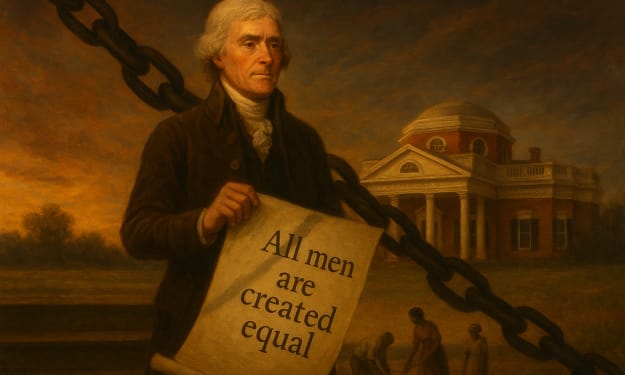
I feel a little bit like I’ve been going crazy lately. So many different things are happening. So many different changes in the world; so many surprising things that are turning out to be the exact opposite of what I thought they would be at this time. I feel so alone with this experience too, but at the same time, I know I am not; I know there are lots of people that are starting to feel the same way. It’s starting to feel more and more like a dystopian science fiction film, and less like reality. What we thought was real, or what we thought was the way things are, is turning out not to be true. For decades, for centuries, humanity has prided itself on seeking and finding knowledge, learning the history of this planet, and then making it the goal to teach this one way and put that in the textbooks.
By Slgtlyscatt3red11 months ago in History
Veil of Shadows Case File #27: The Brownsville Encounter
The last heat of summer still clung to the Willamette Valley when the sky opened over a quiet stretch of Highway 99. In 1954, there was no I-5 slicing through the fields, only a two-lane ribbon of blacktop winding through Brownsville, Oregon; flanked by stubbled farmland that had already surrendered its hay. The air was cool enough to keep the windows rolled up on the old 1938 Packard as three individuals made their way down the highway.
By Veil of Shadows11 months ago in History
The Winchester Mystery House. AI-Generated.
In the heart of San Jose, California, stands a sprawling mansion that seems less like a home and more like a dream- or perhaps a nightmare- in the guise of a home, with staircases that lead to ceilings, doors that open into walls, and windows that overlook other rooms, the Winchester Mystery House is a monument to obsession, grief and mystery. It is a place that seems to defy reason; a labyrinth of wood and glass built not from blueprints, but from the mind of a woman filled with unending grief, superstition, and whispers of the dead. Its creator, Sarah Winchester, transformed her sorrow into ceaseless construction, crafting one of the strangest and most enduring legends in California history.
By Carolyn Patton11 months ago in History
Cults of Gods: Why King of Gods Is Immoral?
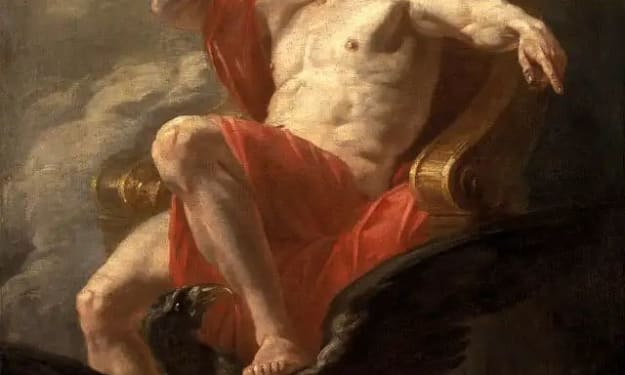
Those who study Zeus’ mythology deeply know that calling him a role model would be like calling a rotten apple delicious. From the start of his reign over Earth, Zeus became infamous for a series of morally questionable acts: he swallowed his first wife, Metis — the Titaness of Wisdom and Cunning; he was endlessly unfaithful after marrying Hera, the goddess of marriage; and he abducted Ganymedes, a Trojan prince, into Olympus for his beauty. And these are only the tip of the iceberg.
By Alex Smith11 months ago in History
The Beauty of Traditions Across Faiths
In a quiet neighborhood where cultures intertwined, the calendar was never empty. Every season brought festivals, ceremonies, and rituals that reflected the rich tapestry of human belief. Families celebrated differently, yet there was a shared rhythm to life—a heartbeat made of devotion, love, and tradition.
By Nangyal khan11 months ago in History
The Drums of Freedom’s Endless Echo
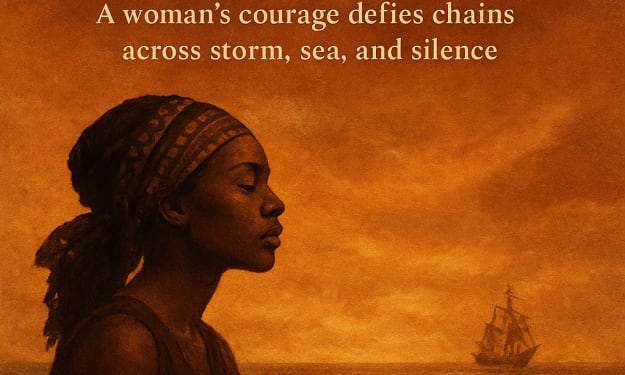
“The Drums of Freedom” The waves of the Atlantic shimmered gold under the morning sun, but for those chained beneath the deck of the Mercy’s Cross, it was a sea of sorrow. The year was 1787, and the slave trade between West Africa and the Americas was at its height. The ship creaked under the weight of despair, its wooden hull soaked with tears and salt. Among the captives was Abeni, a young woman from the Yoruba lands of West Africa. Only a month earlier, she had danced at her sister’s wedding, her laughter echoing through the palm trees. But that joy had been shattered when raiders descended upon her village — men with guns, guided by others who spoke her language but carried the greed of foreign traders in their eyes. Now, Abeni sat in darkness, her wrists raw from the iron cuffs, her body trembling from the stench and heat. Around her, dozens of others breathed in shallow gasps. The air was thick with grief. Yet even there, beneath the suffocating deck, she could still hear it — a faint rhythm, a pulse of life. Someone was tapping quietly on the wooden planks. A message. A memory. A beat of home. That night, as the sailors drank above deck and the ocean whispered below, the tapping grew louder. The rhythm spread — from one prisoner to the next — until the entire hold throbbed like a beating heart. The enslaved spoke no single tongue, yet the rhythm became their common language. It carried courage. It carried defiance. Above, the ship’s first mate, a wiry man named Thomas Blake, frowned. “They’re making noise again,” he growled. The captain, Edward Lowe, waved a dismissive hand. “Let them,” he said. “It breaks no chains.” But in truth, it did — just not the kind of chains they could see. Abeni remembered the stories her grandmother had told — that the spirits of the ancestors traveled on the wind, that even in the deepest darkness, their song could call the lost home. She began to hum softly, her voice trembling at first, then strengthening as others joined in. It was a song of mourning and hope, of rivers and rain, of mothers waiting at the shore. The sailors tried to silence them, but the song returned each night. It became their prayer and their protest. Even as disease spread and the weak were thrown overboard, the rhythm continued. Each beat said, “We live. We endure.” Weeks passed. The Mercy’s Cross neared the Caribbean, its human cargo destined for the sugar plantations. But the sea, it seemed, had other plans. A storm gathered on the horizon — black clouds rolling like angry gods. The wind howled, tearing at the sails. Waves slammed against the ship, and lightning split the sky. In the chaos, one of the iron locks on the lower deck broke loose. Abeni saw her chance. With bleeding hands, she helped others free themselves, passing along the broken chain link like a sacred relic. When the next wave struck, they rose together, bursting onto the deck amid rain and thunder. The sailors shouted, blades flashing, but the storm itself seemed to fight for the captives. Lightning struck the mainmast, setting it aflame. The ship lurched violently, splitting along its side. In that wild, furious moment, Abeni threw herself into the sea — into freedom or death, she did not know which. The next morning, the Mercy’s Cross was gone, swallowed by the Atlantic. Debris floated on the waves — broken wood, torn rope, shattered chains. And among them, clinging to a plank, was Abeni. She coughed, gasped, and stared at the endless horizon. The sea had spared her. Days later, a small fishing vessel from the Bahamas found her drifting near an island. The fishermen, freedmen themselves, pulled her aboard. Though weak, Abeni managed to whisper, “Home.” They did not know where her home was, but they understood what she meant. Years later, stories spread among the enslaved in the Caribbean — of a woman who escaped the Mercy’s Cross, who taught her people the rhythms of freedom. On moonlit nights, they said, she gathered others in secret and beat on drums made from hollowed wood and stretched hide. The rhythm echoed the heartbeat of those who refused to be broken. And so, the legend of Abeni — The Woman of the Drums — lived on. Her song crossed oceans, carried in whispers and work songs, in the pulse of every freedom struggle to come. For as long as the drums beat, the world would remember: The spirit can be bound, but never silenced.
By Mukhtiar Ahmad11 months ago in History
Phumzile Mlambo-Ngcuka Speech at CSW69: Backlash, AI, Representation
Phumzile Mlambo-Ngcuka reflects on UN Women’s creation and warns of a growing backlash against gender equality. She argues that women’s participation strengthens democracy and economies, citing research estimating trillions in global gains. Celebrating progress since the Beijing Declaration and Platform for Action, she urges meaningful commemoration paired with forward planning. Two priorities dominate: digital inclusion—especially women’s presence in AI knowledge-making—and representation, where women still hold only about one third of decision-making roles. She calls for solidarity across movements, protection of affirmative action, and faster action so girls and young women are not left behind as technology and power structures evolve.
By Scott Douglas Jacobsen11 months ago in History
Changez Khan: The Man Who Changed the World
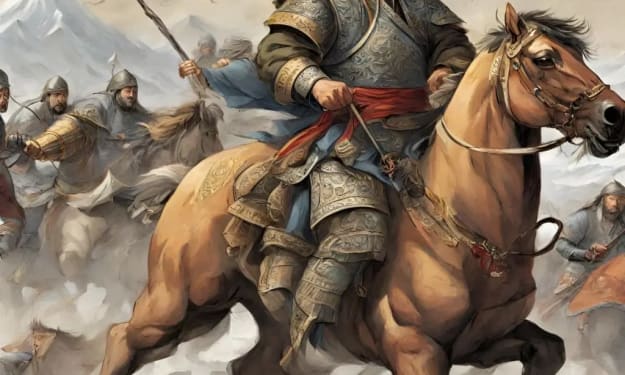
Eight hundred years ago, in the cold, windy lands of Mongolia, a boy was born who would one day shake the world. His name was Temujin, but the world would remember him as Changez Khan — or Genghis Khan, meaning “Universal Ruler.”
By Ghalib Khan11 months ago in History