Latest Stories
Most recently published stories in History.
America Will LOSE This War Part 1
Can you imagine that in 2026 the world’s only superpower, the United States, could lose to a country it has been sanctioning for the past 40 years? This isn’t my claim—it’s the prediction of Professor Syne, whose two predictions about Trump have already come true. Now the world is waiting for the third one.
By Imran Ali Shah6 months ago in History
Which War Caused More Destruction: World War I or World War II?
The two largest conflicts in modern history are World War I (1914–1918) and World War II (1939–1945). Both wars changed the course of human history and caused enormous destruction across many countries. Millions of soldiers and civilians lost their lives, cities were destroyed, and economies collapsed. However, historians generally agree that the Second World War caused far greater damage and loss of life than the First World War. By examining the number of deaths, the scale of destruction, and the impact on civilians, it becomes clear why World War II is considered the deadliest conflict in history.
By shaoor afridi6 months ago in History
This Little Light of Mine was written to praise Jesus
The subject of the light There are television commercials that use the chorus of This Little Light of Mine. The song is also used as a lulaby for children. I grew up at a time when children sang this song in church and it was understood that the "light" was Jesus Christ.
By Cheryl E Preston6 months ago in History
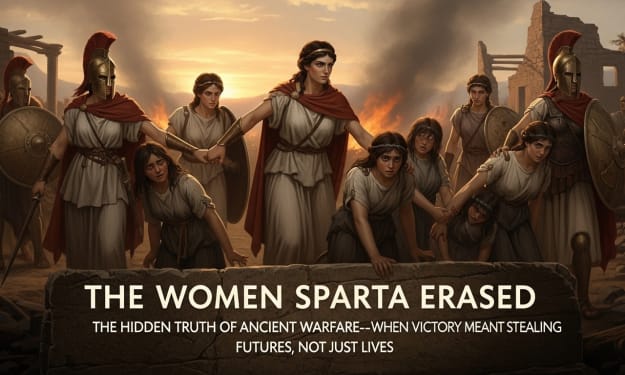
The Women Sparta Erased
Imagine: You are twenty-six years old. Just days ago, you watched your husband die defending your city. Now you stand in the ashes of your burned home, children pressed against your chest, trying to make yourself invisible while armed men move among the survivors.
By Literary fusion6 months ago in History
The War They Didn’t Expect to Fight
Imagine, for a second, you’ve just spent years in the mud and the blood of a world war. You’ve seen things that would make a person’s soul age a century in a weekend. You finally get your discharge papers, hop off the bus in your quiet hometown, and realize the local sheriff is essentially running a Mob racket-and he’s looking at your severance pay like it’s his personal Christmas bonus.
By KWAO LEARNER WINFRED6 months ago in History
Echoes of the Empire
Long before modern cities filled the world with noise and light, there stood a powerful civilization known as the Aurorian Empire. Its cities were built from shining white stone, its roads stretched across vast lands, and its people believed their empire would last forever. The story of Auroria began beside a wide river called Lumeris. The river brought life to the dry lands around it, and small villages slowly grew along its banks. Farmers planted wheat and barley in the fertile soil, fishermen filled their nets each morning, and traders carried goods from village to village. Among these early settlers was a wise leader named Arkon. He believed that the scattered villages would be stronger if they united. Arkon spoke to the villagers, saying, “If we build together, protect one another, and share our knowledge, we can create something greater than any single village.” Inspired by his vision, the people joined together and built the first great city of Auroria. As years passed, the small alliance grew into an empire. Massive stone walls surrounded the cities, grand temples rose toward the sky, and marketplaces filled with merchants from distant lands. The Aurorians invented clever irrigation systems that carried river water across their farms, allowing them to grow food even during dry seasons. Scholars studied the stars, artists carved beautiful statues, and engineers built strong bridges and roads that connected the empire from one end to the other. The empire flourished under a line of capable rulers. Each generation expanded the borders further, bringing new cultures, languages, and ideas into Auroria. Soldiers marched proudly beneath golden banners, while caravans carried silk, spices, and precious metals along the empire’s vast trade routes. People from faraway lands admired the strength of Auroria. Travelers would say, “Its cities shine like jewels in the desert, and its people are masters of knowledge and craft.” For centuries, Auroria grew richer and more powerful. But empires, like seasons, cannot remain unchanged forever. After many generations, the empire came under the rule of Emperor Darius II. Unlike the wise leaders before him, Darius cared more for luxury than leadership. He built enormous palaces decorated with gold and rare gems while ignoring the needs of farmers, soldiers, and ordinary citizens. Taxes grew heavier, and many people struggled to survive. The once-great roads fell into disrepair, and corruption spread among officials who cared only about their own wealth. At the same time, the empire’s borders began to weaken. Neighboring kingdoms that had once feared Auroria saw its growing problems. Small raids turned into larger attacks, and the empire’s army—once disciplined and united—began to lose its strength. Within the cities, people argued about how to save their civilization. Some called for reform and wise leadership, while others fought for power. Among the citizens was a young historian named Lyra. Lyra spent her days studying ancient scrolls that told the story of Auroria’s beginnings. She admired the wisdom of Arkon and the early leaders who had built the empire through unity and cooperation. One evening, while standing on the balcony of the grand library, she looked over the city. The buildings were still magnificent, but cracks had begun to appear in the stone walls, and the once-busy streets were quieter than before. Lyra realized something important. Empires were not destroyed in a single day. They slowly weakened when people forgot the values that had made them strong. Determined to preserve the truth, Lyra began writing a detailed history of Auroria. She recorded the achievements of its people—the inventions, the art, the trade, and the wisdom that had shaped their world. But she also wrote about the mistakes: the greed, the neglect, and the division that had slowly torn the empire apart. Years later, the final collapse came. Enemy armies crossed the borders, and the empire’s weakened defenses could not stop them. Cities fell one by one, and the great capital was eventually abandoned. The once-mighty empire disappeared into history. Centuries passed. Wind and sand covered many of Auroria’s ruins, and nature slowly reclaimed the empty cities. Trees grew through broken streets, and birds nested in the crumbling towers. But the story of Auroria did not vanish completely. Travelers exploring the ancient lands sometimes discovered old stone carvings or fragments of buildings that hinted at the empire’s former greatness. And deep within the ruins of the grand library, explorers eventually found Lyra’s carefully preserved writings. Her scrolls told the full story—the rise, the glory, and the fall of the Aurorian Empire. Scholars who read them understood an important lesson. Great civilizations are not remembered only for their power, but for the wisdom they leave behind. The ruins of Auroria became a place of study and reflection. Historians, students, and travelers came to learn from the echoes of the empire. They walked along the broken roads, looked up at the towering remains of ancient temples, and imagined the vibrant world that had once existed there. Though the empire itself was gone, its story continued to teach future generations about ambition, unity, and the fragile nature of power. And in the quiet wind that moved through the ruins, it sometimes seemed as if the past was whispering its lessons to anyone willing to listen—the lasting echoes of a once-great empire. 📜
By Sahir E Shafqat6 months ago in History
The Search for the Distant World
Long before powerful telescopes and modern space missions, astronomers spent countless nights studying the sky. They watched the stars carefully and recorded the movements of the planets. Each discovery helped scientists understand the vast universe a little better. Among the most fascinating discoveries in astronomy was the discovery of Pluto, a tiny and distant world at the edge of our Solar System. The story of Pluto’s discovery is not just about a planet. It is a story of curiosity, patience, and the determination of scientists who spent years searching for something that no one had ever seen before. The Mystery of Planet X In the early 1900s, astronomers believed there might be another planet beyond Neptune. They noticed that the orbits of Uranus and Neptune did not behave exactly as expected. Some scientists thought that the gravity of an unknown planet might be affecting their motion. One astronomer who became very interested in this mystery was Percival Lowell. Lowell believed strongly that a hidden planet existed far beyond Neptune. He called this mysterious world “Planet X.” To find it, Lowell built an observatory in Arizona known as the Lowell Observatory. From there, he and his team carefully studied photographs of the night sky. They searched for a small object that slowly moved among the stars. Unfortunately, Lowell died in 1916 before he could find the planet he was looking for. But the search did not end. A Young Man with a Dream Years later, a young farm boy named Clyde Tombaugh became interested in astronomy. Tombaugh lived in Kansas and did not have expensive scientific equipment. However, he loved building telescopes and observing the planets from his backyard. Tombaugh carefully drew detailed pictures of Mars and Jupiter using a homemade telescope. He sent these drawings to Lowell Observatory, hoping that professional astronomers might notice his work. The scientists at Lowell Observatory were impressed by his careful observations. In 1929, they invited Tombaugh to work at the observatory and continue the search for the mysterious Planet X. For Tombaugh, it was the opportunity of a lifetime. The Difficult Search The search for Planet X was extremely challenging. The distant planet would appear very small and faint in photographs of the sky. It would look almost exactly like a star. To find it, Tombaugh used a special machine called a blink comparator. This device allowed him to compare two photographs of the same part of the sky taken several days apart. When he looked through the machine, the images switched back and forth quickly. Most stars stayed in the same place. But if an object moved slightly between the two photographs, it would appear to jump back and forth. That movement could reveal a planet. Night after night, Tombaugh studied thousands of star images. The work required incredible patience and concentration. Sometimes he spent hours searching through photographs without finding anything unusual. But he never gave up. The Moment of Discovery On February 18, 1930, Tombaugh was examining photographs taken in January of that year. While comparing two images, he noticed a tiny dot that moved slightly from one position to another. At first, he looked again carefully to make sure it was not a mistake or a flaw in the photograph. But the tiny object had definitely moved. This meant it was not a star—it was something within our Solar System. After additional observations confirmed the movement, the scientists at Lowell Observatory realized that Tombaugh had discovered the long-sought Planet X. The discovery was officially announced on March 13, 1930. Astronomers around the world celebrated the discovery of a new planet beyond Neptune. It was one of the most exciting astronomical discoveries of the 20th century. Naming the New World After the discovery was announced, people from many countries suggested names for the new planet. The final name came from an 11-year-old girl in England named Venetia Burney. She suggested the name Pluto, after the Roman god of the underworld. The name seemed perfect because the planet was dark, distant, and hidden in the far reaches of the Solar System. Astronomers liked the name for another reason. The first two letters, P and L, were also the initials of Percival Lowell, the astronomer who had first searched for Planet X. Soon, the International Astronomical Union officially approved the name Pluto. A Planet That Changed Our Understanding For many decades, Pluto was known as the ninth planet of the Solar System. It became a symbol of exploration and curiosity about the outer regions of space. However, as technology improved, astronomers discovered many other icy objects beyond Neptune in a region called the Kuiper Belt. Scientists realized that Pluto was part of this large population of distant objects. Because of this, in 2006 the International Astronomical Union reclassified Pluto as a dwarf planet instead of a full planet. Although this decision surprised many people, Pluto remains one of the most fascinating worlds in our Solar System. Exploring Pluto In 2015, the spacecraft New Horizons flew past Pluto and sent back the first close-up images of the distant world. Scientists were amazed by what they saw. Pluto has mountains made of ice, vast frozen plains, and a giant heart-shaped region on its surface. These discoveries showed that even small worlds far away from the Sun can be complex and beautiful. The Legacy of the Discovery The discovery of Pluto proved that patience and curiosity can lead to incredible discoveries. Clyde Tombaugh’s careful work and dedication allowed humanity to find a new world billions of kilometers away. Today, Pluto continues to inspire scientists and students to explore the mysteries of space. Even though it is small and distant, Pluto reminds us that the universe is full of surprises waiting to be discovered. 🌌
By Sahir E Shafqat6 months ago in History
Thief who stole $3.5 billion but lost all in one phone call part 2
The following year, the owner of Silk Road was arrested and the FBI shut down the website, seizing about 170,000 Bitcoins. However, 51,680 Bitcoins were still missing, and investigators had been trying to trace them for years.
By Imran Ali Shah6 months ago in History