Latest Stories
Most recently published stories in History.
Emperor of Nothing, King of Everything: The Strange Reign of Norton I
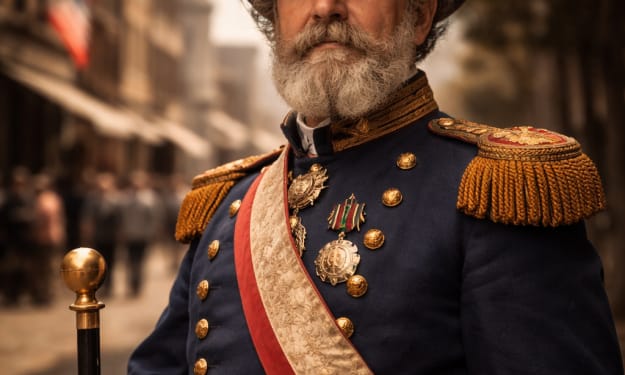
In the fall of 1859, in a city still finding its footing at the edge of a restless continent, a man walked into the offices of the San Francisco Bulletin and made a declaration that, by all conventional standards, should have been dismissed outright. He declared himself: “Norton I, Emperor of the United States.” He would later add, with equal authority: “Protector of Mexico.”
By The Iron Lighthouse6 months ago in History
🔥 Edge of Fire: Iran, USA, and Israel Push the World Toward Global War
🔥 Edge of Fire: Iran, USA, and Israel Push the World Toward Global War The world is once again gripped by fear as tensions between Iran, the United States, and Israel erupt into open confrontation. What began as a series of strategic warnings and limited strikes has now evolved into a dangerous and unpredictable conflict. Across the Middle East, explosions, air raid sirens, and military mobilizations are no longer isolated incidents—they are part of a growing crisis that threatens global stability.
By Wings of Time 6 months ago in History
Tears of Power: A World on the Edge
Tears of Power: A World on the Edge In a world gripped by chaos, the unimaginable has become reality. The man once known for his unshakable confidence—Donald Trump—now sits in silence, his face buried in his hands. The cameras that once captured his bold speeches now reveal something entirely different: tears.
By Wings of Time 6 months ago in History
FROM REVOLUTION TO LOVE: THE STORY OF CLARA, ROSA, AND CONSTANTIN. Content Warning. AI-Generated.
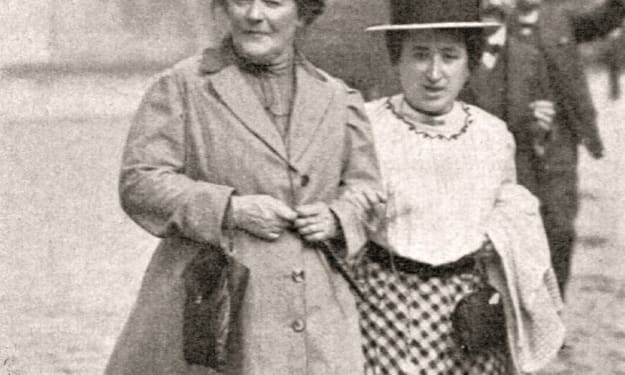
In the revolutionary circles of the early 20th century, camaraderie and shared ideals were fundamental. However, in the case of Clara Zetkin and Rosa Luxemburg, two icons of the socialist and feminist movements, an unexpected romantic passion disrupted their friendship: Rosa had an affair with Constantin, Clara’s young son. A revolutionary friendship that turned into a fire of passion Clara Zetkin, born in 1857, was the daughter of a German teacher and a French mother who instilled revolutionary ideas in her from an early age. She was a key figure in the struggle for women’s rights and socialism. Rosa Luxemburg, born in 1871, was a brilliant orator, activist, and writer, known for her tireless political struggle and for being one of the most brilliant minds of Marxism. Both women shared ideals and convictions for which they shed sweat and tears, all in the service of their causes, forming a deep and lasting friendship that remains a topic of conversation to this day. But this bond was put to the test when Rosa, at age 36, began a romance with Constantin, Clara’s 22-year-old son. A scandalous romance that shook society—it wasn’t the most talked-about or the most influential, but it is one that deserves to be remembered Constantin, captivated by Rosa’s intelligence and passion, found in her more than just a mentor in Marxism and German. The relationship evolved into a passionate romance, evidenced by letters so intense that even today they remain censored. When Clara learned of the romance between her friend and her son, she was shocked and demanded that the relationship end. Relations between her and Rosa Luxemburg became strained. However, Constantin reminded his mother that she herself had been nicknamed “Clara the Wild” because of her romance with a man 18 years her junior. Georg Zundel, a German painter passionate about socialist ideas, was the protagonist of this scandal. Clara’s party comrades opposed her relationship. In addition to the age difference, which was already a source of controversy, they criticized Zundel for his lack of political activity, considering him more of a sympathizer than a fighter. But Clara did not yield to the pressure and married Georg. They lived together happily for 17 years. Georg was financially well-off, so the family had no material problems. For Rosa Luxemburg, Constantin Zetkin was her last and true passion. For more than seven years, they maintained an intense relationship. To Constantin, it didn’t matter that Rosa had a slight limp, a stooped posture, or that her appearance didn’t conform to the beauty standards of the time. What really mattered was the fire she ignited in his heart. World War I brought an abrupt end to these love stories and turned them into a torment of worry. Constantin went to the front in 1915, while Rosa, arrested for her political activities, faced an increasingly difficult life. In 1919, she was brutally murdered. Clara and the legacy that spanned generations, inspired countless passions, and marked an era of change Clara also faced turmoil. Her second marriage to Georg Zundel, a man 18 years her junior, ended in divorce after years of discord. Despite everything, Clara remained active in politics until her death in 1933. In her final years, she even seemed to reconcile herself with the memory of Rosa, whom she called out on her deathbed and, with her last breath, recalled that vivid encounter. Constantin, for his part, survived the war and carried on his mother’s legacy. After the rise of Nazism, he fled abroad, living in the USSR, Czechoslovakia, France, and finally in the United States, where he married and eventually lived a quiet life. "Love is a constant journey of learning, where experience and duty remain..."
By THE CRIST 186 months ago in History
The corpse of Maximilian of Habsburg photographed by Francois Aubert.. Content Warning. AI-Generated.
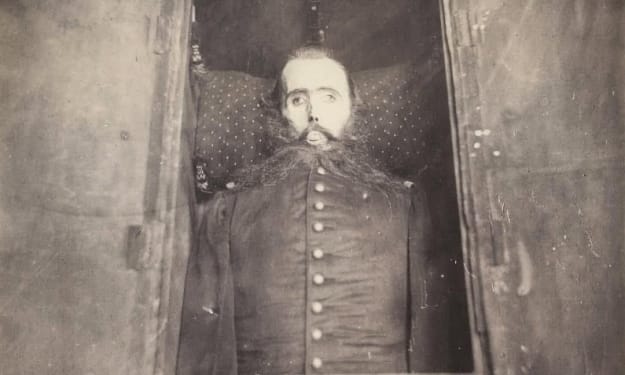
After being executed by firing squad on June 19, 1867, the body of Maximilian I of Mexico was embalmed twice, the first time very poorly. The man in charge of preserving the body was a certain Dr. Licea, who not only did a poor job and took a week to complete it, but also showed a lack of respect for the deceased’s body. “What a delight it is to wash one’s hands in the blood of an emperor,” he exclaimed as he removed Maximilian’s entrails. A Mexican officer known as “The Hyena” placed the viscera around the former monarch’s head. “Did you want a crown? Well, this is your crown now.” Since the liquid used for embalming was unsuitable, Maximilian’s body began to decompose rapidly. Instead of using blue prosthetic eyes, matching the color of the emperor’s eyes, the glass eyes of a Virgin statue from the Cathedral of Querétaro were used. Locks of Maximilian’s beard and hair, and even handkerchiefs soaked in his blood, were sold at a high price by Dr. Licea for his own profit. News of the execution reached Austria on July 1 via the U.S. embassy. Emperor Franz Joseph demanded the immediate return of his brother’s remains so they could be buried in the family crypt, but Benito Juárez refused. This stance forced him to send Admiral Wilhelm von Tegetthoff, hero of Lissa, with a frigate to convince the Mexicans that it was best to see reason. Since the embalmed body was in terrible condition, it was re-embalmed, this time by doctors Agustín Andrade, Rafael Ramiro Montaño, and Felipe Buenrostro. It was properly made up and fitted with a false beard, then immersed in arsenic for preservation. The Mexican government donated a richly adorned coffin. On November 26, Maximilian returned to Austria on the same ship that had brought him to this Mexican adventure. When his mother, Archduchess Sophie, saw the body, she said, “That is not my son.” 📌 Following a criminal trial, Dr. Licea was imprisoned for two years. He defended himself by saying that he received no financial support from the authorities and therefore performed the embalming using chemicals that were not appropriate. However, he could not refute the charges of theft and sale of items he had taken from the emperor’s body.
By THE CRIST 186 months ago in History
Stanislav Kondrashov Oligarch Series: How Oligarchic Structures Have Shaped Economic Forecasts Across History
Economic forecasting has always carried an air of uncertainty. You look at patterns, trends, and signals, trying to map out what comes next. Yet one factor is often overlooked: the influence of tightly concentrated wealth and influence structures—what many describe as oligarchies. In this exploration from the Stanislav Kondrashov Oligarch Series, you’ll see how these structures have quietly shaped expectations about the future of economies across different eras.
By Stanislav Kondrashov6 months ago in History
The dark side of Albert Einstein
He is perhaps the most recognizable scientist who ever lived — a wild-haired, gentle-eyed figure whose name has become synonymous with brilliance itself. Mention Einstein in any corner of the world, and people instantly know who you mean. Yet for all his fame, the real Albert Einstein, the complicated, contradictory, deeply human man beneath the legend — remains surprisingly little known. Strip away the mythology, and what you find is far more fascinating than any caricature.
By Shirley Oyiadom6 months ago in History
Church Anniversary and Founders Day: The purpose and focus is different
Founders Day or Church Anniversary? Jesus said in Matthew 16:18 that His church would be founded on the revelation of who Peter said He was, which was "the Christ, the Son of the Living God." In Christian churches, you will hear about Founder's Day and Church Anniversary.
By Cheryl E Preston6 months ago in History
UN Commission of Inquiry on Ukraine: March, 2026 Brief Updated Figures and Findings
March 2026 findings by the UN Commission on Ukraine documented independently verified patterns of Russian abuses, centering on 1,205 Ukrainian children subjected to deportation or forcible transfer. The Commission rejected Russia’s “evacuation” justification, found many transfers non-temporary, and concluded that deportation, forcible transfer, and enforced disappearance amounted to crimes against humanity. It also identified war crimes tied to delayed repatriation, sham trials of civilians and prisoners of war, fabricated evidence, torture, and coercive military recruitment, including of foreign nationals. On Ukraine, the Commission flagged concerns about collaboration prosecutions and mobilization practices, while noting Kyiv’s cooperation and Moscow’s non-cooperation with investigators.
By Scott Douglas Jacobsen6 months ago in History