
Korea didn’t abandon Chinese characters. It made them a class filter.
Hanja belonged to elites. Hangul waited centuries. De-hanjaization moved the old threshold out of public school and into professional life.
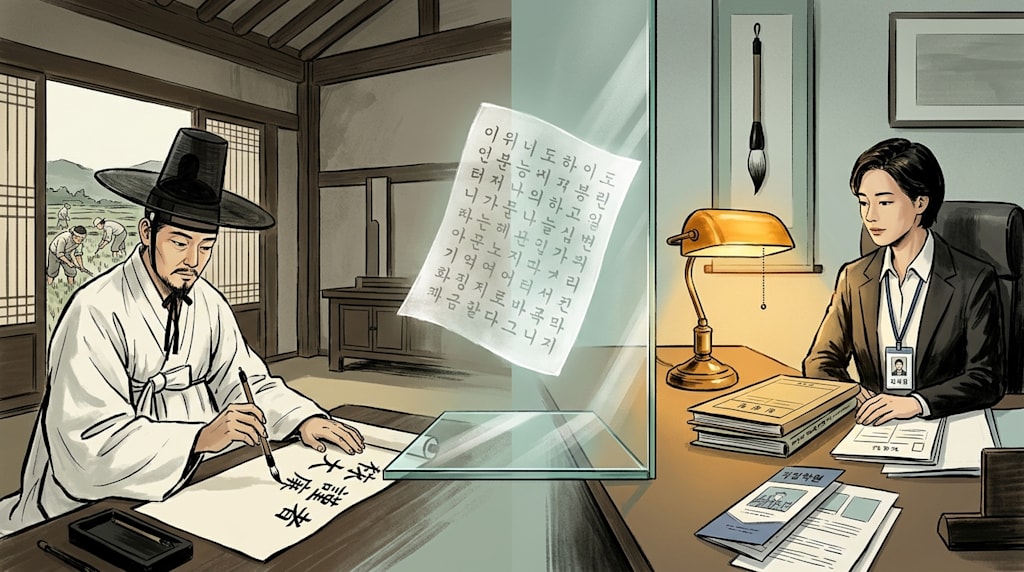
A familiar shorthand says Korea used Chinese characters for thousands of years, then last century the government forced a switch to Hangul. In that version, Korea’s relationship with Chinese characters is simple: long use, sudden rupture, national script.
The reality is messier and more revealing.
In premodern Korea, Chinese characters, or hanja, were never a public script shared by everyone. They were the working language of yangban elites, scholars, officials, and a narrow literate class. Most ordinary people could not read hanja. At best they had some familiarity with Hangul. Hangul was not invented to replace elite literary culture. It was created to give ordinary people a script for their own language. For nearly five centuries after its invention, many elites treated it with suspicion or contempt. It became central to public writing only in the modern era. Later de-hanjaization did not remove hanja from Korean life. It pulled hanja out of the public school pipeline and pushed it into a quieter role as a marker of professional competence and social class.
Hanja did not disappear from Korea. It changed places. It moved from the old elite’s ceremonial robe into the modern professional’s invisible threshold.
Hanja arrived as a script of power, not a script of the people
Chinese characters reached the Korean Peninsula long before the modern era, generally traced to the Three Kingdoms period and earlier cultural contact. Unified Silla, Goryeo, and Joseon used hanja for official documents, history, law, examinations, and classical poetry. For rulers, hanja was more than a writing system. It was a technology of order. Whoever could read and write hanja could enter the bureaucracy, interpret the classics, write history, and speak in the language of power.
But state use is not mass use.
In Joseon, systematic hanja mastery belonged to the yangban and the literate elite. Yangban sons learned classical Chinese in local schools, private academies, and family study rooms. They took the civil service exams and entered office. Hanja literacy was tied to status, power, marriage, lineage, and access to the state. Most farmers, merchants, and artisans had neither the time nor the resources for years of classical study. Hanja had too many characters, too many strokes, and too heavy a canon. For people who worked the land all year, the cost was enormous.
Premodern Korea was not a simple binary of a tiny literate elite and a completely illiterate mass. Local clerks, middle-status groups, some women, and Buddhist monks could have varying degrees of hanja literacy. Local schools and village education existed. But the overall structure was clear. Hanja was an elite literacy system, not a mass literacy system. Ordinary people’s stories, songs, emotions, and practical knowledge moved through oral tradition, folk tales, and later Hangul writing.
The claim that Korea used Chinese characters since ancient times is not wrong. It needs a second sentence. Those were the Chinese characters of the elite, not of the whole people.
Hangul was a commoner script with a long road to legitimacy
In 1443, King Sejong created the script known as Hunmin jeongeum. It was promulgated in 1446. Later called Hangul, it was designed to let ordinary people learn easily and write their own language.
The preface of the Hunmin jeongeum says this directly. The sounds of Korean did not fit Chinese characters, and ordinary people who wanted to express themselves could not find the means. The new alphabet was made so that everyone could learn it easily. Contemporary accounts claimed a clever person could learn it in a morning and a dull person in ten days.
Hangul did not become the national script overnight.
It met resistance from the elite. Joseon literati treated hanja and Confucian classics as the legitimate language of civilization. To abandon hanja and write in Hangul, many argued, was to turn away from the civilized order and slide toward barbarism. Scholars such as Ch’oe Malli and others at the Chiphyŏnjŏn criticized the new script. They feared it would lead the people away from classical learning. For centuries afterward, Korea’s written world remained largely mixed. Official documents, histories, and poetry were dominated by literary Chinese. Hangul appeared in letters, women’s writing, fiction, Buddhist moral texts, popular records, and some educational materials.
Hangul spread widely only from the late nineteenth century into the twentieth. Nationalism, modern schools, newspapers, missionary activity, and print culture all pushed it forward. It moved from a commoner script to the script of the nation. After the Kabo Reforms of 1894, official writing began to change. During the Korean Empire, mixed Hangul-hanja documents appeared. Under Japanese colonial rule, Korean-language scholars and nationalists kept promoting Hangul. In 1948, the South Korean government passed the Hangul Exclusive Use Act and gave Hangul a legal place at the center of public writing.
Hangul was not invented last century to replace hanja. It was created in the fifteenth century, waited nearly five hundred years in the shadow of elite disdain, and became central to public life through the modern nation-state.
De-hanjaization was a state project, not a clean break
South Korea’s systematic de-hanjaization came in the mid-to-late twentieth century, especially under Park Chung-hee. In 1968, the government banned hanja in official documents. From 1970, elementary and middle school textbooks gradually removed hanja. Public education in hanja shrank sharply. A generation grew up often called the Hangul generation. They were fully literate in the Korean alphabet and much weaker in hanja and Sino-Korean vocabulary.
This did not erase hanja from Korean life.
Korean personal names still often keep hanja. Identification cards often include hanja names. Legal texts, historical documents, and technical terminology still carry a large Sino-Korean vocabulary. Official documents may add hanja in parentheses when ambiguity needs to be resolved. Hanja education survived as an elective or as a classical Chinese subject in middle and high school. Private hanja academies remained part of the education market. The debate over restoring hanja education has returned in South Korean society.
De-hanjaization did not eliminate the functional demand for hanja. It changed the channel through which hanja competence was acquired.
In the past, hanja was part of elite education. Later, public schools reduced hanja education, but affluent families could still buy it through private tutoring, family cultural capital, and elite high schools. Hanja competence shifted from a basic element of public education to a cultural asset supported by family resources. The threshold did not vanish. It became less visible.
Why elites still learn hanja
Sino-Korean vocabulary makes up a large share of the Korean lexicon. The common figure is around sixty to seventy percent. In law, medicine, philosophy, history, administration, and other professional fields, many technical terms are Sino-Korean. A person who knows only the phonetic Hangul script can live and work. But precise concepts, homophones, classical texts, and complex judgments are easier to handle with hanja knowledge.
This is where hanja sits in contemporary Korean elite professions. It is not always an explicit exam subject, but it often works as a hidden competence for understanding professional language and entering elite circles.
In the era of the old judicial examination, South Korea’s bar exam was notorious for its difficulty. Pass rates were often extremely low. People commonly called it the hardest exam in the country. Legal statutes and judgments contain many Sino-Korean terms and require precise conceptual control. Medicine is similar. Medical terminology has a high proportion of Sino-Korean words, and doctors without knowledge of hanja roots face higher learning costs. Lawyers, judges, prosecutors, and senior doctors therefore develop a practical demand for hanja literacy.
This has a social consequence. The more hanja education withdraws from public schools, the more it depends on private purchase. Affluent families send children to hanja academies from an early age. Children from ordinary families rarely meet systematic hanja in public school. The starting line is reproduced through what looks like a traditional literacy skill.
Some South Korean politicians have publicly discussed the value of hanja education in recent years. Lee Jae-myung has expressed support for strengthening hanja education. He argued that even learning the Thousand Character Classic can help students understand the deeper meaning of words. He also joked about his own name. Many students do not know the hanja for Jae-myung, and in Hangul, Jae-myung and crime are pronounced similarly and easily confused. The detail is telling. Hanja has not left Korean life. It still shapes names, meaning, and identity.
Presidential calligraphy and the cultural capital of political elites
The observation that Korean presidents all write good calligraphy should not be read literally. Not every one is a master calligrapher. But it points to a durable cultural pattern. Hanja calligraphy remains a symbol of traditional cultivation among Korean political elites.
In the Joseon era, calligraphy was a basic accomplishment of yangban literati. That tradition did not completely break in the modern political elite. Many South Korean presidents have been able to write hanja, inscribe calligraphy, and quote classical phrases. Political figures use calligraphy to display learning, character, and cultural rootedness. This is a continuation of elite cultural capital.
Modern Korean political elites are not all proficient in classical Chinese. Hanja competence has declined among younger politicians. But writing a good hand still carries weight as a cultural sign. In Korea, hanja was never merely a foreign script. It is embedded in elite education, political culture, and the imagination of status.
Writing is never just writing
Return to the opening contrast.
The Korea you thought you knew used Chinese characters since ancient times, and last century the government forced a switch to Hangul. The Korea that actually existed gave hanja for centuries to the yangban and the literate few. Most ordinary people were illiterate. Hangul was born from the need to teach commoners, yet faced long elite resistance. After de-hanjaization, hanja continued to work in professional fields and in the reproduction of class.
The contrast matters because it shows a larger truth. Writing is never just writing. Whoever controls a script controls an entry point into interpreting the world. Whoever is excluded from a script may face an extra threshold in education, profession, and power.
Korea’s story is not a simple story of abandoning Chinese characters. It is a story about script, class, and nation-building. Hanja moved from the ceremonial robe of the elite to the threshold of the professions. Hangul moved from the crutch of commoners to the banner of the nation. De-hanjaization, under an egalitarian slogan, redistributed hanja competence to those who could afford extra education.
So the next time you hear that Korea de-hanjaized, look at what was removed. The hanja class may have left the public classroom. The Sino-Korean vocabulary in legal documents stayed. The hanja names on identity cards stayed. The calligraphy under a president’s brush stayed. The quiet advantage bought in private academies stayed.
The threshold of writing is deeper than it looks. It is also often invisible to the people who never had to climb it.
About the Creator
Jin
Writer of reamstories
https://reamstories.com/jin
Enjoyed the story? Support the Creator.
Subscribe for free to receive all their stories in your feed. You could also become a paid subscriber, letting them know you appreciate their work.
Comments
There are no comments for this story
Be the first to respond and start the conversation.