
Kazan: The City Where Russian and Tatar History Live Side by Side
At first glance, Kazan may look like a city that decided to take a little something from every culture. Orthodox churches rise above the rooftops, shining crescents crown magnificent mosques, and at the heart of it all stands the massive white Kremlin.
But Kazan is interesting for much more than the fact that Islam and Orthodox Christianity exist side by side here. Its real story is far older – and far more complicated.
For centuries, the city stood at a crossroads of peoples, merchants, armies, religions and languages. It was shaped by the Volga Bulgars, the Golden Horde and the Kazan Khanate before being conquered by Ivan the Terrible in 1552.
That was the beginning of a completely new chapter in its history.
Today, Kazan is the capital of Tatarstan and one of the most important cultural centers on the Volga. Its historic center is so unique that the Kazan Kremlin was added to the UNESCO World Heritage List in 2000. UNESCO describes it as an exceptional example of the meeting of Bulgar, Tatar, Russian, Islamic and Christian traditions.
But to understand Kazan, it is worth going back much further.
A City Older Than You Might Think
When people hear the name Kazan, they may imagine a city that developed mainly during the Russian Empire.
Its roots, however, go much deeper.
Archaeological discoveries in the area of today's Kazan Kremlin have revealed evidence of settlement dating back many centuries. Kazan developed during the period of Volga Bulgaria and later became part of the world of the Golden Horde.
By the 13th to 15th centuries, the settlement had become an important political and trading center.
And trade was one of the main reasons for its growth.
Kazan stood in an extraordinarily strategic location.
The Volga was not simply a river. It was a gigantic transportation route.
Goods, people and information traveled along it, connecting distant parts of Europe and Asia. Kazan benefited enormously from its position on these routes and gradually became an important center of commerce and politics.
There is even an unusual archaeological connection with Central Europe.
Among the finds discovered in Kazan was a Czech coin dating to around 929–930. Together with other archaeological evidence, it helps demonstrate just how old and internationally connected the settlement was.
Imagine that for a moment.
At a time when the early medieval Czech lands were still taking shape, people hundreds or thousands of kilometers away were already living in a settlement on the Volga that was connected to long-distance trade.
Kazan was never an isolated place.
When Kazan Became the Capital of a Khanate
During the 13th to 15th centuries, the region came under the influence of the Golden Horde.
In the first half of the 15th century, Kazan became the capital of the independent Kazan Khanate.
And it was far from being some forgotten fortress on the edge of the world.
It was a political, military, commercial and cultural center.
Leatherworking, pottery and weapons production flourished, while merchants maintained connections with Moscow, Crimea, the Ottoman world and other regions.
The fortress occupying the site of today's Kremlin looked very different at that time.
There was a Tatar stronghold.
Inside stood the khan's palace, a mosque, tombs of rulers, warehouses, administrative buildings and other structures.
The fortress was protected by substantial walls and defensive ditches. At its heart stood the political and religious center of the khanate.
Then came the year 1552.
The Year That Changed Everything
Kazan became one of Moscow's most important rivals along the Volga.
Ivan IV, better known as Ivan the Terrible, decided to eliminate the threat.
The siege of Kazan was a major military campaign. Russian forces surrounded the city, and after fierce fighting, the defenses finally collapsed.
In October 1552, Kazan fell.
The consequences were dramatic.
The city was conquered, much of its original population was displaced, and a major reconstruction began according to the needs of the expanding Russian state.
Some Tatar residents were moved away from the area around the Kremlin toward Lake Kaban. Over time, this area developed into what is now known as the Old Tatar Quarter.
And this is where one of the most fascinating paradoxes of modern Kazan begins.
Today, visitors may feel as though the city's different cultures have existed peacefully side by side since the beginning of time.
The reality was much more complicated.
Centuries of warfare, population movements and changes of political power came first.
A White Kremlin Built on the Site of a Tatar Fortress
After the conquest, Moscow began transforming the city's center.
The old fortress was gradually rebuilt in stone, creating the Kremlin we see today.
Pskov craftsmen are traditionally associated with some of its construction.
Today, the Kazan Kremlin is one of the city's greatest symbols.
But its importance is about much more than its white walls.
It is a place where different layers of history literally lie on top of one another.
Archaeological layers beneath the modern buildings can reach several meters in depth.
So when visitors walk across the Kremlin grounds today, they are quite literally walking above the remains of earlier cities.
Beneath the modern surface lies a Kazan that looked completely different.
And that is what makes the Kremlin so fascinating.
A Mosque Beside an Orthodox Cathedral
Inside the Kremlin stand two buildings that might seem, at first glance, to represent completely different worlds.
One is the Orthodox Annunciation Cathedral.
The other is the Kul Sharif Mosque.
The cathedral dates back to the 16th century and is one of the oldest surviving Orthodox buildings in Kazan.
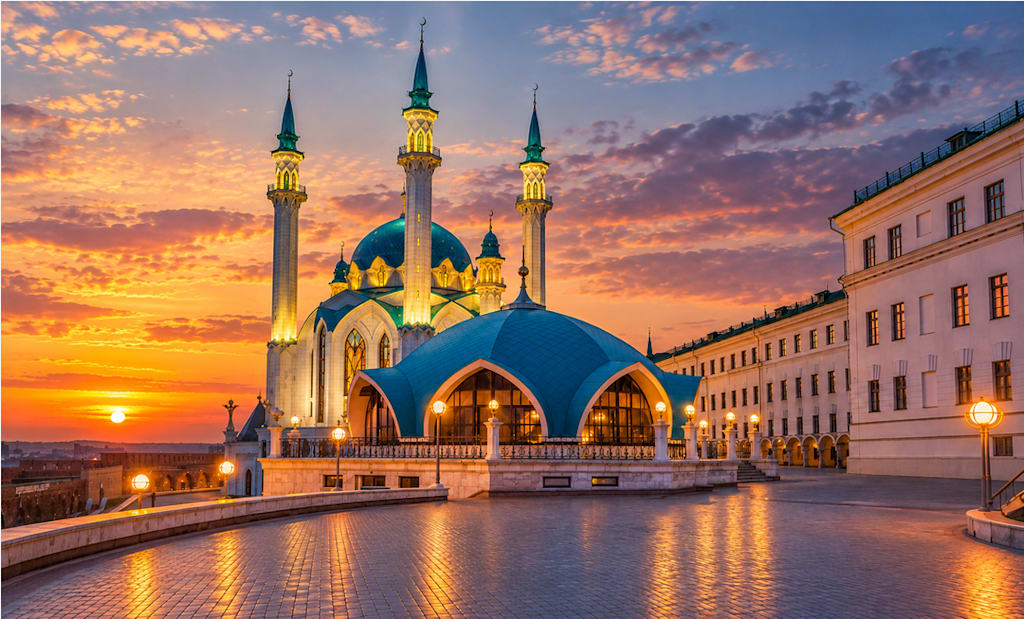
The Kul Sharif Mosque, on the other hand, is modern. It was built between 1996 and 2005 as a monument to the historic mosque and to the imam Kul Sharif.
And there is an important detail behind that name.
Kul Sharif was a religious leader of the Kazan Khanate. According to Tatar tradition, he also took part in the defense of the city during the siege of 1552.
He died when Kazan fell.
The modern mosque is therefore more than an impressive landmark.
For many Tatars, it also represents the revival of Tatar cultural and religious identity.
Its appearance is impossible to miss.
Four main minarets rise about 55 meters into the sky, surrounding the turquoise dome. The interior is decorated with geometric and floral patterns, while the enormous central chandelier weighs roughly two and a half tons.
And here comes another unexpected connection.
The chandelier was made in the Czech Republic, based on designs created by Tatar artists.
At night, the mosque becomes especially spectacular, with its illumination creating the impression that the building is almost floating above the city.
Süyümbike – The Woman Who Became a Legend
Then there is the tower that looks as though it might fall at any moment.
The Süyümbike Tower.
It stands approximately 58 meters high and leans noticeably to one side.
The tower is named after Süyümbike, a ruler of the Kazan Khanate in the 16th century.
And around her grew one of Kazan's most romantic legends.
According to the story, Ivan the Terrible fell in love with Süyümbike and asked her to marry him.
She refused.
The Russian tsar supposedly threatened to destroy Kazan unless she agreed.
Süyümbike finally accepted – but with one condition.
Ivan had to build the tallest tower Kazan had ever seen within seven days.
The tower supposedly rose at an astonishing speed.
When it was finally completed, Süyümbike climbed to the top.
And instead of marrying the tsar, she jumped to her death.
It is a dramatic story.
But this is where legend and history need to be separated.
There is no reliable historical evidence that Ivan the Terrible proposed marriage to Süyümbike or that she died by jumping from the tower.
The tower itself is very real, and it really does lean. But historians have debated its exact date and circumstances of construction.
Perhaps that is precisely why the legend has survived.
History gave Kazan the tower.
People gave it a story.
Kazan Has a Dragon, Too
There is another curious figure hiding in the city's history.
A dragon.
His name is Zilant.
This mythical creature became one of the symbols of Kazan and appears on the city's coat of arms.
According to one legend, a giant serpent or dragon once lived where Kazan now stands.
As with many old legends, the details vary depending on the version.
But one thing has remained constant:
Zilant belongs to Kazan's identity.
So Kazan has almost everything.
A Kremlin.
Tsars.
Khans.
A legendary queen.
A dragon.
And, eventually, some very famous cats.
When Kazan Sent Cats to Save a Royal Palace
In the city center, you can find a rather unusual monument.
It depicts a large, comfortably plump cat relaxing on a couch.
It is not merely a funny tourist attraction.
Behind the so-called Kazan Cat lies a story connected to the Russian imperial court.
According to the traditional story, cats from Kazan became famous in the 18th century for being exceptionally good at catching mice.
When rodents became a serious problem in the unfinished Winter Palace in St. Petersburg, the imperial court needed help.
In 1745, thirty cats were reportedly sent from Kazan to St. Petersburg.
Their new job was to protect the palace from mice.
The story has an even more charming continuation.
According to local tradition, the descendants of these cats are connected with the cats that still live at the Hermitage in St. Petersburg.
In this way, one of Kazan's most amusing legends became a rather unexpected connection between the two cities.
The Place Where Tatar Kazan Survived
Anyone who wants to understand Kazan should not stop at the Kremlin.
Head toward the Old Tatar Quarter.
It developed after the conquest of the city in 1552, when Tatar residents were moved away from the Kremlin area toward Lake Kaban.
Over time, houses, mosques, schools and businesses appeared there.
The neighborhood eventually became an important center of Tatar life. In the 19th century, wealthy merchants, religious leaders, artists and intellectuals lived there.
Today, dozens of historic buildings from the 18th to early 20th centuries remain.
And this is where Kazan suddenly begins to look completely different.
Wooden houses.
Colorful facades.
Decorative window shutters.
Mosques hidden among ordinary city buildings.
Old merchant houses.
Quiet streets.
For a moment, it can feel as though you have left a modern Russian city and entered another country altogether.
The Mosque Approved by an Empress
One of the most fascinating buildings in the Old Tatar Quarter is the Märcani Mosque.
It was built between 1766 and 1770 with permission from Catherine the Great and funding from local Muslims.
Its architecture is particularly interesting.
It combines elements of Tatar tradition with Russian Baroque.
In other words, it is not simply an "Oriental" building.
It is the result of different architectural traditions living side by side for centuries.
There is also a famous story connected with the mosque.
Local officials were supposedly concerned that its minaret was too tall and appealed to Catherine II.
The empress allegedly replied that while she could determine where people should build on the ground, she could not tell them what they were allowed to build toward the sky.
It is a beautiful story and one still repeated in Kazan.
But, as with many historical anecdotes, the exact wording of the supposed conversation is better treated as tradition than as a documented quotation.
A Mosque That Survived the Soviet Era
The Märcani Mosque has another remarkable distinction.
During the Soviet period, when many religious buildings across the Soviet Union were closed, repurposed or destroyed, Märcani remained an active mosque.
For many years, it was reportedly the only functioning mosque in Kazan.
That makes it more than just an attractive historic building.
It is a witness to several radically different periods of history.
Kazan Is Not Just Old. It Is Surprisingly Modern
Eventually, you leave the old quarters and discover that Kazan is certainly no open-air museum.
Historic buildings stand alongside modern architecture, sports complexes and broad city streets.
The city underwent major transformation around the celebrations of its millennium in 2005.
A number of major projects were completed around that time, including the Kazan Metro, the new Kul Sharif Mosque and the Millennium Bridge.
The bridge itself has a huge letter "M" incorporated into its main structure.
That is no coincidence.
The design refers to the city's millennium.
And so Kazan is a place where you can spend one day walking beside medieval walls, entering an old mosque, passing traditional wooden merchant houses and, only minutes later, standing beneath striking modern architecture.
And Then There Is the Food
Tatar cuisine deserves a chapter of its own.
And if there is one sweet treat that almost everyone associates with Tatarstan, it is chak-chak.
It looks deceptively simple.
Small pieces of fried dough are covered in honey and pressed together into a mound or another decorative shape.
But in Tatar culture, chak-chak is much more than an ordinary dessert.
Traditionally, it has been associated with celebrations and important occasions, especially weddings.
It is often described as a symbol of Tatar hospitality.
And Kazan has even had a museum dedicated to chak-chak.
You might expect a museum about tsars, wars or ancient weapons.
Kazan also has a museum devoted to little pieces of fried dough held together with honey.
And somehow, that feels perfectly appropriate.
A City Made of Layers
Kazan is fascinating above all because its history cannot easily be divided into a simple "Tatar" chapter and a "Russian" chapter.
One layer did not completely disappear when another arrived.
Instead, the different layers were rebuilt, covered, transformed and sometimes preserved in streets, houses, mosques, archaeological remains and traditions.
The Kazan Kremlin is the perfect example.
On this single site, the history of Volga Bulgaria, the Golden Horde, the Kazan Khanate, the Russian Empire, the Soviet period and modern Tatarstan all overlap.
UNESCO considers this meeting of cultures one of the key reasons for the site's exceptional value.
And perhaps that is why Kazan is much more interesting than a photograph of a beautiful mosque might suggest.
It is a city that has been conquered, rebuilt and transformed many times.
Yet its older layers never completely disappeared.
The Kazan You Don't See at First
A visitor can walk to the Kremlin, photograph Kul Sharif, admire the leaning Süyümbike Tower and leave.
And still miss the most interesting part.
Because the real Kazan is not just the white walls of its Kremlin.
It is a Czech coin buried beneath the modern city.
It is the memory of a khanate that ended in 1552.
It is the story of Tatar residents moved toward Lake Kaban.
It is the old wooden architecture surviving among modern streets.
It is a mosque that received permission from a Russian empress.
It is an Orthodox cathedral standing only a short distance from a magnificent mosque.
It is a leaning tower surrounded by a romantic story about a proud ruler – even though historians know that legend and fact are not the same thing.
And it is even a cat that supposedly received a one-way ticket from Kazan to St. Petersburg to wage war against mice.
Kazan is not a city with just one history.
It is a city made of layers.
And that is what makes it so fascinating.
You only have to step away from the main street.
Beneath the modern city, another Kazan slowly begins to appear.
A city of Tatars, merchants, khans, religious leaders, soldiers, craftsmen, poets and ordinary people.
A city that is no longer a fortress on the Volga.
But one where the stories of its past are still very much alive.
About the Creator
Enjoyed the story? Support the Creator.
Subscribe for free to receive all their stories in your feed.
Comments
There are no comments for this story
Be the first to respond and start the conversation.