
How the USA Secretly Tested Mustard Gas on Its Own Soldiers Based on Race
When we talk about the horrors of the Second World War and inhuman medical experiments, most of us immediately think of names like Josef Mengele or Japan's Unit 731.
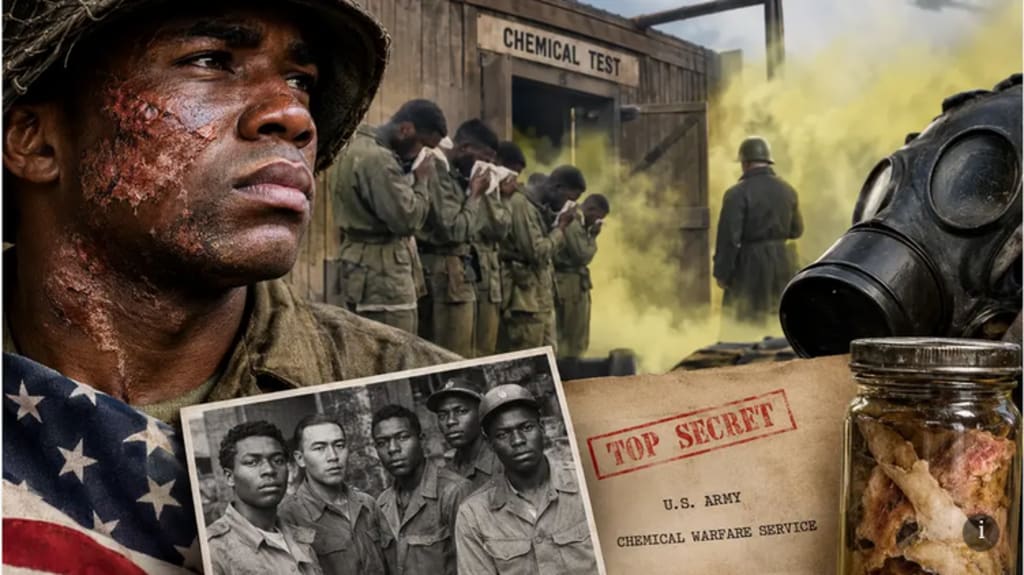
Few people, however, know that very similar and deeply unethical experiments on human beings also took place in the democratic West. And what is perhaps the saddest part – the American military did not carry them out on prisoners of war, but on its own soldiers, who were systematically divided according to the colour of their skin.
For many decades, this subject was kept under the strictest military secrecy. The soldiers had to sign confidentiality agreements under threat of prison and military court. The truth only fully came out in 2015, when the American public radio NPR published a shocking investigative report which forced the Pentagon to admit what had happened.
What was the history of this secret programme, and how did racist scientific myths destroy the lives of thousands of American soldiers?
1. Sixty thousand human guinea pigs
At the beginning of the 1940s, there was enormous fear in Washington. The United States watched the conflict in Europe and the Pacific with horror. Military commanders were convinced that Nazi Germany or Imperial Japan would sooner or later use chemical weapons on the battlefield. The USA therefore started a massive secret programme for defence against, and also preparation for, chemical warfare.
Approximately 60,000 American soldiers became involved in this secret government project. They were divided into several types of tests.
In some patch tests, liquid mustard gas was dropped directly onto the exposed skin of their forearms.
There were also field exercises. Soldiers were placed in the open terrain, sometimes in tropical areas such as Panama, while military aircraft dropped chemical substances over them from above.
Other men were locked inside wooden, airtight chambers. Scientists then pumped toxic gas into the chambers.
2. Racist pseudoscience and the theory of “stronger skin”
The darkest part of the entire programme, however, was a number of research projects which were based specifically on race. Military scientists had fallen for the dangerous pseudoscientific idea that skin colour determined the biological resistance of the human body to chemical toxins.
The theory was simple.
Scientists believed that African Americans and Puerto Ricans had, because of their higher amount of pigmentation, “stronger and more resistant skin” than white soldiers.
Military strategy worked with this myth in a frighteningly cold way. If it could be proven that non-white soldiers could tolerate mustard gas better, the army would train them as elite front-line units for chemical attacks. White soldiers, on the other hand, would remain safely behind the lines.
Besides Black and Puerto Rican soldiers, the Americans also tested American soldiers of Japanese origin, known as Nisei.
In their case, the purpose was somewhat different. The military wanted to test the effectiveness of gas masks on Asian facial anatomy and to study how the gas might affect the enemy in the Pacific.
White soldiers in these specific projects served mainly as a “pure control group”.
3. “It felt as if your whole body was burning”
The conditions in the testing centres were brutal.
One of the men who survived this nightmare was Rollins Edwards, an African American soldier from South Carolina. When NPR investigated the story, Edwards was 93 years old, but he remembered the events from his youth with remarkable precision.
As a young soldier, he was ordered to enter a wooden building together with twelve other Black soldiers.
Nobody told them what was going to happen.
The officers closed the heavy door behind them and locked it. Then a mixture of mustard gas and Lewisite, an even more aggressive arsenic-based chemical agent, was pumped into the chamber through pipes.
The soldiers had no protective suits. They were wearing only their ordinary uniforms.
“You felt as if your whole body was burning,” Edwards remembered years later. “The boys started screaming terribly, crying and trying to break down the door. Some of them passed out. When they finally let us out, we were all in a terrible condition.”
Refusing an order at that time could mean an immediate military court and imprisonment at Fort Leavenworth. Frightened and powerless, the soldiers therefore endured what was happening to them.
The results of the experiments eventually showed something that modern biology has long known: there are no racial differences which make one race naturally resistant to mustard gas.
Black soldiers suffered burns, blisters and lung damage just as severely as white soldiers.
4. Evidence in a glass jar and fifty years of silence
When the war ended, the suffering of these men did not end with it.
Mustard gas can cause long-term damage to the human body. Veterans suffered for the rest of their lives from respiratory problems, emphysema, blindness and skin cancer.
The military machine, however, sent them home with a strict warning. If they told anyone about the tests – including their doctors or wives – they could be accused of revealing military secrets and face imprisonment.
For decades, these veterans therefore visited civilian doctors who could not understand why some of the men had lungs so badly damaged that they looked like those of coal miners, or why their skin was covered with massive scars.
The Department of Veterans Affairs also had difficulty recognising their claims, because the official military records did not mention the chemical tests.
Rollins Edwards became so desperate that, because nobody believed him, he spent years collecting large pieces of his own skin in a glass jar. His skin had been damaged by the mustard gas and kept peeling away from his arms and legs.
He showed this jar to people as physical evidence of what his own country had done to him.
5. An apology that came far too late
The government programme was formally declassified as early as 1993, but the military and the Department of Veterans Affairs did not immediately bring justice to the men who had been involved.
Out of the tens of thousands of soldiers affected by the programme, only a small fraction were eventually located and compensated.
A major change came after 2015, when NPR journalist Caitlin Dickerson tracked down some of the last surviving witnesses and published their stories.
Only after the enormous media attention and pressure from Congress did the Pentagon openly acknowledge that soldiers had been divided according to race during the experiments.
A formal apology followed, together with measures intended to provide compensation.
For the overwhelming majority of the soldiers involved, however, justice came far too late.
Many of them had already died in pain and poverty, carrying the feeling that their own country had betrayed them.
Rollins Edwards died in December 2017 at the age of 95.
At least he lived long enough to see the world finally learn the truth about what had happened inside those wooden gas chambers.
Sources
NPR – “Secret World War II Chemical Experiments Tested Troops By Race”
Investigative reporting by journalist Caitlin Dickerson which brought renewed public attention to the secret mustard gas experiments and included testimonies from surviving veterans.NPR – “The VA's Broken Promise To Thousands Of Vets”
Follow-up reporting examining what happened to the soldiers after the war and the difficulties they faced when trying to obtain recognition and medical assistance.U.S. Department of Veterans Affairs – Mustard Gas and Lewisite
Official information concerning military exposure to mustard gas and Lewisite, including recognised long-term health consequences.PBS NewsHour – World War II mustard gas experiments
Historical reporting on the secret chemical warfare programme and the treatment of minority soldiers during the experiments.Peabody Awards – Secret Mustard Gas Experiments
Information about the investigative reporting which brought the story of the secret experiments and surviving veterans to a much wider audience.Cambridge University Press – Mustard Gas and American Race-Based Human Experimentation in World War II
Academic research examining the connection between chemical warfare experiments, racial theories and human experimentation during the Second World War.
I’m sorry for any mistakes in my English. I’m using this way of writing to improve my English, so please be patient with me and thank you for your understanding.
About the Creator
Enjoyed the story? Support the Creator.
Subscribe for free to receive all their stories in your feed.
Comments
There are no comments for this story
Be the first to respond and start the conversation.