
How One Woman Fixed WW2’s Biggest Problem!
Woman Fixed WW2’s Problem

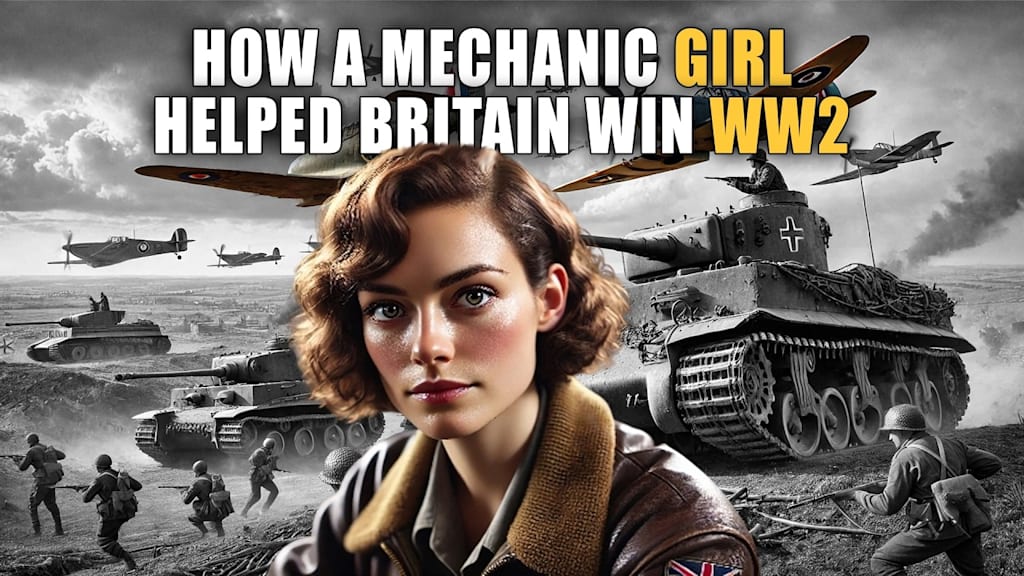
This was the aircraft that became a symbol of Britain during World War II — the Supermarine Spitfire.
It was an exceptional fighter plane, loved by pilots for its speed and agility,
and admired by the public as a machine that could win wars.
But in reality… this plane had a serious problem.
Its engine would suddenly cut out —
right in the middle of a dogfight with German pilots.
Especially when the plane went into a steep dive.
On the other hand, the German Messerschmitt Bf 109 had no such issue.
Because of this, German pilots often gained the upper hand in combat.
Britain did win the Battle of Britain —
but only with great difficulty.
And one of the biggest reasons for that struggle…
was this very flaw in the Spitfire’s engine.
If Britain wanted a clear victory in the rest of World War II,
this strange problem had to be solved.
The best engineers and major companies tried everything…
but no one could fix it.
Until finally… a solution came from the most unexpected place.
A woman — Beatrice Shilling.
What did she do to the Spitfire
that today she’s considered one of the people who helped the Allies win the war?
Welcome back to story.
This problem first appeared in 1938
in the Rolls-Royce Merlin engine used in the Spitfire.
At the time, it didn’t seem like a big issue,
because before the war, pilots didn’t dive aggressively.
But in 1940, during the peak of the Battle of Britain,
this became a matter of life and death.
And the situation was worse than expected.
Before World War II, Britain had already produced over 20,000 Spitfires —
all with the same engine problem.
Not just that — other fighter planes like the Hawker Hurricane
also used the same engine.
So now, in the middle of a global war,
the Allies were forced to fight with flawed aircraft.
During dogfights, pilots performed advanced maneuvers —
diving down suddenly to escape bullets
or pulling up quickly to attack.
This was completely normal in air combat.
But imagine…
in a life-or-death situation, your engine suddenly shuts off.
That’s exactly what British pilots were facing.
Luckily, during the Battle of Britain,
they had a home advantage —
they were fighting close to their bases.
German pilots, however, had to cross the English Channel, fight,
and then return for refueling.
This gave Britain a slight edge.
So what was the actual problem?
When a plane dives steeply,
gravity affects everything differently.
Fuel inside the carburetor would move away from where it was needed.
In the Merlin engine,
the fuel outlets were positioned in a way that, during a dive,
fuel moved away from them.
As a result, the engine would lose fuel supply —
causing it to stall or sputter.
Top engineers tried to fix it.
Even experts from Rolls-Royce failed.
Then came Beatrice Shilling.
She wasn’t just an engineer —
she was also a motorcycle racer.
She had been working at the Royal Aircraft Establishment
and specialized in carburetors.
When others failed, she asked for permission to try.
At first, people underestimated her.
But within just a few days…
she solved the problem.
Her solution?
Simple… yet brilliant.
She designed a small brass restrictor plate
with a precisely sized hole.
This plate was installed inside the carburetor.
It controlled the fuel flow
and prevented it from flooding or cutting off during dives.
This fix became famously known as
“Miss Shilling’s Orifice.”
It didn’t completely eliminate the issue —
but it solved it enough to save countless lives.
And the best part?
It was quick and easy to install.
Shilling herself traveled to different airbases
on her motorcycle
to install it in Spitfires and Hurricanes.
Later, she helped develop an improved carburetor design
that permanently solved the issue.
After World War II,
pilots gave her full credit for her contribution.
She was awarded the Order of the British Empire (OBE).
But Beatrice Shilling wasn’t just an engineer —
she was a pioneer.
She opened doors for women in engineering
at a time when it was almost impossible.
Even today, many believe that
if she hadn’t solved this problem…
the outcome of World War II
might have been very different.
Hope you liked this story —
don’t forget to like and share.
See you in the next one.
About the Creator
Imran Ali Shah
🌍 Vical Midea | Imran
🎥 Turning ideas into viral content
✨ Watch • Share • Enjoy
Enjoyed the story? Support the Creator.
Subscribe for free to receive all their stories in your feed.
Comments
There are no comments for this story
Be the first to respond and start the conversation.