
How LA's Wildfire Spread So Fast!
Wildfire Spread

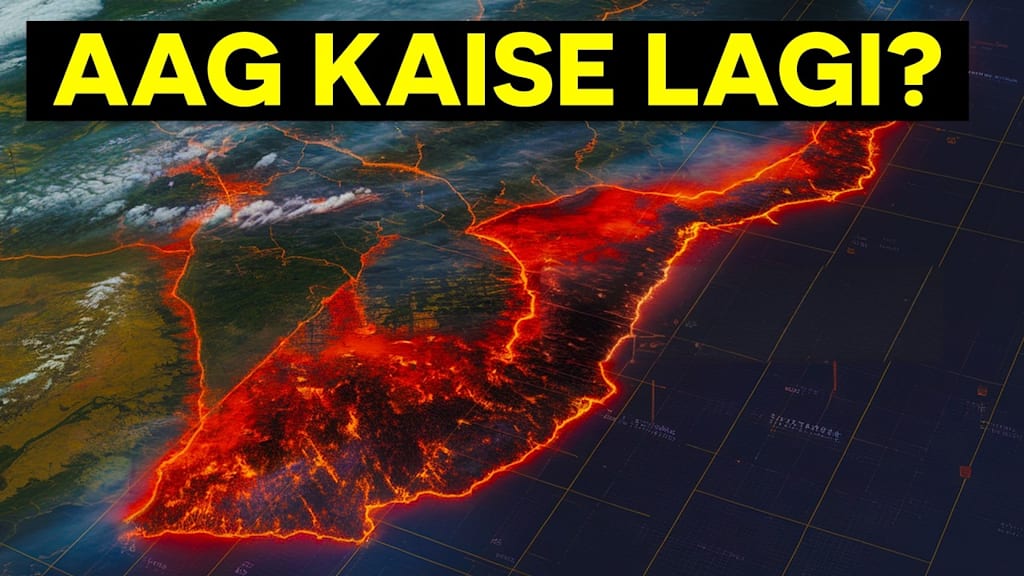
On the morning of January 6, 2025, a man named David Morrow was sitting on the balcony of his apartment, enjoying the view of the Pacific Ocean. Like every other day, it seemed completely normal.
Suddenly, about five miles away from his apartment, he noticed flames and sparks rising from the hills of Pacific Palisades. Within just one hour, the fire grew so massive that thick smoke completely covered the mountains.
From satellite views, the fire was first reported in the hills of Pacific Palisades. But within a few hours, it had spread to Eaton, Hurst, Kenneth, Getty, Skirball, and the San Fernando areas.
At the time the fire started, winds were blowing at speeds of nearly 100 km/h, moving from inland areas toward the ocean.
This raises an important question:
If the fire first began near Pacific Palisades — which is close to the ocean — then how did it spread 30 to 40 kilometers inland, against the direction of the wind?
Welcome once again to
This wildfire devastated around 38,000 acres, or nearly 150 square kilometers of land. More than 12,000 buildings and homes were destroyed, and over 180,000 people were forced to evacuate.
It became one of the most destructive fires in the history of Los Angeles. Even during the production of this video, the fire had not been completely extinguished.
Every possible attempt to stop the blaze appeared to be failing. Water bombers were dumping nearly 45,000 liters of water at a time, but against the scale of the fire, it looked like only a few drops.
Special fire-retardant chemicals were also being sprayed, yet nature seemed unstoppable.
California already faces water shortages, and many fire hydrants were reportedly empty. Since the fire had spread across seven different regions, firefighters and equipment were divided into multiple fronts.
On top of that, winds moving at 70 to 100 km/h intensified the flames even further.
Before understanding the real reason behind the Los Angeles wildfire, let’s look at California’s history with wildfires.
Over the past 25 years, California has been a hotspot for wildfires.
In 2003, the Cedar Fire in San Diego County burned around 273,000 acres. It started on October 25 and ended on November 4.
In 2017, the Tubbs Fire burned 36,000 acres during October.
Later in 2017, the Thomas Fire destroyed around 280,000 acres, beginning in December and ending in January.
On November 8, 2018, the Camp Fire burned nearly 500,000 acres and lasted until November 25.
In 2020, the Glass Fire destroyed around 67,000 acres, lasting from September into October.
If we carefully observe the timing of these wildfires, one thing becomes very clear:
Most of them occurred during winter months.
And the Los Angeles wildfire also erupted during peak winter.
So why do California’s most destructive wildfires often happen in winter?
The answer lies in a phenomenon called the Santa Ana Winds.
These are hot and dry winds that blow across Southern California and Baja California, especially during autumn and winter.
To understand this, look at California geographically. To the east lies a vast desert region known as the Mojave Desert and the Great Basin. The sun heats these deserts intensely, increasing air pressure there.
Meanwhile, over the Pacific Ocean, the air remains cooler and lower in pressure.
As we learned in school, air moves from high-pressure regions toward low-pressure regions. The greater the pressure difference, the faster the wind travels.
That is exactly what happens here.
The Santa Ana Winds rush from southeastern California toward the ocean. As these hot, dry winds travel, they suck moisture out of everything in their path.
As a result, the entire region becomes extremely dry. Bushes and trees lose moisture and become highly flammable fuel for wildfires.
And if even a small fire starts, the powerful winds rapidly intensify it. Burning embers spread quickly, and within moments the wildfire can move out of control.
Normally, a wildfire should spread in the same direction as the wind. But in Los Angeles, the opposite happened.
The fire was first seen near Pacific Palisades close to the ocean, but later spread inland.
Why?
To understand this, we need to look at an interesting phenomenon called the Mountain Wave Rotor.
The side of a mountain where the wind directly strikes is called the windward side. The opposite side is known as the leeward side.
When strong winds hit the mountain, the airflow creates a vortex effect on the leeward side. In this vortex, air can rotate in circular patterns.
This means that while winds at the top of the mountain move in one direction, winds near the base may move in the opposite direction.
In the Los Angeles wildfire, this phenomenon likely played a major role.
Pacific Palisades lies on a leeward side, and because of the mountain wave rotor effect, reverse-direction winds formed beneath the mountain slopes. These winds helped push the fire inland.
Once a wildfire becomes extremely intense, it can also create bizarre and unpredictable phenomena.
One of these is the Fire Tornado.
A fire tornado is a rare and dangerous phenomenon formed during intense wildfires. It behaves somewhat like a tornado, but instead of water vapor, it contains flames, smoke, and superheated air.
The extreme heat rapidly warms surrounding air, causing it to rise upward at high speed. Cooler air rushes in underneath to replace it.
This creates a rotating updraft that can pull burning debris and dry vegetation into a spinning vortex, making the fire even more destructive.
Eventually, the fire tornado can generate its own wind patterns, independent of the surrounding atmosphere, making its direction almost impossible to predict.
In many cases, it pushes the wildfire uphill along mountain slopes.
Wildfires are a reality, and because of climate change, scientists believe they may become more frequent in the future.
Today, artificial intelligence is even being used to predict the direction in which fires may spread. This information is then shared with firefighters to help them respond faster.
Firefighters also spray chemical retardants around active fire zones to stop the spread. But in Los Angeles, every time crews managed to control one area, strong winds carried embers to another location.
America’s first recorded major wildfire occurred in 1871 near Michigan. That fire destroyed around 1.2 million acres and killed nearly 2,500 people.
From the Peshtigo Fire of 1871 to today’s Los Angeles wildfires, nature continues reminding humanity that controlling fire remains incredibly difficult.
But perhaps if we better understand nature and adapt ourselves to climate change rather than fighting against it blindly, the cycle of devastating wildfires may someday slow down.
We hope you enjoyed
About the Creator
Imran Ali Shah
🌍 Vical Midea | Imran
🎥 Turning ideas into viral content
✨ Watch • Share • Enjoy
Enjoyed the story? Support the Creator.
Subscribe for free to receive all their stories in your feed.
Comments
There are no comments for this story
Be the first to respond and start the conversation.