
How 130 Men Survive 8 Months in Submarine
130 Men Survive 8 Months

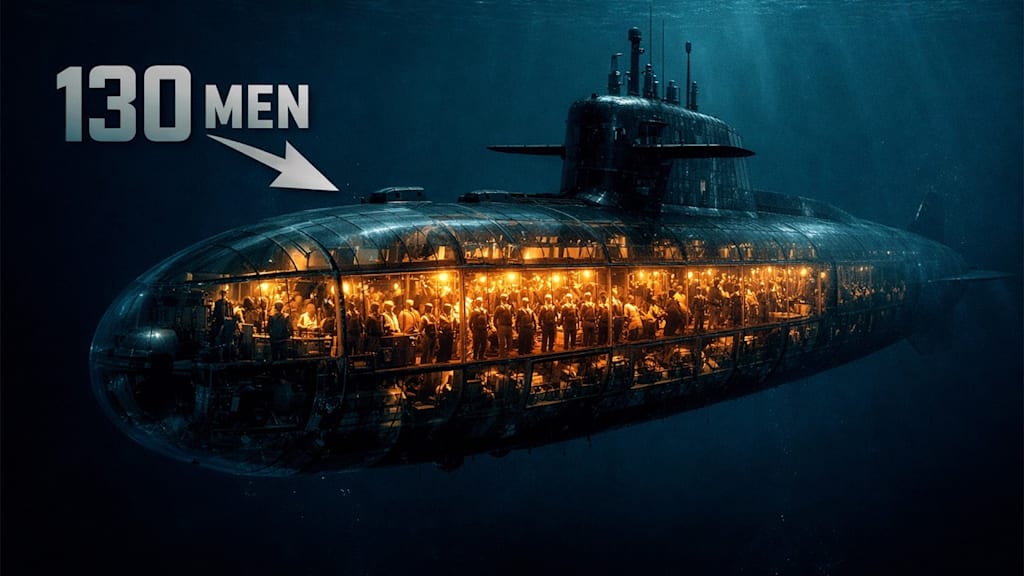
During World War II, a German submarine named German submarine U-1206 was hiding deep in the North Sea. Below it lay the terrifying depths of the ocean, and above it, British aircraft were constantly patrolling.
At that critical moment, the submarine’s captain made a fatal mistake while using the toilet—he opened the wrong valve. Within seconds, seawater rushed into the vessel and reached the batteries. This caused a dangerous chemical reaction, producing chlorine gas inside the submarine.
The crew had no choice but to surface. But as soon as they did, British naval forces and aircraft spotted them. The submarine was attacked, destroyed, and the entire crew was captured.
At depths of around 200 meters, submarines leave absolutely no room for error. Even the smallest mistake can turn into a death sentence. It is often said that a submariner’s greatest enemy is not the opponent—but their own mind.
A submarine is essentially a steel tube moving silently hundreds of meters beneath the ocean. Above is crushing water pressure, below is silent death—and in between are humans. The crew can remain underwater not for days, but for months.
Life inside a submarine is far from luxurious. In reality, it feels more like confinement than comfort. Space is extremely tight—so much so that two people can barely pass each other. Despite their large appearance, submarines must hold engines, supplies for months, and over 130 crew members.
For comparison, a prisoner in a standard cell might have around 80 square feet of space, while a submariner may have only about 20 square feet. Privacy is almost nonexistent—your personal space barely extends beyond your shoulders.
This environment introduces the first major challenge: Claustrophobia. People may experience panic attacks, increased heart rate, and poor decision-making. That’s why naval selection processes carefully screen candidates for this condition.
Sleep is another major issue. Private beds are rare. Instead, sailors use tight bunk beds stacked on top of each other—so cramped that you can barely sit up. Many submarines use a system called “hot bunking,” where one sailor sleeps in a bed just vacated by another. Beds are shared and never truly “empty.”
There’s no natural day or night cycle underwater. Sunlight never reaches these depths, so artificial lighting is used to simulate day and night, helping regulate sleep cycles.
Food, however, is taken very seriously. Submarines carry up to 20,000 kg of supplies. Fresh food is consumed early in the mission, after which the crew relies on canned and frozen items. Meals are crucial for maintaining morale, and some submarines even have ice cream machines or special meal nights.
Oxygen is one of the most fascinating aspects. Submarines use electrolysis to split seawater into oxygen and hydrogen. The oxygen is used for breathing, while hydrogen is safely removed. At the same time, carbon dioxide produced by breathing is removed using chemical scrubbers.
Fresh water is also produced onboard by desalinating seawater through distillation or reverse osmosis. However, usage is strictly controlled—showers may last only 60 seconds.
Waste management is another complex challenge. Human waste is stored in tanks and later expelled into the ocean using powerful pumps that overcome external pressure. If valves are opened incorrectly—like in the U-1206 incident—water can flood the submarine instantly.
Solid waste is compacted and sometimes ejected in sealed containers.
Despite all the advanced systems, the human mind remains the weakest link. Months without sunlight, limited contact with family, constant stress, and confined spaces can lead to depression and anxiety. Even small arguments can escalate dangerously.
Lighting systems are used to simulate day and night cycles, but the psychological pressure remains intense.
There have been other deadly mistakes too. For example, in 1944, the USS Tang fired a torpedo that malfunctioned and circled back, hitting the same submarine that launched it.
Incidents like U-1206’s toilet accident or USS Tang’s torpedo failure highlight a harsh truth: life in a submarine isn’t just about fighting the enemy. It’s about constantly battling your own mind, your machines, and the silent, unforgiving ocean—where even the smallest mistake can mean death.
About the Creator
Imran Ali Shah
🌍 Vical Midea | Imran
🎥 Turning ideas into viral content
✨ Watch • Share • Enjoy
Enjoyed the story? Support the Creator.
Subscribe for free to receive all their stories in your feed.
Comments
There are no comments for this story
Be the first to respond and start the conversation.