
Gwydion and Gilfaethwy: The Men Who Became Each Other
When Math's Punishment Became a Mirror for the Self
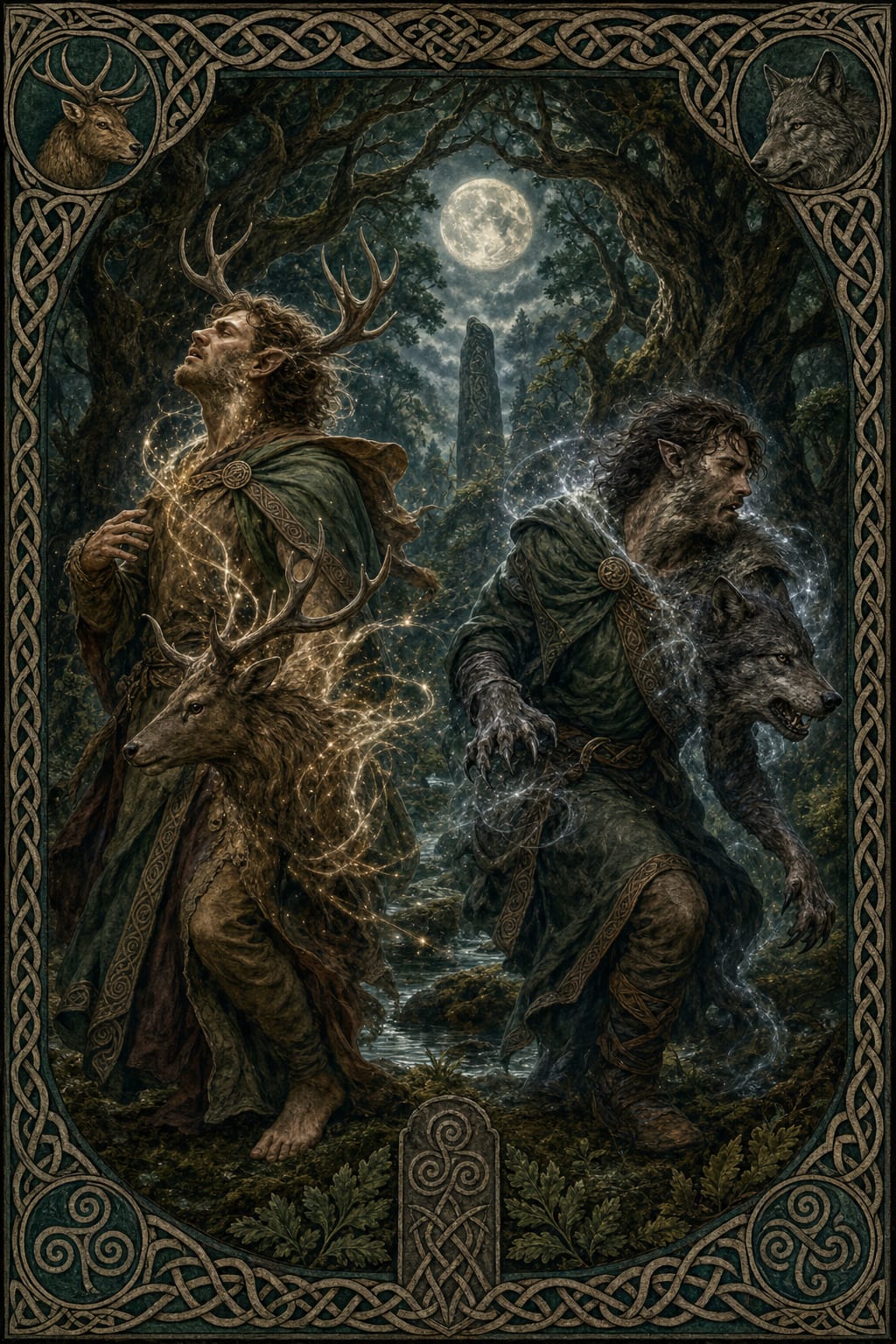
In the Fourth Branch of the Mabinogion, one of the foundational texts of Welsh literature, there is a passage so strange and so startling that it tends to make modern readers stop cold and read it again. Two brothers — Gwydion and Gilfaethwy, nephews of the great king Math — have done something terrible. Gilfaethwy has assaulted Goewin, the woman who serves as Math's foot-holder, a sacred role in the court. Gwydion helped him, manufacturing a war as a distraction. When Math discovers what has happened, he does not simply imprison them or exile them. He transforms them.
For three consecutive years, the brothers live as mated pairs of animals. In the first year, Gwydion becomes a stag and Gilfaethwy becomes a hind, and together they produce a fawn. In the second, their genders are exchanged: Gwydion becomes the boar's mate and Gilfaethwy the boar, and they produce another offspring. In the third year, Gwydion becomes the she-wolf and Gilfaethwy the wolf. Each year, Math receives the child born of their union. After three years and three children, Math releases his nephews from the enchantment and restores them to human form.
This is, without question, one of the most remarkable passages in all of medieval European literature. And it demands to be taken seriously.
What Kind of Punishment Is This?
The conventional reading frames this transformation primarily as a humiliation. Math is punishing two men by making them live as animals, by stripping them of their social status, by forcing them to breed like livestock. There is certainly that dimension to the text. Welsh society, like many medieval societies, placed enormous weight on rank, on the distinction between the human and the animal, and on male honor — and all three are violated here.
But there is more happening than simple humiliation, and the text's complexity rewards careful attention. Math does not transform both brothers into the same animal and send them out separately. He transforms them into mated pairs, into partners, into each other's counterpart. And crucially, he alternates who bears the female role year by year. This is not the story of a man being emasculated by becoming permanently female. It is the story of two men moving through genders, experiencing first one side and then the other, bearing young and then siring young, inhabiting female bodies and then male bodies again.
The text does not pause to editorialize. It does not describe Gwydion or Gilfaethwy as shamed specifically by the femaleness of their forms. The shame, such as it is, appears bound up in the animal nature of their punishment, in the loss of human status, in the compulsion placed upon them. But the text also makes clear that the children born of these unions — Hyddwn, Hychddwn, and Bleiddwn — are real. They are brought before Math. They are transformed back into human children. They matter.
What the Myth Holds
This is where the queer reading becomes not just possible but almost inescapable. Here are men who bear children. Here are men who experience female bodies — not as visitors or observers, but as participants, as the ones who conceive and carry and give birth. And then they switch. They do both. The Welsh myth does not treat this as metaphysically impossible or morally inconceivable. Math, the most powerful figure in the text, the one who administers this punishment, is clearly able to imagine it.
What does it say that medieval Welsh mythology could imagine men experiencing female embodiment, bearing children, and then returning to male form, all within a single coherent narrative frame? It says that the rigid binary we sometimes project backward onto the ancient world was not as absolute as we assume. The body, in this tradition, is subject to transformation. Gender, as expressed through the body, is contingent — malleable under the right circumstances, whether those circumstances are a king's enchantment, a shapeshifter's will, or the logic of the Otherworld.
There is also the matter of what Gwydion and Gilfaethwy learn. The text implies — without spelling it out — that their time in these forms changes them. They are released from the enchantment only when Math is satisfied that the punishment has run its course. And the Welsh tradition is deeply interested in transformation as education, as the forging of a different kind of knowing. One of the oldest ideas in Celtic thought is that a warrior or a leader must know how to be in many positions — not just the one that social rank assigns them.
Power, Shame, and the Complicated Hero
It would be dishonest, and frankly disrespectful to the text, to flatten this passage into a simple queer triumph narrative. The context is a sexual assault. Goewin is the victim around whom this punishment orbits, and her experience — her violation, her loss of the position she held through her virginity, and Math's attempt at restitution by marrying her — is part of the story too. The transformation of the brothers cannot be fully separated from what it is meant to address.
And yet the modern queer reader is invited to sit with the full complexity of this, not to resolve it. The myth does not offer us clean figures. Celtic literature rarely does. What it offers instead is something stranger and more honest: the acknowledgment that male bodies can become female, that the boundaries between genders are crossable, that transformation is real and that it produces real things — including children, including knowledge, including, ultimately, a changed person on the other side.
Finding Yourself in the Difficult Transformation
For LGBTQIA+ readers, there is something specific and powerful in the recognition that Celtic myth makes room not only for the triumphant queerness of heroes, but for the complicated, involuntary, uncomfortable, and ultimately transformative experience of inhabiting a different body than the one the world assigned you. Gwydion's experience of female embodiment was not chosen. It was imposed. And yet it was real. And it produced real things. And he came out the other side of it still himself — or perhaps more himself than before.
The Fourth Branch of the Mabinogion is not a comfort read. It is not a safe space in the modern sense. But it is deeply, unflinchingly honest about the strangeness of embodiment, the contingency of gender, and the fact that transformation — even forced transformation — is something that happens, and that people survive, and that changes them in ways that cannot simply be reversed. Some of those changes are wounds. Some of them are gifts. Often they are both at once.
Celtic myth knew that long before we had language for it.
About the Creator
The Celtic Spirit- A modern Guide to Celtic Belief and Practice
explaining Celtic mythology, druid practice, and reconstructions of paganism for modern readers
Enjoyed the story? Support the Creator.
Subscribe for free to receive all their stories in your feed. You could also become a paid subscriber, letting them know you appreciate their work.
Comments
There are no comments for this story
Be the first to respond and start the conversation.