
Guardians of the Sky: A Detailed Insight into the Pakistan Air Force and Its Powerful Fighter Jet Fleet
Exploring the Jets, Engines, and Technological Advancements of the Pakistan Air Force (PAF)
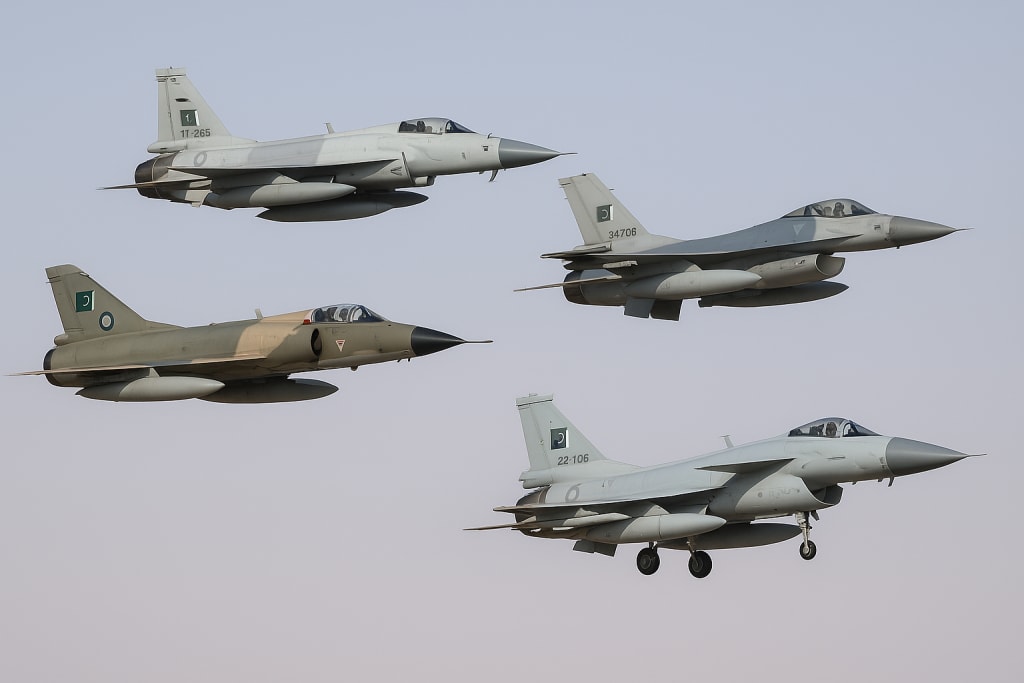
Introduction The Pakistan Air Force (PAF) is one of the most respected air forces in South Asia, known for its professionalism, combat readiness, and innovation. Since its inception in 1947, the PAF has evolved into a highly capable aerial warfare force. This article explores the history, organization, and especially the advanced fighter jets and jet engines that make up the core strength of the Pakistan Air Force. --- 1. Historical Background of the Pakistan Air Force 1.1 Birth and Early Years (1947–1965) The Pakistan Air Force was established on August 15, 1947, following the partition of British India. Initially, it inherited limited aircraft and personnel from the Royal Indian Air Force, such as Hawker Tempest and Dakota transports. 1.2 Evolution through Conflicts 1947–48 Kashmir War: The PAF played a logistical and reconnaissance role. 1965 War: The PAF performed exceptionally well, with legends like M.M. Alam gaining fame. 1971 War: Despite strategic losses, the PAF remained operationally effective. Kargil Conflict and War on Terror: The PAF adapted to modern warfare and counterinsurgency operations. --- 2. Organizational Structure of the PAF The Chief of Air Staff (CAS) currently is Air Chief Marshal Zaheer Ahmed Baber Sidhu. The PAF is organized into: Central Air Command (CAC) Northern Air Command (NAC) Southern Air Command (SAC) Training Command (TC) Main roles include air defense, ground support, ISR (intelligence, surveillance, reconnaissance), and strategic deterrence. --- 3. PAF's Modernization Strategy In recent decades, the PAF has focused on: Indigenous aircraft production (like JF-17 Thunder) Upgrading legacy aircraft (e.g., F-16s) Developing UAVs and drones Enhancing training and research capabilities Strategic collaborations with China, Turkey, and others --- 4. Fighter Jets of the Pakistan Air Force 4.1 List of Key Fighter Jets in PAF JF-17 Thunder (Pakistan-China): Multirole fighter powered by RD-93 or WS-13 engine F-16 Fighting Falcon (USA): Multirole, powered by Pratt & Whitney F100-PW engines Mirage III and V (France): Interceptor and strike roles, powered by Atar 09C engines J-10C Vigorous Dragon (China): Modern multirole fighter, powered by WS-10B engines F-7PG (China): Interceptor, powered by WP-13F engine --- 5. JF-17 Thunder – The Backbone of the PAF 5.1 Overview The JF-17 Thunder is a 4th-generation multirole fighter jointly developed by Pakistan and China. It is lightweight, cost-effective, and equipped with modern avionics. 5.2 Engine Details RD-93 Turbofan Engine (Russian) Thrust: Approx. 8,300 kgf with afterburner Max speed: Mach 1.6 WS-13 Engine (Chinese variant) Enhanced fuel efficiency and thrust Expected to replace RD-93 in future variants 5.3 Variants Block I and II: Initial production batches with operational capabilities Block III: Includes AESA radar, helmet-mounted display, and improved electronic warfare systems --- 6. F-16 Fighting Falcon – The American Powerhouse 6.1 Overview The F-16 is a high-performance multirole fighter. Pakistan operates several versions acquired from the USA, and the aircraft is used for both air-to-air and air-to-ground missions. 6.2 Engine Details Pratt & Whitney F100-PW-200/220E Engine Thrust: Approx. 23,770 lbf Capable of Mach 2+ speeds Known for high agility and combat readiness 6.3 Upgrades Mid-Life Upgrade (MLU) program Improved avionics and radar BVR missile capability Enhanced survivability systems --- 7. Mirage III and Mirage V – The Classic French Fighters 7.1 Role and Capabilities These aircraft have served in PAF for decades. They are still operational due to local upgrades and are mainly used for ground attack and reconnaissance missions. 7.2 Engine Atar 09C Turbojet Engine (French) Speed: Mach 2.2 Thrust: Approx. 14,100 lbf Modified variants in Pakistan can carry cruise missiles like RA’AD --- 8. J-10C Vigorous Dragon – A Strategic Addition 8.1 Overview The J-10C is a 4.5-generation fighter acquired from China and is considered a competitor to India’s Rafale. 8.2 Engine WS-10B Turbofan Engine (China) Thrust: Approx. 13,200 kgf Features supercruise capability and stealth airframe Equipped with PL-15 long-range missiles and AESA radar --- 9. F-7PG and Other Legacy Aircraft 9.1 F-7PG A Chinese variant of the MiG-21 Engine: WP-13F Turbojet Speed: Mach 2.0 Service Ceiling: 58,000 feet Being retired gradually 9.2 Retired Aircraft Sabre, MiG-19, MiG-21, Canberra, and others Super Mushshak used as a trainer aircraft --- 10. Future Aircraft Projects 10.1 Project AZM – Pakistan’s 5th Generation Jet Under development by Pakistan Aeronautical Complex (PAC) Expected to include stealth features, advanced radar, and twin engines Likely to be powered by WS-15 or Turkish TF6000 engines 10.2 UAVs and Drones Burraq: Armed UAV used in counter-terror operations Shahpar-II: ISR and ground attack drone Kamra Research Center is leading UAV development --- 11. Engine Summary Table Note: Plain text version for easier copying. JF-17 Thunder: RD-93 or WS-13 (Russia/China), 8,300 kgf thrust F-16 Fighting Falcon: F100-PW-200/220E (USA), 23,770 lbf thrust Mirage III/V: Atar 09C (France), 14,100 lbf thrust J-10C: WS-10B (China), 13,200 kgf thrust F-7PG: WP-13F (China), 6,220 kgf thrust --- 12. Training and Maintenance PAF Academy Risalpur and Combat Commanders School train pilots and officers Pakistan Aeronautical Complex (PAC) Kamra handles aircraft manufacturing and overhauls Collaborations exist with China, Turkey, and the USA for training and development --- 13. International Relations and Exports Joint exercises with Turkey, Saudi Arabia, Qatar, and China Exports of JF-17 to Nigeria and Myanmar Defense diplomacy to enhance regional ties --- Conclusion The Pakistan Air Force stands tall among global air forces with its commitment to innovation, excellence, and aerial supremacy. With a strong mix of foreign and indigenous fighter jets, advanced jet engines, and upcoming stealth projects, the PAF is poised to secure the skies of Pakistan for decades to come. As regional dynamics evolve, the PAF’s role in deterrence, defense, and diplomacy becomes more vital than ever.
About the Creator
Enjoyed the story? Support the Creator.
Subscribe for free to receive all their stories in your feed.
Comments
There are no comments for this story
Be the first to respond and start the conversation.