
From Pearl Harbor to V-J Day: A Brief History of the Pacific War
Remembering World War II's Pacific Theater
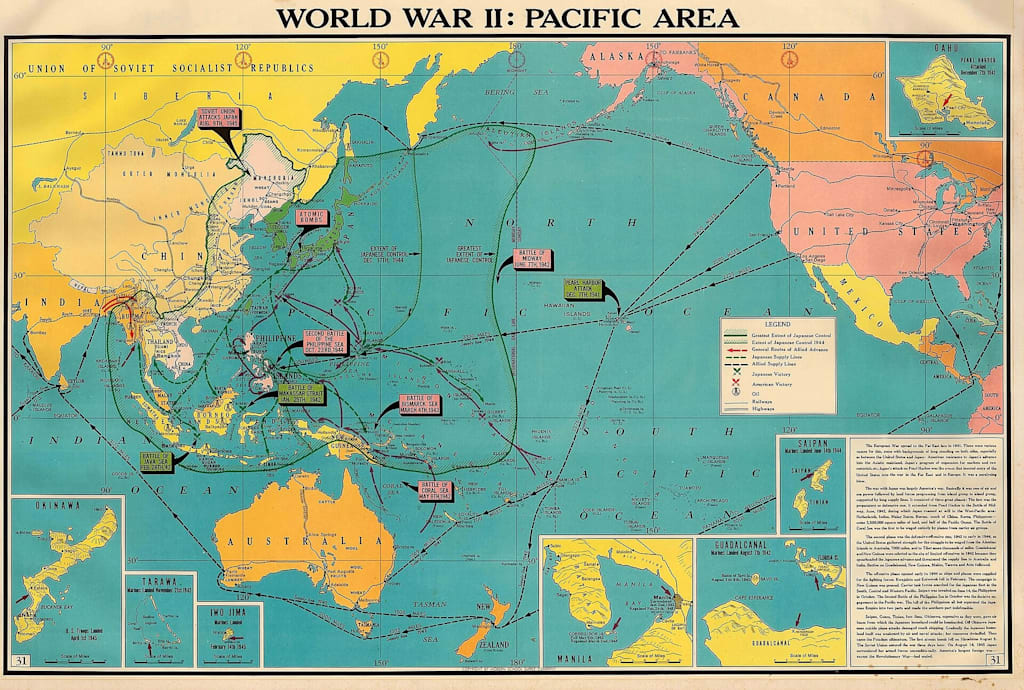
The Pacific War started in late 1941 and continued until 1945. However, tensions between Japan and the West are best traced back to the '30s with the Japanese occupation of Manchuria.
Following the Japanese occupation of Manchuria in '32, America pursued an economic trade embargo with Japan. Therefore, American Iron ore, steel, and oil exports to Japan were stopped. In addition to this, Japan also later withdrew from the League of Nations.
Such were the effects of the American economic embargo that Japan began plans for military action in the Pacific region by the early '40s. To this extent, Pearl Harbor, the Philippines, and a number of European colonies became potential targets for Japan.
As such, on the December 7, 1941, a Japanese carrier force targeted Pearl Harbor. Here, up to eight American battleships were knocked out of action in addition to hundreds of aircraft by Japanese B5Ns and dive bombers. However, American carriers were not present during the raid, while fuel depots also remained intact. Salvage operations post Pearl Harbor repaired and re-floated a number of ships. As such, Pearl Harbor did not necessarily meet all the objectives laid down by the Imperial Japanese Navy. At any rate, the Pacific War began here.

However, it was enough to give Japan at least a temporary advantage in the Pacific War. With this, in early 1942, Japanese armies captured a number of European colonies in the region, such as Burma, the Dutch East Indies, Hong Kong, and Manila. The Philippines was also lost on 8th May 1942, while General MacArthur vowed to return.
Despite this, the American carriers remained and were ready to engage the IJN. The Battle of Coral Sea was one of the early naval battles, which forced Japan to abandon Port Moresby. Given this, American carriers increasingly became the target for the IJN.
As such, plans were drafted to trap an American carrier fleet off Midway Island. With this, Japan could then capture Midway Island. A potent Japanese fleet was assembled for Midway Island in June of '42, although this was intercepted by America, and Admiral Nimitz was aware and prepared for the impending Japanese advance. Early air-craft skirmishes saw Japanese bombers attempt to bomb the airbases on Midway Island. However, these were not directly hit. While Japan's A6M fighter plane remained potent, American SBD dive bombers were still able to strike at the Japanese carriers. With this, 4 Japanese carriers were sunk at the battle along with hundreds of supporting aircraft. Later, Japan was able to sink the American carrier, the Yorktown. However, the Battle of Midway was a defeat for Japan.

The Guadalcanal campaign also continued in '42. However, by February of '43, the Allies were able to secure the island as Japan's remaining armies retreated from Guadalcanal. As such, it became an important base for the Allied operations in the region.
With such victories, the Allies began Operation Cartwheel in '43. Operation Cartwheel drafted Allied plans to bypass the base of Rabaul in favor of less well-defended positions. This would prepare Nimitz and the Allies for their island-hopping strategy.
In 1944, two further naval battles effectively won the war for the Allies. The first was the Battle of the Philippine Sea, off the Marianas. Here, in an attempt to defend the Marianas, an IJN fleet was assembled to halt Allied landings. However, it was another reversal for Japan, and the Allies were able to sink a further three Japanese carriers along with 600 aircraft.
The defeat here paved the way for the Allies to capture Leyte Island and then occupy the Philippines, cutting Japanese oil supplies. As such, the IJN assembled a large fleet of battleships, destroyers, and carriers to try to defend Leyte Gulf. However, with Allied air superiority, the battle was a final defeat for the IJN, with 12 destroyers, 8 cruisers, and 3 battleships lost. As such, the Allies gained clear naval superiority. In addition, Leyte also fell to the Allies, and MacArthur recaptured the Philippines.
By 1945, with Japan's defeat imminent, the Battle of Iwo Jima was one of the final battles. Iwo Jima was an American target for potential airbases and air support. A garrison of 20,000 soldiers remained in defense, although the IJN could no longer provide any naval support. As such, the Allies were able to capture the island, despite the strong defenses set up. With Okinawa also falling in '45, a Battle of Japan was a possibility.

However, Japan had still not surrendered to the Allies. As such, two bombs were dropped on the Japanese cities of Nagasaki and Hiroshima. On August 3, 1945, the USSR also declared war on Japan and defeated Japanese soldiers in Manchuria. With this, the Japanese surrendered on August 15th, 1945. Officially, the Pacific War ended on September 2 with a formal surrender.
About the Creator
Matthew A
Matthew is the author of Battles of the Pacific War 1941-1945. Battles of the Pacific War is available on Amazon and Lulu in e-book and paperback formats. Check out the book’s blog at battlesofthepacificwar.blogspot.co.uk.
Enjoyed the story? Support the Creator.
Subscribe for free to receive all their stories in your feed.
Comments
There are no comments for this story
Be the first to respond and start the conversation.