
Ernest Shackleton’s Endurance: The Greatest Survival and Leadership Story Ever Told
How 28 men survived Antarctica after losing their ship, their mission, and almost every hope of returning home

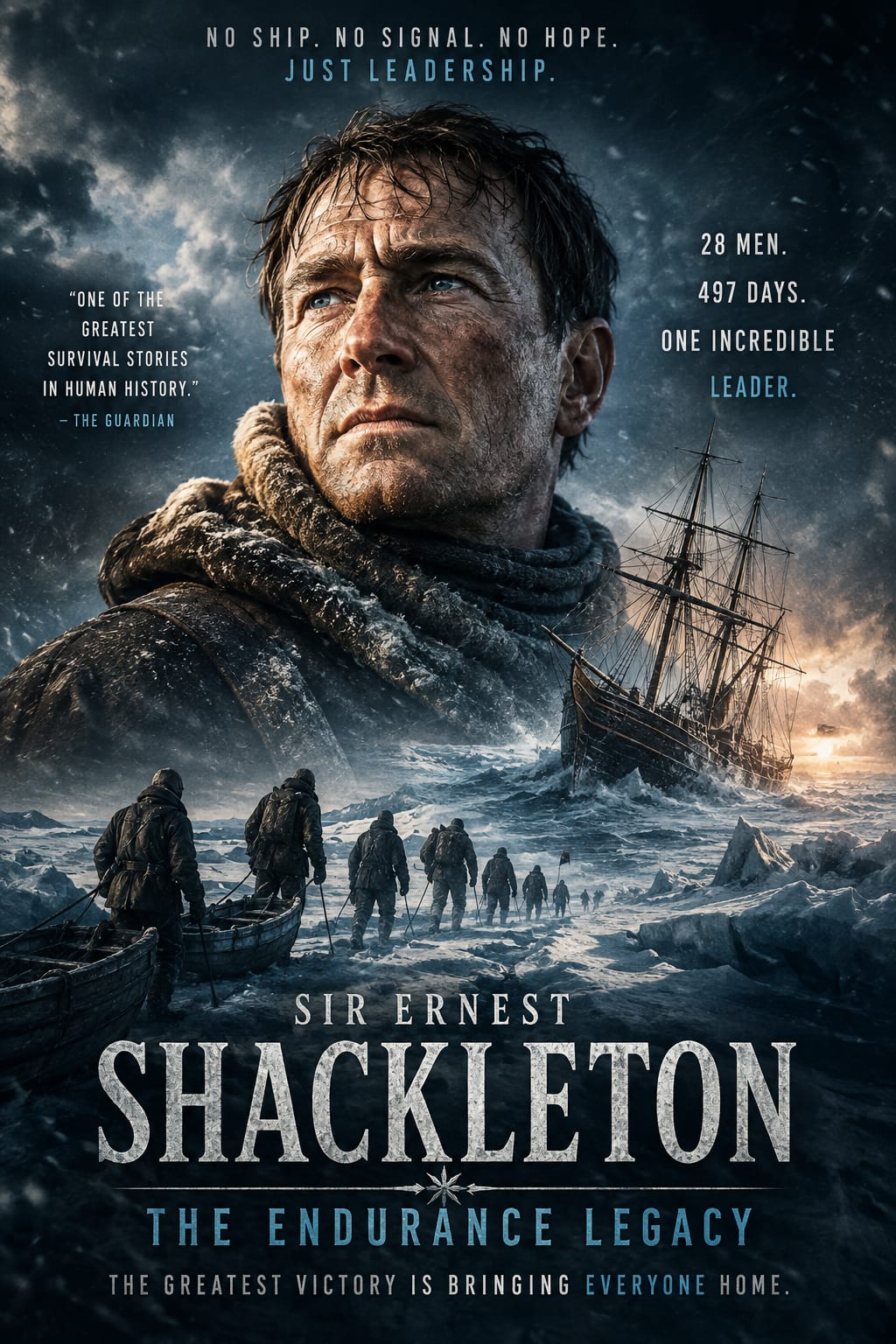
Imagine standing on a fragile sheet of ice surrounded by complete darkness.
The temperature has dropped below minus 40 degrees. Beneath your feet, there is no solid land—only thousands of feet of freezing black ocean. The ship that carried you to Antarctica has just been crushed by the pressure of the ice and has disappeared beneath the water.
You have no radio, no GPS, and no way to contact the outside world. Nobody knows where you are.
You are stranded with 27 other men in one of the most dangerous places on Earth.
This was not a fictional survival movie. It was the terrifying reality faced by Sir Ernest Shackleton and the crew of the Endurance.
Shackleton’s mission ended in complete failure. His ship was destroyed, his expedition never reached its goal, and his men were trapped for months in the Antarctic wilderness.
Yet today, his story is remembered as one of the greatest examples of leadership, courage, mental strength, and survival in human history.
A Mission That Was Considered Impossible
In August 1914, while Europe was moving toward the First World War, Shackleton and his crew began an ambitious journey aboard a ship called Endurance.
Their objective was to cross the Antarctic continent on foot.
At that time, this was considered one of the last great challenges of exploration. Shackleton knew the journey would be dangerous, but he believed that his experienced crew and carefully prepared ship could succeed.
By October, the expedition had reached South Georgia Island. Local sailors warned Shackleton that the sea ice was unusually dangerous that year. Moving farther south could mean sailing directly toward death.
Shackleton decided to continue.
As Endurance entered the Weddell Sea, the water around the ship gradually began to freeze. By January 1915, the ice had become so thick that moving even a short distance was almost impossible.
Eventually, the ship became completely trapped.
The crew initially tried to break the ice using axes and tools. However, Shackleton understood that human strength was powerless against the enormous forces of the Antarctic environment.
The men were no longer travelling through the ice.
They had become prisoners of it.
Shackleton’s Most Important Battle
The greatest danger was not immediately hunger, cold, or physical exhaustion.
It was the human mind.
When people remain trapped in the same place for months, surrounded by nothing but ice and darkness, fear begins to spread through the group. Anxiety, hopelessness, and anger can become more dangerous than the environment itself.
Shackleton understood that the emotional state of a leader affects everyone around them.
If he appeared afraid, his men would become afraid. If he lost hope, the entire crew could collapse psychologically.
Therefore, he created a daily routine.
The men played football on the ice. Shackleton organized dog races, competitions, shared meals, and entertainment. These activities might have looked like simple ways to pass the time, but they served a much deeper purpose.
Shackleton was protecting his crew’s mental health.
He created the feeling of ordinary life in a place where nothing was normal. He kept the men occupied because he understood that an empty mind could quickly become controlled by fear.
The End of the Endurance
As the months passed, the pressure of the ice became more violent.
Huge sheets of frozen ocean crashed against one another with sounds like explosions. The wooden structure of Endurance began to bend, break, and scream under the pressure.
Water entered the ship, and Shackleton eventually gave the order to abandon it.
The crew carried supplies, equipment, and three small lifeboats onto the ice. They established a temporary camp while watching their only connection to the outside world slowly fall apart.
On November 21, 1915, Endurance finally disappeared beneath the freezing ocean.
For Shackleton, it was the destruction of his greatest dream.
He could have stood there mourning his ship and the failure of the expedition. Instead, he immediately changed the mission.
Crossing Antarctica no longer mattered.
Keeping every man alive became the only objective.
Shackleton told his crew that the ship and supplies were gone. Now, they would return home.
That ability to abandon an old dream and accept a new reality became one of his greatest leadership qualities.
Leaving Everything Behind
The men needed to reduce the weight they would carry across the ice.
Shackleton knew that asking people to abandon their valuable possessions would be difficult. Instead of simply giving an order, he reached into his own pocket, removed his gold watch and coins, and threw them onto the ice.
The message was clear.
Money, status, personal possessions, and social position had no value in their current situation. Survival depended only on discipline, teamwork, courage, and the ability to keep moving.
Each man was permitted to carry only a very small amount of personal property.
Shackleton led through action rather than speeches. He did not demand a sacrifice that he was unwilling to make himself.
The Cruel Reality of Survival
As food became limited, Shackleton faced one of the most painful decisions of the expedition.
The team’s dogs could no longer be fed. There was also not enough food for the men.
The dogs had been companions to the crew and were loved deeply. However, Shackleton knew that keeping them alive was no longer possible.
Leadership is often presented as the ability to motivate people with inspiring words. Shackleton’s experience revealed another side of it.
A leader must sometimes carry the burden of making decisions that nobody else wants to make.
He could not change the reality of their situation. He could only accept it and make the choices necessary to give the remaining men a chance of survival.
Shackleton never offered false promises. He did not tell the crew that rescue would arrive the next morning.
Instead, he gave them something more powerful: the belief that they could save themselves.
A Journey Across the Deadliest Ocean
By April 1916, the sheet of ice beneath the camp was beginning to break apart.
The crew could no longer remain where they were. Shackleton ordered the men into three small lifeboats and decided to attempt a journey toward Elephant Island.
The surrounding waters were among the most dangerous in the world.
Massive waves crashed over the boats. Ice formed almost immediately whenever seawater entered. The men repeatedly scraped frozen water from the boats to prevent them from becoming too heavy and sinking.
They were exhausted, dehydrated, cold, and surrounded by death.
Yet the group remained united.
Shackleton did not demand special treatment. He experienced the same cold, hunger, and discomfort as every ordinary sailor. When one of the expedition’s photographers lost his gloves, Shackleton reportedly gave him his own, despite the danger to his hands.
This shared suffering created trust.
His men did not follow him simply because he was their commander. They followed him because he never asked them to experience a pain that he refused to experience himself.
On April 15, 1916, after approximately 497 days surrounded by unstable ice and freezing water, the crew finally reached the solid ground of Elephant Island.
For the first time in more than a year, they stood on land.
However, they were still far from safety.
The Impossible Voyage to South Georgia
Elephant Island was isolated and rarely visited. There was no radio station, settlement, or reliable method of calling for help.
Shackleton understood that waiting would eventually lead to death.
He selected five men and prepared the strongest lifeboat, the James Caird, for an almost impossible journey. They would travel approximately 1,300 kilometres across the violent Southern Ocean to reach South Georgia Island.
Shackleton left 22 men behind and promised that he would return for them.
The James Caird was only about 22 feet long. In the enormous waves of the Southern Ocean, it looked like a small wooden toy.
Navigation depended largely on Frank Worsley, who had to calculate their position using brief glimpses of the sun through thick clouds. A tiny navigational error could cause them to miss South Georgia completely and disappear into the Atlantic Ocean.
The men ate while lying inside the boat. Saltwater caused painful injuries to their feet. They were wet, exhausted, and unable to rest properly.
After more than two weeks, they finally saw the mountains of South Georgia.
But their struggle was not finished.
Thirty-Six Hours Across Frozen Mountains
The boat reached the wrong side of the island.
The whaling station and possible rescue were located across unexplored mountains and glaciers. The James Caird was too damaged to continue safely around the coast.
Shackleton and two companions decided to cross the island on foot.
They had no proper climbing equipment, maps, or tents. To gain traction on the ice, they removed screws from the boat and hammered them into the soles of their boots.
The three men travelled continuously for around 36 hours.
They could not stop for long because sleeping in the freezing conditions might mean never waking up. Their bodies were exhausted, but stopping was not an option.
Eventually, they reached a mountain ridge and heard the sound of a whistle from the whaling station below.
It was the first clear sign of civilization they had experienced in more than a year.
When Shackleton reached the station, he was almost unrecognizable. His hair and beard had grown, his clothes were filthy, and his body had been weakened by months of suffering.
The outside world had assumed that Shackleton and his crew were dead.
But Shackleton did not ask for comfort or celebration.
His first priority was rescuing the 22 men still waiting on Elephant Island.
The Promise Was Kept
Several rescue attempts failed because thick ice prevented ships from reaching the stranded crew.
Meanwhile, Frank Wild maintained discipline on Elephant Island. Every morning, he reportedly encouraged the men to prepare themselves because their leader might return that day.
For four months, they watched the sea and waited.
Finally, on August 30, 1916, Shackleton reached Elephant Island aboard a rescue ship.
Through his binoculars, he could see figures moving along the shore.
He began counting them.
Every man was alive.
The expedition had lost its ship, equipment, supplies, and original objective. The crew had endured freezing temperatures, hunger, dangerous seas, isolation, and psychological pressure.
Yet all 28 members of the Endurance expedition survived.
What Shackleton’s Story Teaches Us
Shackleton did not become legendary because his original mission succeeded.
It failed completely.
He became legendary because he recognized when the old mission was no longer possible. Instead of remaining emotionally attached to a destroyed dream, he accepted reality and created a new mission.
His story teaches us that greatness is not about never failing.
It is about responding correctly when failure arrives.
Every person has an “Endurance” in life. It may be a career, relationship, business, personal identity, or dream. Sometimes life crushes that dream just as the Antarctic ice crushed Shackleton’s ship.
Many people continue standing beside the wreckage, unable to accept that their original plan is gone.
Shackleton chose differently.
He let the old dream sink and focused entirely on what could still be saved.
His leadership also demonstrates the importance of emotional control. A leader’s panic can spread through a family, workplace, or team. During a crisis, people look toward the person in charge for stability.
Shackleton may have felt fear internally, but he did not allow that fear to control his decisions or destroy the confidence of his men.
He also understood the value of routine. Even in unbearable conditions, he kept his crew active and mentally engaged.
When life becomes chaotic, routine can become a form of protection. Exercise, reading, work, conversation, and daily responsibilities help prevent fear from occupying every corner of the mind.
Most importantly, Shackleton acted without waiting for perfect conditions.
He did not have perfect information, perfect equipment, or a guaranteed route to safety. He used the lifeboat available to him and made the best possible decision with the knowledge he possessed.
Ernest Shackleton transformed one of history’s greatest expedition failures into one of humanity’s greatest survival victories.
His story reminds us that the person who survives is not always the strongest or most powerful.
Sometimes, it is the person who accepts reality first, adapts quickly, protects the people around them, and continues moving forward when everything appears to be lost.
About the Creator
parwinder singh
🎬 Movie & Entertainment Writer sharing reviews, ending explanations, story breakdowns, plot twists and hidden details from Bollywood, Hollywood, South Indian cinema, Korean dramas and OTT releases.
Enjoyed the story? Support the Creator.
Subscribe for free to receive all their stories in your feed.
Comments
There are no comments for this story
Be the first to respond and start the conversation.