
Egypt is all set to Break Dubai's Record
Dubai's Record

This is Cairo, which is not only the capital of Egypt but also the financial and economic hub of the entire country. If we move toward its east, we see almost nothing in the Sahara Desert except a few highways. But this satellite image is from 2015 — since then, a lot has changed.
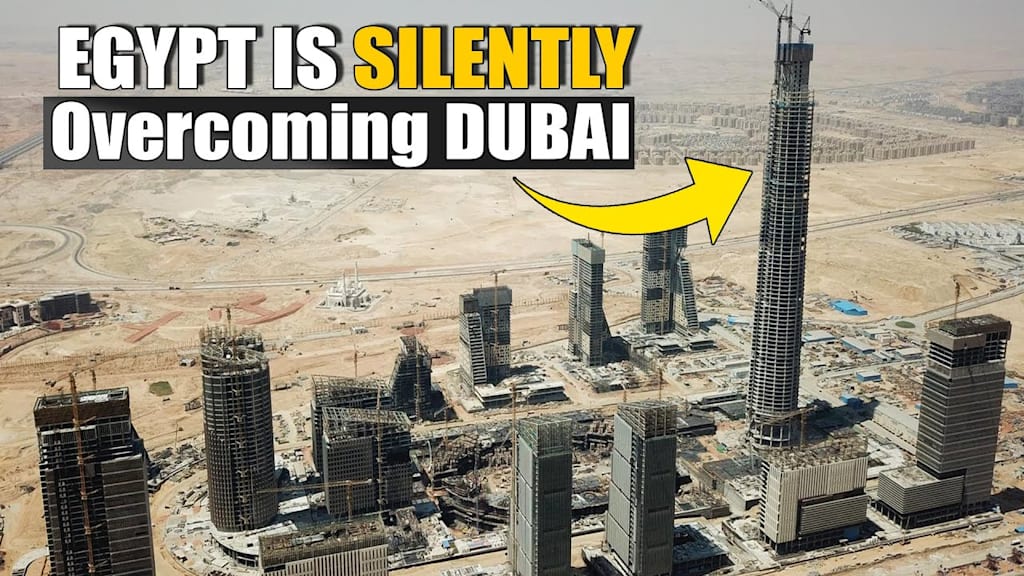
The Egyptian government decided to completely transform this desert area. Not only is a new capital city being built here, but Africa’s tallest building is also under construction to compete globally. It is called the Iconic Tower. Egypt has now decided to challenge Dubai as well.
Before 2013, this was nothing but a sea of sand, but now they aim to build a skyscraper even taller than Burj Khalifa. But why was this barren land chosen for such a massive project? And why is Cairo being replaced?
For the past 12 years, the title of the world’s tallest building has belonged to Burj Khalifa. Before that, the title shifted between different countries. From 2004 to 2010, it belonged to Taipei 101 in Taiwan. Before that, Malaysia’s Petronas Towers held the record. And for nearly 25 years, the Sears Tower in Chicago held the title.
But if we look deeper into history, Egypt’s pyramids held the title of the tallest structures in the world for around 4,000 years. Now, through this new capital city, Egypt wants to reclaim that title.
This new city does not yet have an official name, but it is commonly referred to as the “New Administrative Capital” or simply “NAC.” Building entirely new cities is nothing new for countries, and many nations have changed their capitals before.
In 2024, Indonesia planned to launch its new capital Nusantara to replace Jakarta because Jakarta is gradually sinking. On the other hand, South Korea is even planning floating cities due to rising sea levels.
But there are several reasons behind Egypt building NAC. The biggest issue is traffic. Cairo is considered one of the most congested cities in the world. If you look at Google live traffic data, nearly 90% of Cairo’s roads are jammed during morning hours.
Egypt has a population of 104 million, and astonishingly, around 25% of the entire population lives in this green region around the Nile River. Naturally, people settle where water exists. About 90% of Egypt is covered by the barren Sahara Desert where there is virtually no water.
The Nile River flows from Ethiopia and Sudan into Egypt and eventually splits into multiple channels before reaching the Mediterranean Sea. That’s why most agriculture and population are concentrated in northern Egypt.
Traffic and overpopulation are not the only issues. Another major reason for building a new city is the scattered government offices in Cairo. In most countries, parliament, ministries, and presidential offices are located close to each other. But in Cairo, these offices are spread across the city.
This creates difficulties for government officials to coordinate, and when they travel with heavy security, traffic congestion worsens even more. Egypt’s parliament and Shura Assembly are located near Tahrir Square, which is a highly crowded area and unsuitable for such sensitive institutions.
Often, police must block entire areas for security reasons, creating even more problems. The government believed that building a new city was the only solution left to handle these issues.
Egypt started building new cities in 1977 to reduce pressure on Cairo. Many small and large cities were developed, but the growing population continued concentrating around the capital. Later, New Cairo City was built east of Cairo, but even that failed because all these cities together increased the burden on Cairo.
Finally, in 2015, the Egyptian government decided to change the capital entirely. This new capital is being carefully planned over an area of around 700 square kilometers east of Cairo.
After seven years of construction, the first phase is nearing completion. A dedicated government district has been built where all state offices will be relocated from Cairo. Along with ministries and a new parliament building, a luxurious presidential palace is also being constructed.
Besides the government district, ultra-luxury residential zones are also part of the project. A stadium with a seating capacity of 90,000, a 40,000-room hotel complex, and a theme park four times larger than Disneyland are planned.
Solar energy farms, an electric railway system connecting the new capital with Cairo, and a completely new international airport are also part of the project. Egypt is also building a massive military headquarters inspired by the Pentagon, called “The Octagon.”
As for religious structures, the Al-Fattah Al-Aleem Mosque is being built with space for 17,000 worshippers, making it the largest mosque in Egypt. The largest cathedral in the Middle East is also under construction there.
In addition, an international financial hub is being developed, where Africa’s tallest skyscraper, the Iconic Tower, is rapidly rising. Once completed, the 77-floor tower will stand 1,292 feet tall.
And this is only the beginning. Egypt also has a master plan to build the world’s tallest building to compete with Dubai. Its design will be inspired by ancient Egyptian obelisks.
If completed successfully, this tower would exceed 1,000 meters in height, surpassing Burj Khalifa, which stands at 828 meters.
To bring greenery and freshness into this barren desert, a giant recreational park is also planned in NAC. Its size is so massive that it stretches across large sections of the city. Compared to New York’s Central Park, it will be six times larger.
Nowadays, mega-structures have become a global trend, and countries are investing billions of dollars into new infrastructure projects. According to estimates, Egypt has already spent around $45 billion on NAC.
However, constructing extremely tall buildings in the desert presents major engineering challenges because everything tends to sink into the sand. To solve this, engineers must build extremely strong foundations.
Before constructing the Iconic Tower, Chinese engineers built a massive raft foundation — a huge concrete slab designed to distribute the tower’s weight evenly over the desert ground.
To support the 393-meter-tall Iconic Tower, around 18,500 cubic meters of concrete were used. It became the largest foundation ever built in the Middle East.
Not only the largest, but also one of the fastest built foundations ever. Engineers poured all 18,500 cubic meters of concrete in just 38 hours, setting a new world record.
After the foundation, the 77-story structure was also raised extremely quickly within just one year. The plan was to launch the Iconic Tower in the first half of 2023.
Egypt has entered the global race to reclaim its lost glory, but whether this ambitious master plan succeeds or not will become clear in the coming years.
About the Creator
Imran Ali Shah
🌍 Vical Midea | Imran
🎥 Turning ideas into viral content
✨ Watch • Share • Enjoy
Enjoyed the story? Support the Creator.
Subscribe for free to receive all their stories in your feed.
Comments
There are no comments for this story
Be the first to respond and start the conversation.