
Diogenes: The Homeless Philosopher Who Told Alexander the Great to Move Out of His Sun
How a disgraced banker’s son rejected wealth, mocked Plato, lived in a clay jar, and became ancient Greece’s boldest symbol of freedom

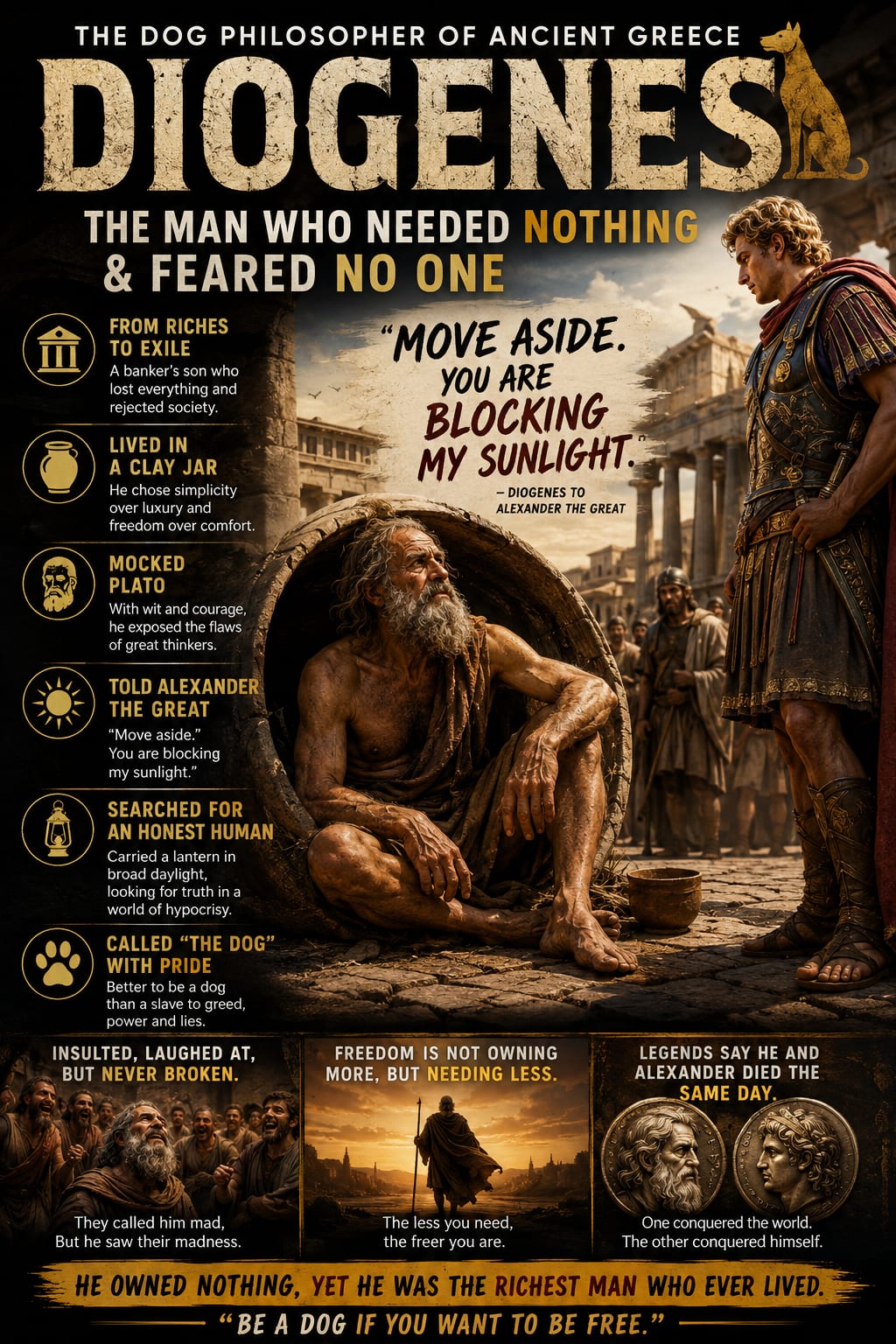
Around 2,500 years ago, the crowded marketplace of Athens was filled with wealthy merchants, magnificent buildings and celebrated philosophers debating the meaning of life.
Yet near the edge of that sophisticated society lived a man inside a large, discarded clay jar.
He owned almost nothing. His clothes were torn, his hair was unkempt, and many Athenians treated him like a mad beggar. People laughed at him, insulted him and called him “the Dog.”
But this man was not an ordinary homeless person.
His name was Diogenes of Sinope, and he would become one of the most fearless and controversial philosophers in history.
Diogenes did not write his philosophy in thick books. He demonstrated it through the way he lived. He mocked social status, challenged respected thinkers such as Plato and even told Alexander the Great—the most powerful ruler of his age—to move aside because he was blocking the sunlight.
Was Diogenes genuinely insane, or was he the only person brave enough to expose the madness hidden beneath civilized society?
From Privilege to Exile
Diogenes was born in Sinope, a prosperous Greek colony located near the Black Sea. According to traditional accounts, he came from a wealthy and influential family.
His father was associated with the city’s mint, where coins were produced and managed. Diogenes may also have worked in the same profession.
However, his comfortable life collapsed when he and his father were accused of damaging, altering or debasing the city’s currency. Historians continue to debate whether the incident was motivated by greed, politics or something more symbolic.
Whatever the truth may have been, the consequences were severe.
Diogenes lost his wealth, reputation and citizenship. He was banished from Sinope and forced to leave behind everything that once defined him.
For a person living in ancient Greece, exile was almost like social death. Identity, protection and status were closely connected to one’s city. Without a homeland, a person could easily become invisible.
Diogenes, however, transformed his punishment into liberation.
A famous story claims that the Oracle of Delphi instructed him to “deface the currency.” Diogenes eventually interpreted this message in a philosophical way. He would no longer attack metal coins; he would challenge the false values society treated as valuable currency—wealth, reputation, luxury, power and social approval.
The wealthy banker’s son disappeared.
In his place emerged one of history’s greatest rebels.
The Philosopher Who Chose a Clay Jar
When Diogenes arrived in Athens, he had little money and nowhere to live.
Rather than searching for another comfortable home, he deliberately reduced his needs. He began living inside a huge clay storage vessel known as a pithos, which was traditionally used to store grain or wine.
His possessions were reportedly limited to a cloak, a staff, a small bag and a drinking cup.
Even the cup eventually became unnecessary.
One day, Diogenes saw a child drinking water by collecting it in his hands. Realizing that the child needed no special container, Diogenes threw away his cup.
“A child has beaten me in simplicity,” he supposedly admitted.
For Diogenes, every unnecessary possession was another chain. A person who owned a large house had to protect it. Someone who desired luxury had to earn enough money to maintain it. A person obsessed with reputation had to constantly worry about the opinions of others.
People believed possessions gave them freedom.
Diogenes believed possessions often became their masters.
The Birth of Cynicism
Diogenes became the most famous representative of Cynicism, an ancient philosophical movement that promoted simplicity, self-sufficiency and life according to nature.
The modern word “cynical” usually describes someone who distrusts people’s motives or sees negativity everywhere. Ancient Cynicism, however, was far more radical.
The Greek word connected to Cynicism was associated with dogs. Diogenes’ critics called him a dog because of his shameless behaviour, rough appearance and rejection of social manners.
Instead of feeling insulted, he proudly accepted the name.
A dog, he believed, lived naturally. It did not pretend to be something it was not. It showed loyalty to honest people, barked at hypocrites and attacked those who threatened it.
Diogenes used the identity of “the Dog” as a weapon against society’s artificial rules.
He wanted people to understand that freedom did not come from gaining more. It came from needing less.
Diogenes Versus Plato
While Diogenes lived among ordinary people in the marketplace, Plato taught philosophy inside his famous academy.
Plato discussed ideal forms, politics, knowledge and the nature of reality. Diogenes preferred direct demonstrations that exposed weaknesses in complicated theories.
One of their most famous clashes began when Plato reportedly defined a human being as a “featherless biped”—a creature that walked on two legs and had no feathers.
Diogenes responded in unforgettable fashion.
He plucked the feathers from a chicken, carried it into Plato’s academy and announced:
“Behold! I have brought you Plato’s man.”
Plato’s definition reportedly had to be modified to include “broad, flat nails.”
The incident perfectly represented Diogenes’ style. He did not respond with a lengthy academic argument. He used a shocking visual example to demonstrate how easily an impressive definition could collapse.
Another story describes Diogenes entering Plato’s luxurious home with muddy feet and walking across an expensive carpet.
“I am trampling on Plato’s pride,” he declared.
Plato calmly replied that Diogenes was doing so with pride of his own.
Even Plato could recognize that rejecting luxury might itself become another form of ego.
Searching for an Honest Human
One of the most famous images connected to Diogenes shows him walking through Athens in broad daylight while carrying a lit lantern.
People laughed and asked why he needed a lamp when the sun was already shining.
“I am looking for a human being,” Diogenes replied.
The marketplace was filled with thousands of people, but Diogenes was not searching for a human body. He was searching for a person who was honest, independent and free from hypocrisy.
To him, most people were controlled by greed, fear, desire, ambition or public opinion. They looked human on the outside but had surrendered their freedom on the inside.
The lantern became a symbol of his search for authenticity in a world dominated by masks.
A Slave Who Behaved Like a Master
Despite preaching freedom, Diogenes was reportedly captured by pirates while travelling by sea.
The pirates took him to a slave market, where prisoners were examined and sold like animals.
When the auctioneer asked Diogenes what kind of work he could perform, he gave a remarkable answer:
“I know how to govern men. Sell me to someone who needs a master.”
A wealthy man named Xeniades was impressed by his confidence and purchased him.
Diogenes was taken to Corinth, where he became responsible for educating Xeniades’ children. Rather than behaving like a defeated slave, he became a respected teacher.
He taught the children discipline, physical strength, simple living and independence.
Although Diogenes had been legally enslaved, his mind remained free. The people who owned wealth and power often appeared more enslaved than he was because they were controlled by fear, desire and social expectations.
When Diogenes Met Alexander the Great
The most legendary moment of Diogenes’ life occurred when Alexander the Great visited Corinth.
Alexander was a young king with an enormous army and ambitions to conquer the known world. Important politicians, wealthy citizens and respected thinkers gathered to welcome him.
Diogenes did not attend.
Instead, he remained outside, relaxing in the sunlight.
Curious about the philosopher’s reputation, Alexander personally went to meet him. Standing before Diogenes, the king offered to grant him anything he desired.
Diogenes looked at the ruler and gave one of history’s most famous replies:
“Move a little to the side. You are blocking my sunlight.”
Alexander could have offered him gold, protection, a palace or political influence. Diogenes wanted none of it. The only thing Alexander could give him was something the king was currently taking away—the warmth of the sun.
The philosopher needed nothing from the conqueror.
According to the legend, Alexander later told his companions:
“If I were not Alexander, I would wish to be Diogenes.”
Diogenes reportedly responded that even if he were not Diogenes, he would still wish to be Diogenes.
Alexander had conquered kingdoms.
Diogenes had conquered his desires.
The Meaning Behind His Rebellion
Diogenes’ behaviour was often intentionally offensive. He ate in public when doing so was considered improper, rejected formal manners and challenged society’s strongest taboos.
His purpose was not simply to shock people.
He wanted to ask uncomfortable questions.
Why were natural human needs treated as shameful while warfare, slavery, political corruption and mass violence were accepted as respectable?
Why did society admire people who accumulated more than they needed but insult people who chose to live with less?
Why was a king considered successful because he controlled millions of people, while an individual who controlled his own desires was dismissed as a failure?
Diogenes believed civilization had reversed morality. People were ashamed of nature but proud of greed, conquest and manipulation.
His philosophy was an attempt to turn those values upside down.
The Death of the Dog Philosopher
Diogenes reportedly lived into old age, although several different stories describe how he died.
One account claims that he became ill after eating raw octopus. Another says he died after being bitten by a dog. A more dramatic legend states that he deliberately held his breath when he decided that his life had reached its natural conclusion.
The exact cause remains uncertain.
An even more fascinating tradition claims that Diogenes and Alexander the Great died on the same day.
Whether historically accurate or not, the comparison is powerful. One man spent his life trying to conquer the world. The other spent his life trying to conquer himself.
After Diogenes’ death, the citizens of Corinth reportedly honoured him with a monument topped by a marble dog.
The insult he had embraced became the symbol of his immortality.
Why Diogenes Still Matters Today
Modern life is very different from ancient Athens, but Diogenes’ questions remain relevant.
People still measure success through possessions, popularity, job titles and social approval. Many spend years chasing things they do not truly need, hoping that the next purchase, promotion or achievement will finally make them feel complete.
Diogenes offers a disturbing alternative:
Perhaps freedom is not the ability to own everything.
Perhaps freedom is the ability to walk away from what controls you.
His lifestyle was extreme and is not a practical model for everyone. Yet the central message behind it remains powerful. A person who requires less is harder to manipulate. Someone who is not desperate for approval is difficult to silence. A person who controls desire possesses a kind of wealth that no ruler can provide.
Diogenes had no palace, army or fortune.
Yet when the most powerful man in the world stood before him, it was Alexander who appeared to be lacking something.
The king wanted the entire world.
Diogenes only wanted his sunlight.
About the Creator
parwinder singh
🎬 Movie & Entertainment Writer sharing reviews, ending explanations, story breakdowns, plot twists and hidden details from Bollywood, Hollywood, South Indian cinema, Korean dramas and OTT releases.
Enjoyed the story? Support the Creator.
Subscribe for free to receive all their stories in your feed.
Comments
There are no comments for this story
Be the first to respond and start the conversation.