
Cults of Gods: Asclepius, Physician of Gods
What were Asclepius' cult and religious functions?

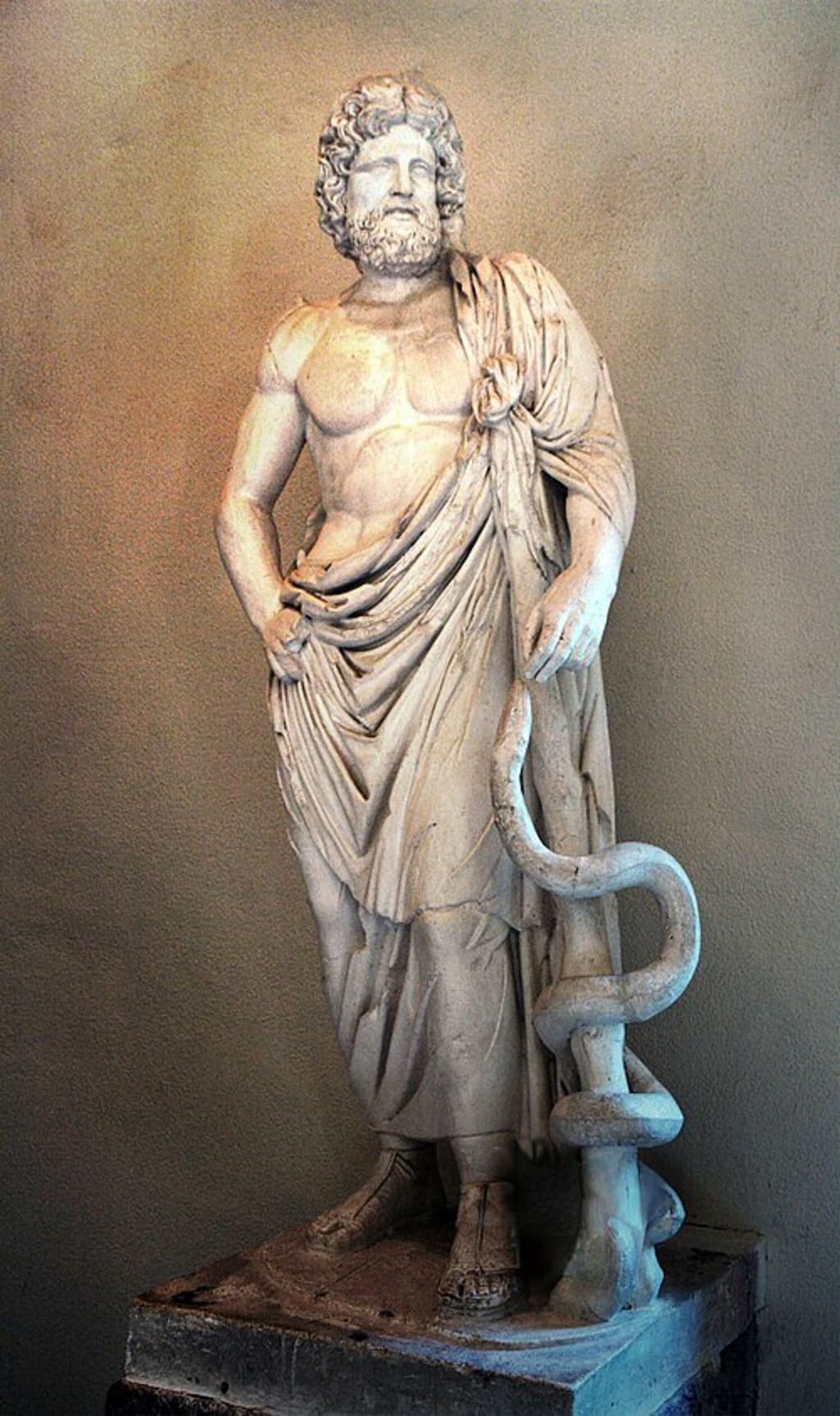
The one who managed to bring the dead back, and for it was killed, Asclepius earned his divinity through serious transgression.
Asclepius is the god of medicine. He was also the patron god, and reputed ancestor of the Asklepiades, the ancient guild of doctors.
Asclepius was depicted as a kindly, bearded man holding a serpent-entwined staff. Although he is largely absent from ancient Greek vase painting, statues of the god are quite common.
The etymology of the name “Asclepius” (Greek Ἀσκληπιός, translit. Asklēpios) remains unknown. Some have connected it to the Hittite roots aššula(a)- (“well-being”) and pai/pi- (“to give”). Others have suggested a connection with the Greek words aiglē and aglaos, meaning “glorious” (often found in epithets of Asclepius’ father, Apollo).
Finally, some have pointed out that Asclepius’ name contains elements typical of Pre-Greek names (a/ai followed by -glap- or -sklap-/schklap/b-) and may thus have been Pre-Greek in origin (Robert Beekes reconstructs the original form of the name as *(a)-sʸklap-).
In difference to his father Apollon, who specializes more in abstract healing, Asklepios specializes in anatomical healing which is reflected in next lines:
those who came to him afflicted with congenital sores, or with their limbs wounded by gray bronze or by a far-hurled stone, or with their bodies wasting away from summer's fire or winter's cold, he released and delivered all of them from their different pains, tending some of them with gentle incantations, others with soothing potions, or by wrapping remedies all around their limbs, and others he set right with surgery.
Many of his epithets reflect his qualities like healer (Paean and Iatros) and he who is like no body else (Amymōn "Peerless"). Another part of his epithets connected him with the guild of doctors called Asklepiades
There were hundreds of temples of Asclepius (called Asclepiaea, or Asclepiaeon in the singular) in the ancient world. One of the oldest ones was in Tricca, regarded locally as the place where the god had been born. There was another impressive (but likely more recent) temple of Asclepius at Messenia, which a rival local tradition also claimed as the site of the god’s birth.
The cult of Asclepius began rapidly expanding during the fifth century BCE. It was during this time that the two most important ancient cults of Asclepius were established on the Aegean island of Cos and in the central Greek city of Epidaurus.
Both Cos and Epidaurus boasted a great Asclepiaeon. Cos was also home to a school of physicians known as the Asclepiadae. Hippocrates, the most famous physician of ancient Greece, was a member.
The Asclepiaeon of Epidaurus became particularly renowned. It was surrounded by a sacred complex and a grove in which it was forbidden for anyone to die or be born.
The cult of Asclepius continued to spread throughout Greece, with special help from Epidaurus. Asclepius thus came to Sicyon, Aegina, Tegea, and Athens, where he was worshipped first at the harbor of the Piraeus and then, by the end of the fifth century BCE, on the slopes of the Acropolis.
The cult also spread to other, more distant sites, including Pergamum and Smyrna in modern-day Turkey and even Italy. The Asclepiaeon of Rome, established in 293 BCE, became quite important. Suffering from a severe plague, the Romans had been instructed by an oracle to import the cult of Asclepius from Epidaurus. A great temple was built on Tiber Island after the sacred snake of Asclepius, brought by boat from Epidaurus, chose it as its new home.
Asclepiaea temples tended to share certain features. For example, they were usually located outside of the main town, often in a valley or by the seashore. Like the temples of other gods, Asclepiaea also included a statue or “cult image” of Asclepius, situated in a prominent place; particularly famous was the giant chryselephantine cult image in the Asclepiaeon of Epidaurus. Most Asclepiaea also had a sacred snake who lived in the sanctuary, and some, like the one at Epidaurus, had a sacred dog.
The central feature of the Asclepiaea was an incubation room (called an enkoimētērion in Greek). Sick worshippers could sleep in this special room in the hope that Asclepius would appear to them and cure them, or tell them in a dream how they could cure themselves. Those who had been cured in this way would dedicate a tablet or stele in which they described how the god had helped them and gave thanks. Many such tablets still survive, detailing some remarkable illnesses and cures.
Finally, Asclepius was frequently worshipped together with the other members of his healing family: his father Apollo, his sons Machaon and Podalirius, and his daughters (especially Hygieia).
The festival of Asclepius, called the Asclepiaea, was celebrated wherever there was an Asclepiaeon (a temple of Asclepius). The Asclepiaea of Epidaurus, held every fifth year, were particularly important. These included athletic as well as musical competitions.
Athens, which had another important sanctuary of Asclepius, celebrated both an Asclepiaea (twice per year) and an Epidauria (to commemorate the day when Asclepius was brought to Athens from Epidaurus).
On feast days and in his various temples, Asclepius received different types of sacrifices. These included standard burnt sacrifices, but also hair sacrifices to him or his daughter Hygieia.
Thank you for reading my article!
About the Creator
Enjoyed the story? Support the Creator.
Subscribe for free to receive all their stories in your feed.
Comments
There are no comments for this story
Be the first to respond and start the conversation.