
Chains of the Crown
A Historical Story of Resistance, Sacrifice, and Freedom in the Indian Subcontinent under British Rule
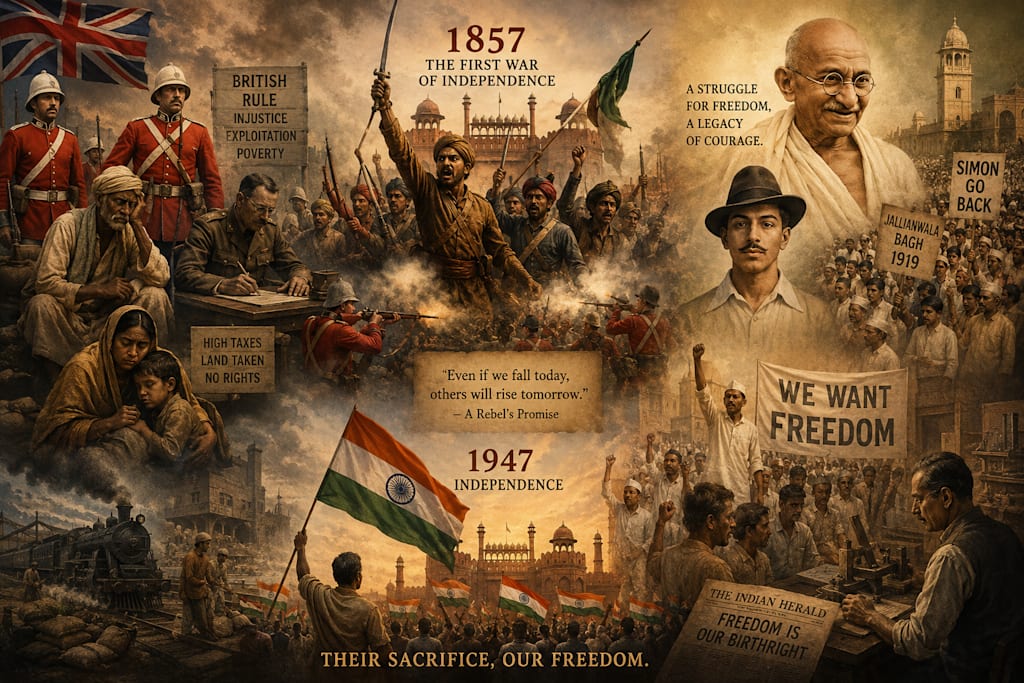
The year was 1857. Across the vast lands of the Indian subcontinent, fear and anger spread like wildfire. Villages whispered stories of injustice, heavy taxes, stolen harvests, and soldiers punished for speaking against the rulers from Britain. The British Empire had tightened its grip over the land, controlling kingdoms, trade, and even the lives of ordinary people.
In the small town of Meerut, a young schoolteacher named Ahsan sat quietly beneath a banyan tree, listening to the worried voices of villagers.
“They take our crops,” an old farmer complained. “And if we fail to pay taxes, they take our land too.”
Another man clenched his fists. “Our kings are gone. Our traditions are insulted. How long must we stay silent?”
Ahsan looked toward the dusty road where British soldiers marched every morning. Their red coats and rifles had become symbols of fear. Yet inside him, a fire was growing.
For years, the people of the subcontinent had suffered under British rule. The East India Company had arrived as traders but slowly became rulers. They divided kingdoms, defeated nawabs and maharajas, and forced unfair laws upon millions. Wealth from India flowed to Britain while local people struggled to survive.
One evening, Ahsan’s closest friend, Hariram, arrived with urgent news.
“The soldiers have rebelled in Meerut,” he whispered. “They refused to use the new rifle cartridges.”
Ahsan knew the rumors. The cartridges were said to be greased with cow and pig fat, offending both Hindu and Muslim soldiers. Many believed it was another attempt by the British to disrespect local beliefs.
“The rebellion has begun,” Hariram said nervously. “People are joining together.”
That night, Ahsan could not sleep. He thought of his father, who had died after losing their farmland to British taxes. He remembered children begging in markets while British officers held grand parties inside luxurious buildings.
At dawn, he made his decision.
“I will not live as a slave,” he told his mother.
Tears filled her eyes, but she nodded silently.
Soon, towns across the subcontinent erupted in resistance. Soldiers, farmers, craftsmen, and students joined together against British forces. Hindu and Muslim fighters stood side by side, united by pain and hope. Old rivalries disappeared as the dream of freedom became stronger than fear.
Ahsan and Hariram traveled from village to village, spreading messages of unity.
“This land belongs to its people,” Ahsan would say. “Not to foreign rulers.”
In Delhi, rebel forces declared the aging Mughal emperor Bahadur Shah Zafar as a symbolic leader. For a brief moment, it seemed possible that British rule might collapse.
But the British Empire was powerful.
More troops arrived from Britain. Cannons thundered across cities. Entire neighborhoods were burned. Villagers suspected of helping rebels were punished harshly. Fear returned to the land.
One afternoon, Ahsan and his companions hid inside an abandoned mosque after a brutal battle.
“We are losing,” one rebel whispered.
“No,” Ahsan replied firmly. “Even if we fall today, others will rise tomorrow.”
Days later, British troops attacked their hideout. Smoke filled the air as gunfire echoed through the streets. Hariram was struck in the chest while protecting Ahsan.
“Ahsan…” he gasped weakly, “promise me… one day this land will be free.”
Tears streamed down Ahsan’s face as he held his dying friend.
“I promise.”
The rebellion of 1857 was eventually crushed. Thousands died. Cities were destroyed. The British Crown took direct control of India from the East India Company, beginning an even stricter era of colonial rule.
Yet the rebellion changed something forever.
The people of the subcontinent had discovered their collective strength.
Years passed. Ahsan grew older, but his spirit remained unbroken. He became a writer and secretly distributed pamphlets criticizing British policies. Across the country, new leaders emerged. Some believed in peaceful protest, while others demanded armed struggle.
By the early 1900s, the freedom movement had become unstoppable.
Young students boycotted British goods. Workers organized protests. Newspapers printed articles demanding independence. Leaders like Mahatma Gandhi promoted non-violence, while revolutionaries such as Bhagat Singh inspired the youth with courage and sacrifice.
Ahsan watched proudly as millions joined the movement.
One day, his grandson asked him, “Dada, why did the British come here?”
Ahsan sighed deeply.
“They came for trade,” he said softly. “But greed turned traders into rulers.”
“Why did our people fight them?”
“Because every human being deserves dignity, freedom, and the right to live without chains.”
The struggle continued through wars, imprisonments, and protests. British authorities tried to silence the movement, but every arrest created more resistance. The Jallianwala Bagh massacre of 1919 shocked the world when British troops opened fire on unarmed civilians gathered peacefully in Amritsar.
After that tragedy, even more people demanded freedom.
Finally, in 1947, after decades of sacrifice, Britain ended its rule over the Indian subcontinent. India and Pakistan became independent nations. Crowds filled the streets with tears, prayers, and celebrations.
By then, Ahsan was an old man.
As he stood beneath the same banyan tree where he once listened to villagers complain about British rule, he smiled quietly.
The road ahead would not be easy. Partition brought pain and violence between communities. Families were separated forever. But despite the sorrow, colonial rule had ended.
Hariram’s words echoed in Ahsan’s heart.
“One day this land will be free.”
And at last, it was.
The conflict between the people of the subcontinent and Britain was not only a war for land. It was a struggle for identity, respect, and self-rule. Countless ordinary people gave their lives so future generations could live in freedom.
History remembers emperors and armies, but true freedom was won by farmers, teachers, workers, students, and dreamers who refused to bow before injustice.
About the Creator
Enjoyed the story? Support the Creator.
Subscribe for free to receive all their stories in your feed.
Comments
There are no comments for this story
Be the first to respond and start the conversation.