
Cernunnos and the Animals
Horned God of the Wild Market
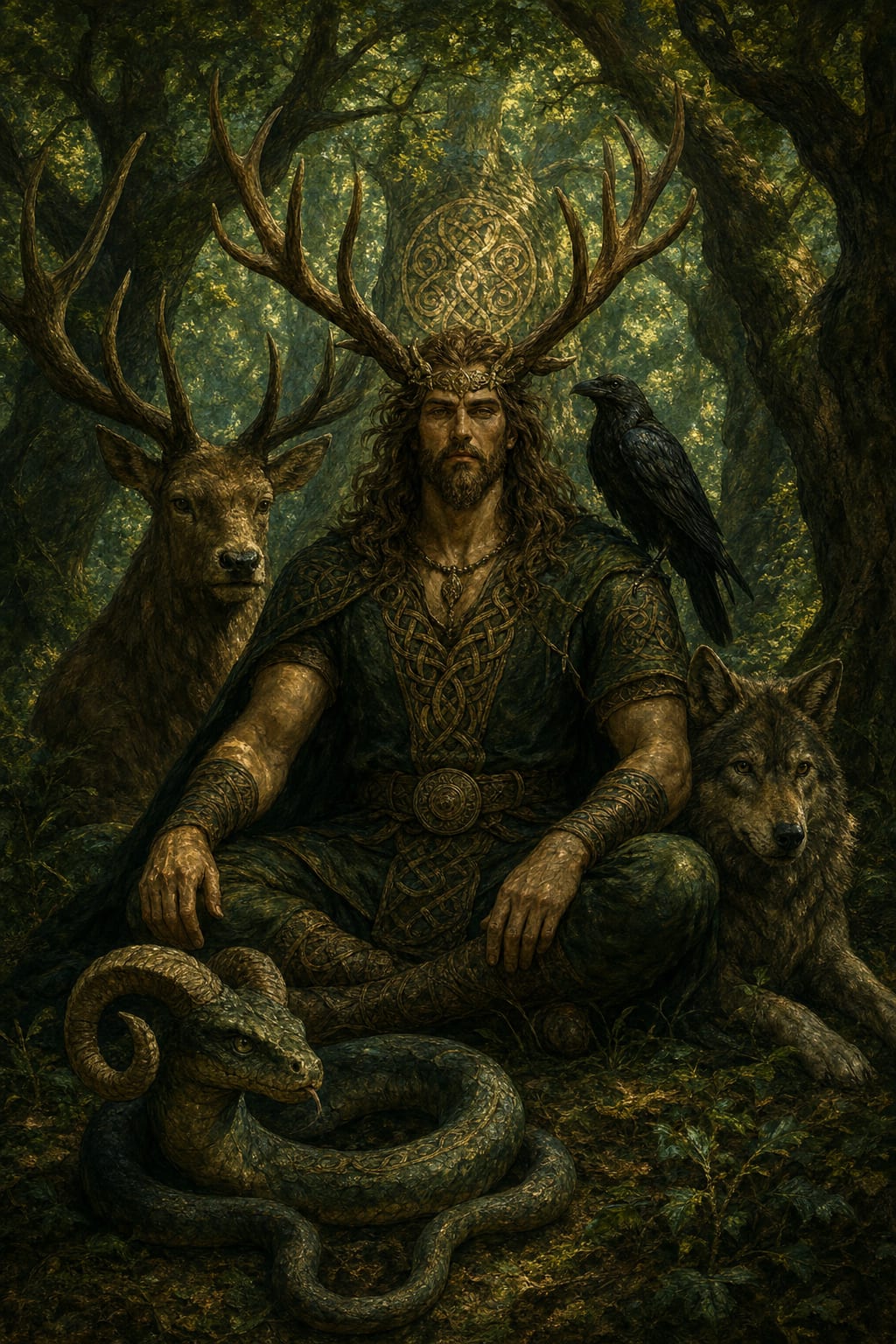
Among the figures of Celtic religion, few are as striking and mysterious as Cernunnos. He appears antlered, seated among animals, holding symbols of wealth and power, and looking less like a ruler above nature than a being deeply woven into it. Unlike some gods who are remembered mainly through literary stories, Cernunnos survives mostly through imagery and scattered inscriptions. That makes him harder to define, but it also makes him fascinating. He seems to belong at once to the forest, the herd, the crossroads of exchange, and the unseen movement of prosperity through the land. He is not only wild. He is ordered wildness — abundance held in balance.
The Gundestrup image
The most famous image linked to Cernunnos appears on the Gundestrup Cauldron, where an antlered figure sits cross-legged, surrounded by animals, holding a torque in one hand and often associated with a serpent in the other. This image has become central to how people imagine him because it gathers together so many of his defining symbols at once: animal life, sacred authority, wealth, and the strange stillness of a being who does not dominate nature from outside, but sits within it.
Scholars often see this image as showing a mediator between worlds that human beings usually separate. On one side there is the untamed realm of beasts, antlers, and serpents. On the other there are the worked metals, the ornaments of status, and the signs of human economy. Cernunnos seems to join the two. He belongs neither wholly to wilderness nor wholly to civilization. Instead, he stands where both meet, reminding us that human wealth is never fully separate from the living systems that support it.
Animals at his side
The animals surrounding Cernunnos are one of the clearest clues to his role. Deer, boar, serpents, and other creatures often appear with him, suggesting that he is not simply a god of hunting, but a lord of animal life itself. That distinction matters. A hunter overcomes animals; Cernunnos seems to dwell among them. He is not shown as their destroyer, but as their keeper, companion, or balancing force.
This gives him a very different feeling from later figures of conquest over nature. Cernunnos represents relationship rather than domination. The stag’s antlers link him to seasonal cycles, growth, and renewal. The boar suggests strength, ferocity, and wild plenty. The serpent, especially when horned or ram-headed in Celtic art, adds another layer of chthonic or underworld power. Together, these animals make Cernunnos a figure of the forest as living system — not chaos, but vitality governed by hidden order.
This is why he is often imagined as a protector of herds, woods, and the balance of life in the wild. He is not the sentimental guardian of a peaceful nature, but the keeper of a world that includes danger, reproduction, hunger, and regeneration. His animals are not pets. They are the life of the land itself.
Torques, coins, and hidden wealth
One of the most intriguing things about Cernunnos is that he is not associated only with animals. He is also strongly linked with torques, the metal neck-rings that symbolized status, prestige, and wealth in Celtic culture. In some representations he holds or displays these objects, and in others he is associated with containers of goods or imagery that suggests abundance and circulation. This makes him a figure not only of the forest, but of prosperity.
That connection can seem surprising at first. Why would a horned god of beasts and wilderness also be linked to wealth? But in an older agricultural and pastoral society, the answer is almost obvious: wealth comes from the living land. Herds, healthy forests, access to game, fertile ground, and the movement of goods all begin in a relationship with the natural world. Cernunnos can therefore be understood as a god of resources before they become coinage — of abundance before it becomes counting.
This is what makes him feel like a kind of “wild banker,” though not in any modern commercial sense. He represents the circulation of value from the land into human society. Torques, trade goods, and signs of prosperity do not stand opposed to the antlers and animals around him. They grow out of the same sacred economy. He shows that what humans call wealth is ultimately rooted in life itself.
The wild market of midsummer
This connection between animal life and prosperity makes Cernunnos especially meaningful when thinking about summer fairs and seasonal markets. At such gatherings, animals, goods, people, and agreements all come together. Herds are exchanged, produce is sold, marriages are arranged, legal matters are settled, and community wealth becomes visible. These are not separate from nature. They are human expressions of what the land has provided.
In that sense, Cernunnos can be imagined as a symbolic presence at the wild market of midsummer. He stands behind the movement of animals into herd, herd into trade, and trade into community survival. He reminds us that no fair, market, or exchange exists independently of the earth that feeds it. Summer abundance is not an abstract blessing. It comes from living systems — from forests, animals, pastures, rivers, and the seasonal turning of the world.
That is why Cernunnos matters. He joins the antler and the torque, the serpent and the ornament, the beast and the exchange. He is a god of wildness, but not wildness without order. He is a god of prosperity, but not prosperity without roots. He keeps before us the older truth that every market begins in the meadow, every ornament begins in labor, and every form of wealth begins in the life of the land.
The horned god of living abundance
Cernunnos endures because he refuses simple categories. He is not merely a forest god, not merely a fertility god, and not merely a symbol of wealth. He is all of these at once, but in a specifically Celtic way: through balance, circulation, and relationship. He sits among animals without losing dignity. He holds wealth without separating it from the world that produced it. He is a god of threshold spaces — between wilderness and settlement, instinct and exchange, hidden life and visible prosperity.
In the end, Cernunnos is the horned god of living abundance. He reminds us that civilization does not stand apart from the wild, but depends on it. At the midsummer fair, in the forest herd, in the exchange of gifts, animals, and goods, his presence can still be imagined: not as a conqueror, but as the keeper of the deeper economy through which life sustains life.
About the Creator
The Celtic Spirit- A modern Guide to Celtic Belief and Practice
explaining Celtic mythology, druid practice, and reconstructions of paganism for modern readers
Enjoyed the story? Support the Creator.
Subscribe for free to receive all their stories in your feed. You could also become a paid subscriber, letting them know you appreciate their work.
Comments
There are no comments for this story
Be the first to respond and start the conversation.