
Bangladesh Situation Explained
Bangladesh Situation

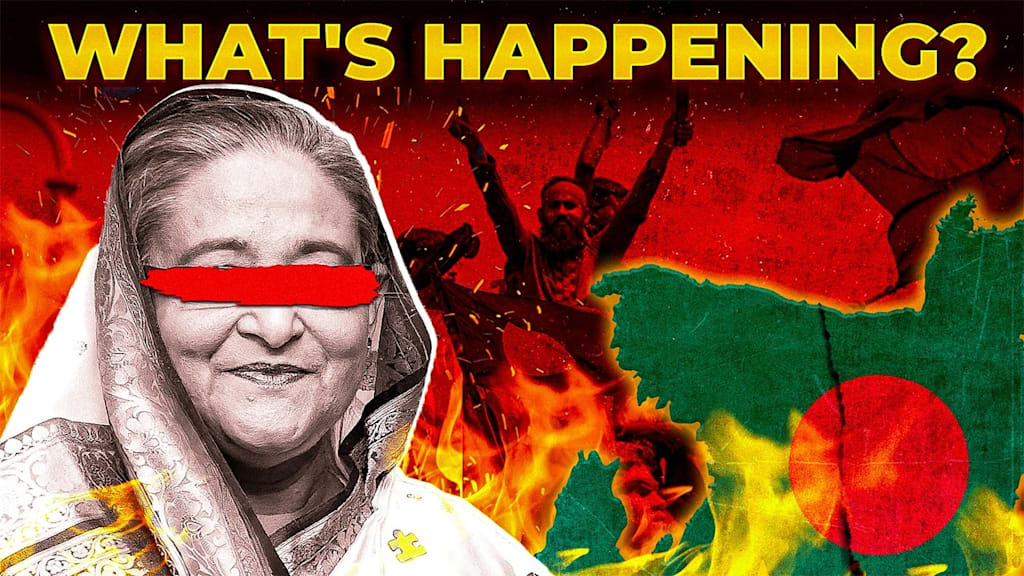
Bangladesh’s police and army have been going after students.
In some places, police vans were seen running over students,
while in others, helicopters were landing on university rooftops.
Thousands—甚至 millions—of students took to the streets in protest.
Some organized rallies, others marched in protest demonstrations.
Very quickly, the student movement spread so widely
that they were forced to block roads, highways, and even the railway system.
The situation escalated to the point where the Bangladesh government
deployed not just the police—but also the army—against the students.
Local media was barely reporting anything.
On top of that, internet, social media, and even WhatsApp were shut down.
More than 200 unarmed students were killed,
thousands were injured,
and countless others were arrested.
Because the country remained shut down for so many days,
Bangladesh suffered losses of over $2 billion.
After all this, one question remains in everyone’s mind:
Why is all of this happening in Bangladesh?
Welcome once again story.
This all began on June 5, 2024,
after a decision by the High Court.
The court reinstated the quota system in Bangladesh Civil Services.
At first, there were peaceful protests,
but then Eid holidays arrived, so protests were postponed.
After Eid, students resumed protests—
and this time, they were more serious.
They blocked roads and demanded the complete removal of the quota system.
Initially, the protests were only about the quota system,
but soon, other issues became part of the movement.
Bangladesh is ruled by the Awami League party.
This party also has a student wing called Chhatra League.
Members of this group attacked protesting students at several places—
with support from the police.
This made students even angrier.
At the same time, in some areas, army vehicles marked with UN logos
were used against protesters.
This created the impression that the United Nations was involved.
When this news reached international media,
it damaged the UN’s reputation worldwide.
Later, it was clarified that those vehicles were rented for UN missions,
but their logos had not been removed.
Before the anger could settle,
on July 14, 2024, Prime Minister Sheikh Hasina made a statement
that made things even worse.
She said:
“If freedom fighters don’t get job quotas, then should collaborators (Razakars) get them?”
This statement acted like fuel to the fire.
To understand this, you need to know who freedom fighters and Razakars were.
Before 1971, Bangladesh was part of Pakistan,
known as East Pakistan,
while present-day Pakistan was West Pakistan.
India geographically separated the two regions,
and there were many differences—especially language.
In East Pakistan, Sheikh Mujibur Rahman’s Awami League was very strong.
At that time, Pakistan was under martial law,
led by General Yahya Khan, who was responsible for holding elections.
In those elections, Awami League won a landslide victory—
167 out of 169 seats in East Pakistan.
Out of 300 total seats in the National Assembly,
they held a clear majority.
This meant they could easily form the government—
but the military leadership did not want that.
This led to civil disobedience in East Pakistan.
On March 7, 1971, Sheikh Mujibur Rahman hinted at independence.
By March 23, Bangladesh’s flag was seen across East Pakistan.
In response, a military operation was launched
to stop the separation.
The war lasted nine months.
Some military units in East Pakistan defected
and formed the Mukti Bahini (Freedom Fighters).
On the other side, groups supporting West Pakistan
were called Razakars.
In the final weeks, India supported Bangladesh,
and East Pakistan became an independent Bangladesh.
Since freedom fighters played a key role in independence,
Sheikh Mujibur Rahman introduced a 30% quota for them in civil services.
Later, in 1997,
the quota was extended to their children.
In 2010, it was further extended to their grandchildren.
However, only about 10% of eligible families actually used the quota,
and the rest went unused.
Meanwhile, merit-based candidates only had 44% quota,
which became insufficient.
Students felt frustrated that despite hard work,
they couldn’t secure jobs,
while others could get them easily through quota.
In 2018, a petition against the quota system was filed,
but the court rejected it.
However, due to massive protests,
Prime Minister Sheikh Hasina later abolished the quota system through an executive order.
Everything remained calm for a few years.
Then suddenly, on June 5, 2024,
the High Court canceled that order
and reinstated the quota system.
That’s when protests began again.
As the situation worsened,
on July 21, 2024, the Supreme Court of Bangladesh intervened.
It restructured the quota system:
93% for merit (previously 44%)
5% for freedom fighters (previously 30%)
1% for minorities
1% for disabled individuals
After this decision,
students agreed to end protests—but only if:
Arrested students were released
Officials responsible for killings resigned
At the time this video is being made,
those demands have not yet been fulfilled.
However, the government claims the situation is now under control.
Mobile services, internet, and social media
are gradually being restored.
What do you think about this entire situation?
Let me know in the comments.
And if you liked this story,
don’t forget to like and share.
About the Creator
Imran Ali Shah
🌍 Vical Midea | Imran
🎥 Turning ideas into viral content
✨ Watch • Share • Enjoy
Enjoyed the story? Support the Creator.
Subscribe for free to receive all their stories in your feed.
Comments
There are no comments for this story
Be the first to respond and start the conversation.