
Arianrhod's Children: Shame, Identity, and the Right to Be Named
Shame, Identity, and the Right to Be Named
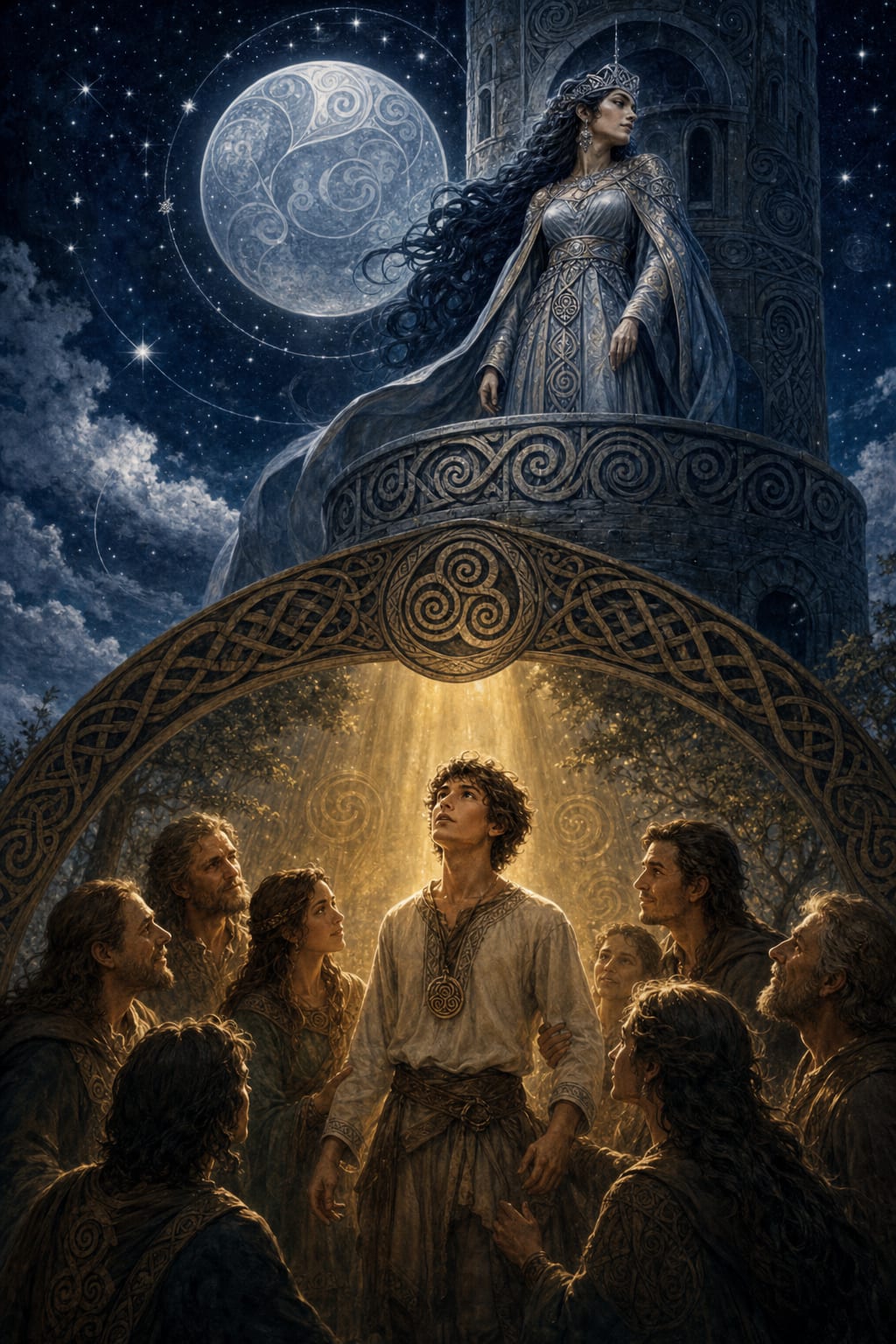
In Welsh tradition, to be a person — fully, socially, legally — required certain things. You needed a name. You needed arms, the mark of your readiness to defend yourself and your standing in the world. And you needed a place in the human community: a bond, a belonging. These were not merely customs. They were the architecture of personhood itself. To withhold them was to withhold you.
In the Fourth Branch of the Mabinogion, the goddess Arianrhod withholds all three from her son. She swears that he will never have a name unless she gives it. She swears he will never bear arms unless she arms him. She swears he will never take a human wife. Three curses, or — depending on how you read them — three refusals to acknowledge that her son has the right to exist in the world. And the story that follows is about what it means to claim your personhood when the one who should have given it to you has refused.
It is one of the most quietly devastating stories in all of Celtic myth. And for LGBTQIA+ readers — particularly those who know what it is to be denied a name, denied recognition, denied the full personhood that a parent's love should freely give — it lands with a weight that is not merely literary.
Arianrhod and the Refusal to Witness
Arianrhod is not a simple villain, and it would do the myth and its readers a disservice to flatten her into one. She is a figure of sovereignty, of power, of a particular kind of fierce self-determination. Her refusal to acknowledge her son is rooted in shame — her own shame, the shame that came from the circumstances of his birth, which exposed her before the court of King Math. The child is the living evidence of something she cannot forgive, and so she tries to unmake him: not by killing him, but by refusing to give him the tools to be real in the world.
This is its own kind of cruelty, and the myth knows it. But Arianrhod is also trapped. She is navigating a world in which her power and her worth have been tied to her status in a way that her son's existence has disrupted. Her refusals are acts of self-protection — desperate, harmful, aimed at the wrong target, but comprehensible. She is not evil. She is wounded, and she is wielding that wound against someone smaller.
Many LGBTQIA+ people have a version of Arianrhod in their lives. A parent whose love is real but conditional. A family member whose shame about what you are becomes, somehow, a withholding of the basic acknowledgment that you exist on your own terms. The Welsh myth is honest about the fact that these things can coexist: a person can have real power and real wounds and still cause real harm with both.
The Name as the First Act of Recognition
In Welsh tradition, as in many pre-modern cultures, naming was not merely labeling. It was the first act of social recognition — the declaration that this person existed, that they had a place in the community, that they were real in the eyes of the world. To be without a name was to be unreal, unanchored, outside the circle of acknowledgment.
When Gwydion tricks Arianrhod into calling out to her son — "Lleu Llaw Gyffes," Bright One of the Skillful Hand — she gives him a name in the moment of forgetting to withhold it. It slips out of her, called forth by circumstance, by the child's own presence in disguise. And though it was extracted through trickery, the name is real. It sticks. Lleu keeps it.
This matters. The myth does not say that a name is only valid if given freely and without resistance. It says that a name is real once spoken. That the act of naming — however it happens, whether through ceremony or through necessity, whether given or taken, whether offered in love or extracted through sheer insistence on existing — is binding. You are named. That is what you are.
For everyone who has ever had to choose their own name — who has had to reach past the name given at birth toward the one that fits, the one that says this is who I actually am — the story of Lleu Llaw Gyffes is not just ancient Welsh mythology. It is the myth of self-naming. It is the myth of the person who refuses to remain unreal because someone else refused to see them.
Arms, Belonging, and the Right to Take Up Space
After the name, Gwydion tricks Arianrhod into arming Lleu by staging a false attack on her fortress. In the crisis, she arms the stranger she does not yet recognize as her son. Again: the thing that was withheld is obtained through trickery, through necessity, through Lleu's continued insistence on becoming himself despite her resistance.
And then the third thing — a human wife, a belonging — Math and Gwydion cannot get from Arianrhod at all. They make Blodeuwedd instead, conjuring a woman from flowers: oak and broom and meadowsweet. This solution has its own complications, its own story, its own tragedy. But the gesture matters: when the person who should have given Lleu belonging refused, other people built it for him instead.
Here is the found family, in its oldest Welsh form. Here is the principle that the world does not end when the one who should love you chooses not to. That other people can step into the space your blood family left empty. That the love you are owed, when refused by those who should freely give it, can come from elsewhere — from the person who chooses you, from the community that sees you, from the found kin who witness who you actually are.
Sovereignty and Self-Naming
Arianrhod's name deserves attention of its own. She is a figure of sovereignty — the great goddess in Celtic tradition who holds within herself the power to confer or deny legitimacy. Her very name is associated with the Silver Wheel, with the turning of fate, with the stars and the cosmos and the great turning that holds all of us within it. She is not small. She is not merely a bad mother in a domestic drama.
And yet the myth holds both things at once: she is enormously powerful and she is using that power to diminish someone who depends on her. This is the complexity that Celtic myth specializes in — the refusal to make its most important figures simply heroic or simply villainous. Arianrhod is real in the way that complicated people are real.
The myth does not resolve her into a lesson. It allows her to remain ambiguous. What it does resolve is this: Lleu exists. He has a name. He has arms. He has people who love him. He has a place in the world. Arianrhod's three refusals did not prevent any of it. They made it harder, and they made it stranger, and they left a wound that the myth carries quietly through to the end. But they did not win.
Your Name Does Not Require Permission
At the end of June, at the close of a month spent walking through the queer threads of Celtic tradition — the shapeshifters and the warriors, the Otherworld and the sacred bonds, the men who bore children and the soul friends who saw each other without masks — we arrive here: at the most personal truth the myths carry.
Your name is real. Your identity is real. Your personhood does not require the approval of someone who should have given it freely and did not. Celtic myth, in its strange and ancient wisdom, already knew this. It knew that names are sometimes extracted through trickery and survival. It knew that belonging is sometimes built by found family instead of born family. It knew that the person who refuses to witness you is telling you something about their own wounds, not about your worth.
Lleu survived Arianrhod. He became himself anyway. He did it with the help of those who chose to see him, to speak his name, to build the world around him that his birth family refused to provide.
You are allowed to do the same. You have always been allowed.
The old stories knew.
About the Creator
The Celtic Spirit- A modern Guide to Celtic Belief and Practice
explaining Celtic mythology, druid practice, and reconstructions of paganism for modern readers
Enjoyed the story? Support the Creator.
Subscribe for free to receive all their stories in your feed. You could also become a paid subscriber, letting them know you appreciate their work.
Comments
There are no comments for this story
Be the first to respond and start the conversation.