
Anatomy of Evil: How the Tragedy of Child K. Helped Hitler Legitimize Mass Murder
Anatomy of Evil: How the Tragedy of Child K. Helped Hitler Legitimize Mass Murder
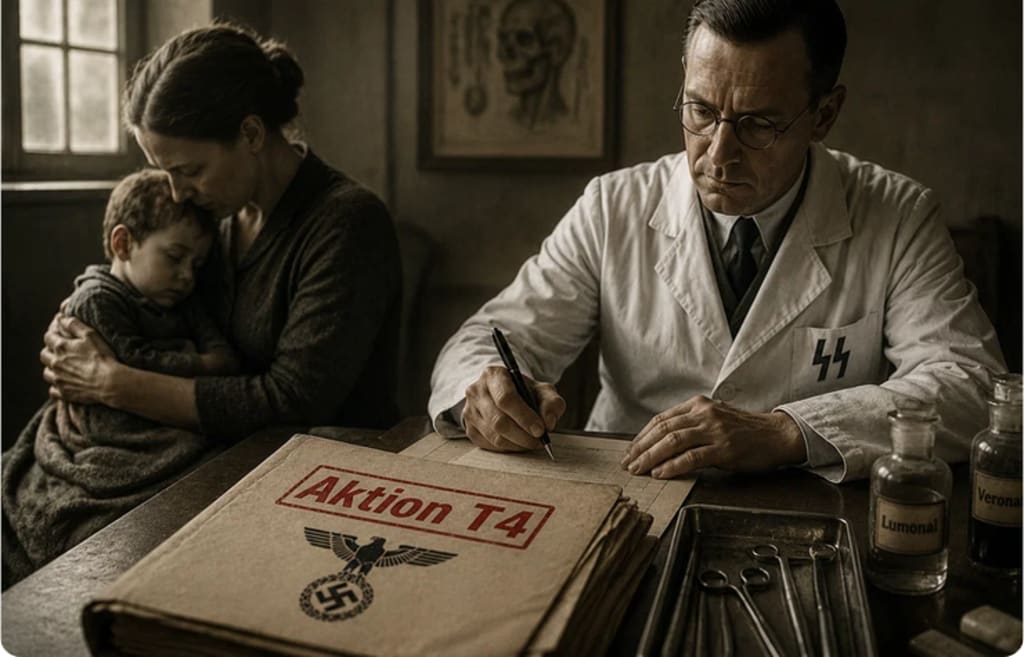
In the summer of 1939, a request reached Hitler that might, at first glance, have appeared to be a desperate attempt by parents to end the suffering of a severely disabled child.
No one could have known what path this request would open.
An individual case became a precedent. The precedent became an administrative procedure. The administrative procedure became a secret program.
And the program became systematic mass murder of tens of thousands of people.
Today, the case is known primarily as the case of “Child K.” Older literature sometimes identified the child as Gerhard Kretzschmar, but this identification has since been questioned. That does not change the substance of the story. The important issue is not only the fate of the individual child.
What matters is what the Nazi regime did with his case.
The Child Who Was Supposed to Be “Mercifully” Killed
Child K. was born in 1939 with severe disabilities.
According to historical sources, the parents asked for permission to have the child killed. They appealed directly to Hitler because, in Germany at the time, there was no legal mechanism allowing doctors to kill someone simply because they were severely ill or disabled.
And this is where the first crucial moment of the story takes place.
Hitler had no law to rely on.
There was no legitimate legal decision allowing a doctor to say: this person is no longer worthy of life, and therefore we may kill them.
Hitler nevertheless made the decision.
He assigned the case to his personal physician, Karl Brandt.
And with that, a door was opened that would later prove very difficult to close.
Karl Brandt: The Doctor Who Stopped Healing
Karl Brandt was not an ordinary party official.
He was a doctor.
That is perhaps what makes the entire story so horrifying.
The Nazi regime did not need only fanatical soldiers, police officers, or members of the SS. It also needed doctors who would accept the idea that some lives were worth less than others.
Brandt was among those involved in carrying out the program.
After Hitler's decision, the child was killed.
And this individual case began to be used as something far greater than the tragedy of one family.
When an Exception Becomes a Rule
Even before the war, the Nazi regime promoted the concept of so-called “racial hygiene.”
People with disabilities were portrayed in Nazi ideology as both a genetic burden and an economic burden.
This context is important.
Mass murder did not emerge overnight.
First, the language changed.
A person became a “case.”
A patient became a “burden.”
A sick person became a “liability.”
And a medical decision gradually became a verdict on whether a person had the right to live.
In 1939, this way of thinking began to turn into an organized system.
First, the Children
Before the mass murder of adults began, the Nazi regime targeted children with severe physical or mental disabilities.
In August 1939, German doctors, midwives, and other healthcare workers were ordered to report newborns and young children with certain serious disabilities.
On paper, it looked like medical administration.
In reality, it was creating a list of future victims.
The children were assessed by medical panels.
And something both absurd and horrifying often happened:
the doctors deciding whether they should die did not even have to see them.
Decisions were made based on forms.
Based on diagnoses.
Based on a few lines on a piece of paper.
The person gradually disappeared, leaving behind only a medical record.
“Euthanasia” as a Word Meant to Conceal Murder
The Nazis deliberately used the word euthanasia.
It meant “good death.”
But what was taking place under this designation had nothing to do with modern voluntary euthanasia.
The victims were not free patients choosing to die.
Others decided whether they would live.
And many of them had no idea what was happening to them.
The word “euthanasia” was intended to create an impression of compassion.
In reality, it concealed murder.
The Birth of Aktion T4
In the autumn of 1939, the program expanded to include adult patients with physical and mental disabilities.
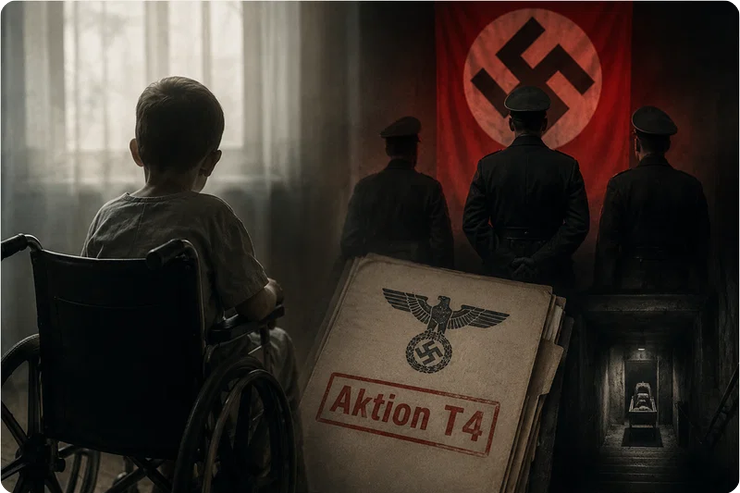
This was when Aktion T4 emerged.
The name was not some mysterious Nazi symbol.
It simply came from the address of the Berlin headquarters:
Tiergartenstraße 4.
This was where the large-scale operation was coordinated and kept secret from the public.
Hitler entrusted the program to Philipp Bouhler and Karl Brandt.
And here comes another crucial detail.
Hitler's order was not a law.
It was a private document on Hitler's personal stationery.
It was also backdated to September 1, 1939, the day Germany invaded Poland and the war began. The document was actually signed later, in the autumn.
Why?
To create the impression that the program was connected to the extraordinary circumstances of wartime.
In reality, it was an attempt to provide at least some form of protection for those carrying out the killings.
Murder as an Administrative Process
This is where the story becomes even more chilling.
There was no need for one enormous room filled with fanatical murderers.
All that was needed was a system.
One person filled out a form.
Another checked it.
A third made the decision.
A fourth arranged the transport.
A fifth carried out the murder.
Another person issued the death certificate.
And someone else sent a message to the family.
Evil was divided among dozens of people so that each could pretend they were merely doing their job.
This mechanization is one of the most important aspects of Aktion T4.
The Buses That Took Patients Away
Patients were transported from institutions to special killing centers.
Buses were used whose windows were covered or painted over so that people could not see inside.
Families were often not told where their relatives were actually being taken.
Then came the notification of death.
With a false cause.
With a false date.
Sometimes families were even sent an urn containing ashes.
They were not the ashes of the individual person.
The ashes of victims were mixed together during cremation, and a portion was randomly placed into an urn. The family received the urn together with death documentation containing an invented cause of death.
It was a remarkably elaborate attempt to create the illusion of an ordinary death.
And Then Came the Gas
Within Aktion T4, six major killing centers were established for adult patients.
There, the Nazis began systematically using carbon monoxide.
Victims were taken into rooms presented as showers or other ordinary facilities.
They were then killed with gas.
The bodies were cremated.
Documents were falsified.
Families were deceived.
And the entire process was designed to look like ordinary administrative work within the healthcare system.
How Many People Were Killed?
The program's internal statistics recorded that between January 1940 and August 1941, 70,273 people were murdered in the six main killing centers.
But the killings did not end there.
After the official termination of Aktion T4 in August 1941, decentralized killings continued in hospitals and other institutions.
The children's program continued as well.
According to estimates, at least 10,000 children were murdered as part of the Nazi “euthanasia” program during the war.
Why Did Hitler Stop the Program?
Here comes another paradox.
Aktion T4 was not stopped because Hitler suddenly changed his mind.
Protests began to grow.
People noticed that patients were disappearing from hospitals.
Families received suspicious explanations.
It became increasingly obvious that the official accounts of deaths did not add up.
Some members of the clergy also protested.
The most famous was Clemens August Graf von Galen, Bishop of Münster, who publicly denounced the killings in August 1941.
Hitler subsequently ordered the main phase of T4 to be stopped.
But the killings did not stop.
They simply changed form.
And This Is the Darkest Part of the Story
Aktion T4 was also a kind of school for mass murder.
The people who worked in the program gained experience in organizing transports, keeping records of victims, falsifying documents, cremating bodies, and handling the technical aspects of killing.
Some of these experiences were later used in other Nazi killing operations.
That is why historians regard T4 as an important part of the path toward the later industrialized mass murder.
Did One Letter Change History?
Perhaps.
But not in as simple a way as the story itself might suggest.
The Nazis had already developed an ideology that divided human beings according to their supposed value.
The propaganda already existed.
The concept of racial hygiene already existed.
The idea that a sick or disabled person could be a “burden” already existed.
The case of Child K. therefore did not create the Nazis' desire to kill.
But it provided a specific situation the regime could exploit.
And that may be even more frightening.
Because this is not a story in which one person made one insane decision and an entire system suddenly collapsed into catastrophe.
It is the story of a system that was already prepared.
It simply needed to find its first door.
The Worst Part Was Not Hitler
Hitler was, of course, the person who gave the program political protection and approved its direction.
But the murders themselves were not carried out by one person.
They were carried out by doctors.
Nurses.
Clerks.
Drivers.
Administrators.
People who prepared forms.
People who decided who was “worthy of life.”
People who issued false death certificates.
And that is precisely why the story of Child K. matters.
Because it shows that mass crimes do not always begin with mass gatherings of fanatics.
Sometimes they begin with a single form.
A single stamp.
A single decision that one particular human being no longer has the same value as everyone else.
Sunday's Final Thought
When people hear “Aktion T4” today, most think of Nazi gas chambers.
But the beginning was much less obvious.
It was in a hospital.
In a medical report.
In a diagnostic box.
In the decision of several specialists.
And perhaps that is why this story is more important than yet another account of how the Nazis murdered people.
Because it reveals the mechanism.
How the meaning of words can be changed.
How a human being can be turned into a number.
How murder can be renamed “mercy.”
And how a state can gradually convince part of society that some human lives are no longer as valuable as others.
Child K. was not the cause of the Nazi program.
He was one of the first cases through which the regime tested how far it could go.
And after that, it was no longer about one child.
It was about tens of thousands of people.
And eventually, millions.
The greatest danger does not begin when someone presses the button. It begins much earlier — when society allows someone else to decide the value of a human life.
AI Disclosure
AI was used to assist with the English translation and language editing of this article. The original article was written by the author in Czech. The English version was reviewed, edited and adapted by the author before publication.
Sources
United States Holocaust Memorial Museum – Euthanasia Program and Aktion T4 — přehled dětského programu, Aktion T4, Karla Brandta, šesti vražedných center a rozsahu programu.
German History in Documents and Images – Hitler’s Written Authorization for the Euthanasia Program — originální Hitlerův příkaz z roku 1939, včetně informace, že byl podepsán později a zpětně datován k 1. září 1939.
Harvard Law School – Nuremberg Trials Project, Document PS-630 — originální dokument předložený u Norimberských procesů, Hitlerovo pověření Philippa Bouhlera a Karla Brandta.
German History in Documents and Images – T4 Registration Form (1939/1940) — ukázka skutečného registračního formuláře používaného v systému Aktion T4.
Henry Friedlander – The Origins of Nazi Genocide: From Euthanasia to the Final Solution, University of North Carolina Press, 1995.
foto: https://chatgpt.com/c
About the Creator
Enjoyed the story? Support the Creator.
Subscribe for free to receive all their stories in your feed.
Comments
There are no comments for this story
Be the first to respond and start the conversation.